Top 3 White Label Voice AI Agent Platforms in 2026
Date
Aug 31, 26
Reading Time
8 Minutes
Category
AI Voice Agents
Share


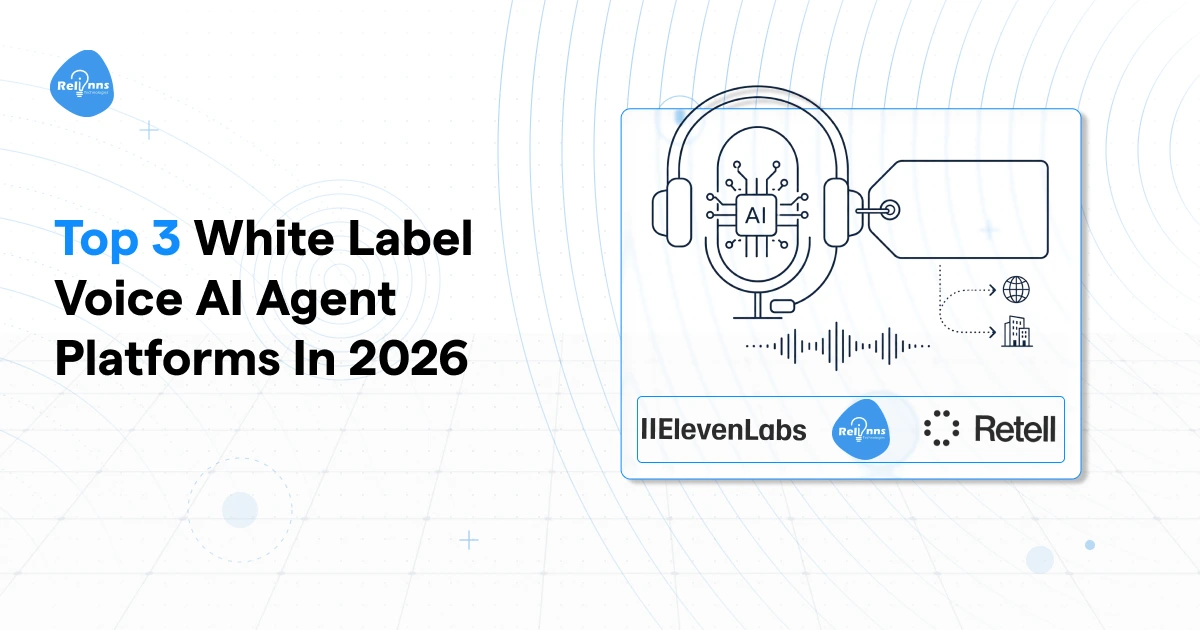
You've done the homework. You know what white-label AI voice agents are, or if you want a refresher on the basics, start there. What you need now is a real white-label voice AI agent platform, one you can put your name on and sell.
Search for one, and you'll hit a wall of AI voice agent white-label solutions saying the same thing: full white-label capability, enterprise-grade, built to scale. Somewhere along the way, buyers were convinced that any platform with a white-label tier should just work.
It doesn't. Most white-label voice AI agent platform pitches fall apart the second real call volume hits: voice quality breaks down, compliance turns into a claim rather than proof, and pricing stacks fees that nobody mentioned on the demo call.
Before shortlisting anything, calculate how much voice agents cost after telephony, model usage, white-label infrastructure, integrations, and client support are included.
We looked at three platforms, each built for a different job, and we'll say plainly where each one wins and where it doesn't.
But before you look at any platform, there's a failure pattern most guides skip.
Top 3 white label AI voice agent providers in 2026:
- Relinns = custom-built white label voice AI for regulated, integration-heavy enterprises
- ElevenLabs = best voice quality on the market, needs a custom wrapper built
- Retell AI = phone-first platform, near-human turn-taking, built for real call volume
Why White Label Voice AI Platforms Keep Disappointing in Production
Every platform pitching itself as a white-label voice AI agent gets lumped into one category, and that's the first problem. Three very different products hide under that same label.
First, developer-first orchestration tools. You bring your own carrier, your own billing, your own compliance paperwork. Every client becomes its own build, every time.
Second, UCaaS platforms with AI bolted onto an existing phone system. The AI stays shallow, reseller margins stay thin, and there's a third brand sitting inside your client relationship that nobody asked for.
Third, purpose-built reseller platforms, the real white label voice AI agent platform category. Fewer of these exist, but they're the ones that actually hold up once you sell them.
Then there's the wrapper-on-wrapper trap. You resell a platform that's itself reselling someone else's AI voice stack. Two monthly bills, and your margin sits exposed the moment the provider underneath changes its terms.
A 10-minute demo will never show you interrupt detection, turn-taking, or latency under real call volume. Those only break in production, right when your client's automated calling ROI is actually on the line.
Compliance is the quiet deal-breaker. Most platforms self-report compliance with HIPAA, GDPR, or SOC 2 with no evidence to back up the claim. Check HIPAA compliance proof before you believe it, especially for clients in regulated industries.
Most agencies don't get burned by picking the wrong AI. They get burned by picking the wrong infrastructure underneath it.
So what does a platform actually need before you put your name on it?
What Actually Separates a Real White Label Platform from a Rebadged Demo
White-label used to mean one thing: swap the vendor's logo for yours, slap on your brand colors, and you're done. That's the floor, not the ceiling.
A real white-label voice AI agent platform means you own the experience end-to-end: the pricing, the compliance story, the support chain your client calls when something breaks at 2 am. Five criteria tell you which side of that line a platform sits on. They also track the same voice agent performance metrics that predict real production behavior. Once you see how platforms actually compare side by side, the gap becomes obvious fast.
Expert tip: Ask any shortlisted vendor one question before signing: can you show a live deployment from a client in a regulated industry? Not a case study PDF. An actual working call. How they answer tells you whether they've deployed in compliance environments for real, or just claim they can.
That's the real litmus test for any white-label voice AI agent platform, table or no table. Against that framework, here's where the three platforms actually land.
Relinns Technologies: When the Project Needs More Than a Platform
Relinns isn't your typical white-label voice AI agent platform, and it isn't a SaaS subscription you sign up for on a Tuesday. It's a team that builds a custom voice AI agent on a stack assembled specifically for your use case: Retell AI for telephony orchestration, ElevenLabs for the voice itself, Deepgram for speech-to-text, Twilio as the telephony layer, and LangChain for the agent logic.
That combination matters more than it sounds like it should. Insurance pre-authorization requires real-time payer data to be pulled mid-call. Healthcare booking needs to write directly into an EHR, not just log a ticket. Logistics NDR handling must communicate with a TMS in real time. No off-the-shelf platform reaches that depth of integration, and that's not a knock on those platforms; it's just not what they were built for. It's also where contact center automation ROI actually gets decided for enterprises this complex, not on the sales call.
Relinns works across healthcare voice AI deployments, insurance, ecommerce, and supply chain and logistics, with HIPAA, GDPR, and SOC 2 designed into the architecture from day one, not bolted on after a client asks about it.
This isn't no-code, and it isn't a 24-hour setup. Timelines run project-based, and the minimum engagement reflects real enterprise scope. If you want to understand what goes into a custom voice agent build before committing, read that first.
Action item: If your use case touches patient data, financial records, or anything with a regulatory audit trail, ask one question: who owns the compliance posture when something goes wrong? With a custom build, the answer is clear. With a platform, read the terms.
This is built for mid-to-large enterprises with real technology budgets, C-suite buyers, and integration requirements a templated platform simply can't meet. It's the custom AI vs off-the-shelf decision made concrete.
Expert tip: Enterprise voice AI deployments fail at the integration layer, not the AI layer. Voice quality can be perfect, and the caller experience still breaks the moment the agent can't pull from your CRM or write to your EHR in real time. That's where a custom architecture earns its cost.
If a pre-built platform actually fits your use case, two options stand above the rest, and they sit at very different ends of the spectrum.
ElevenLabs: The Voice Quality Benchmark
ElevenLabs has a paradox built into it. Eleven v3 produces speech that actually holds up on a real phone call: the pacing, the emotion, the tone control that goes into making AI voice sound human, and nothing else at this model tier comes close. Callers describe it as human, not "pretty good for AI." And yet ElevenLabs hands you zero branded client portal out of the box.
What it does natively is genuinely strong: voice generation, voice cloning from a short audio sample, Voice Design for building a custom voice with no sample at all, a Conversational AI Agents platform with a workflow builder, and support across 29 languages for anyone running multilingual voice AI deployments.
The white-label path here is different from a typical white-label voice AI agent platform setup. ElevenLabs is the voice engine, full stop. The client-facing layer, the part your customer actually sees, gets built around it through a wrapper or custom development. That's a deliberate trade: the best voice on the market, in exchange for infrastructure work most platforms hand you pre-built.
Compliance covers SOC 2, GDPR, and a Zero Retention Mode for sensitive data environments. Pricing runs usage-based from $5 a month plus per-character charges, and those costs stack fast once call volume climbs, something worth modeling into your voice AI return on investment before you commit. Integrations cover Salesforce, Stripe, Zendesk, and Twilio.
The voice-quality gap between ElevenLabs and the next-best option is real. The infrastructure gap you have to fill around it is equally real.
Judged purely as a white-label voice AI agent platform, ElevenLabs is voice-first, not turnkey, and that's fine as long as you know it going in. If production-ready phone AI without a full infrastructure build is what you actually need, the third option is the strongest direct answer.
Retell AI: The Phone-First Production Platform
Retell built its interrupt detection and turn-taking model on real phone conversation data, not scripted demo calls, and it shows. Latency sits around 600ms, interruptions get handled without the awkward dead-air pause most platforms still have, and backchanneling holds up on a live PSTN call. Multiple independent reviewers have said the same thing: callers genuinely believe they're talking to a person.
The feature set is built for the phone, not retrofitted onto it: a visual drag-and-drop conversation flow builder, a built-in IVR replacement, warm call transfers, branded caller ID, and SIP trunking baked in. That combination is a big reason agencies default to Retell first when choosing a white-label voice AI agent platform for anything phone-heavy.
QA tooling is where Retell pulls ahead on QA and regression testing: conversation simulation before launch, A/B testing across call flows, and live call monitoring with satisfaction, sentiment, and outcome tracking layered on top.
Compliance covers HIPAA, SOC 2 Type II, and GDPR, with a self-hosted deployment option for anyone with strict data residency requirements. On scale, batch outbound calling has no concurrency limits, which is the whole point if you're running high-volume campaigns.
The honest white label reality: there's no branded client portal included. You build on top of Retell's APIs or pair it with a wrapper layer for client-facing management, true of most serious AI voice agent white label solutions at this level, not a Retell-specific gap.
Pricing is usage-based, starting at around $0.07 per minute, which is what makes Retell pencil out as a white-label voice AI agent platform, even at scale. Bill your client $0.25 a minute, and you're sitting above 60% gross margin, real AI call agent ROI, with 31+ languages supported on top of that.
Expert tip: Retell's turn-taking model is the hardest single thing to copy at any price point. Natural interrupt detection and backchanneling in real PSTN calls remain unsolved problems for most platforms. If call naturalness is something your clients will actually notice and care about, run Retell first in your evaluation.
Three platforms, three very different answers. Now let's put them side by side.
Side-by-Side: The Three Platforms
Three platforms, three different answers to what a white-label voice AI agent platform actually needs to be. Which column matters most depends entirely on your situation: your client's industry, and how much infrastructure work you're willing to take on yourself.
Which One Fits Your Situation
Picking the right white-label voice AI agent platform for your situation comes down to three quick filters, not a long checklist.
Complex integrations, a regulated industry, an enterprise-size deal: go with Relinns. You need a build partner for a real white-label voice AI agent platform, not just a subscription, especially where guardrails for regulated industries actually matter.
Best possible voice quality, and you've got technical resources to build around it: ElevenLabs. Budget for the infrastructure work upfront.
Production-ready phone AI with strong compliance and real API capability: Retell AI. The call naturalness is unmatched at this price point, and it's usually the fastest path to real AI receptionist ROI without a full custom build.
Action item: If you're still unsure which one applies, the answer is almost always the same: talk to someone who has actually deployed in your specific vertical. A demo shows you the AI. A deployment shows you the platform.
Final Word
The white label voice AI agent platform market is bigger than it's ever been, and most of it will still let you down the second real production traffic hits. That's the real test of any white label voice AI agent platform: does it survive contact with your actual business, not just a demo call?
Relinns, ElevenLabs, and Retell each deserve a serious look, for completely different reasons: one builds for you, one gives you the best voice on the market, and one gets you live on the phone fastest.
If your use case sits in enterprise, touches a regulated industry, or needs real integration control, skip the demo and book a scoping call instead. Get real numbers on AI voice agent cost savings before you commit to anything, straight from the team behind AI voice agent development.