AI Recommendation Systems: How Modern and Generative Models Work
Date
Mar 06, 26
Reading Time
12 Minutes
Category
Generative AI
Share


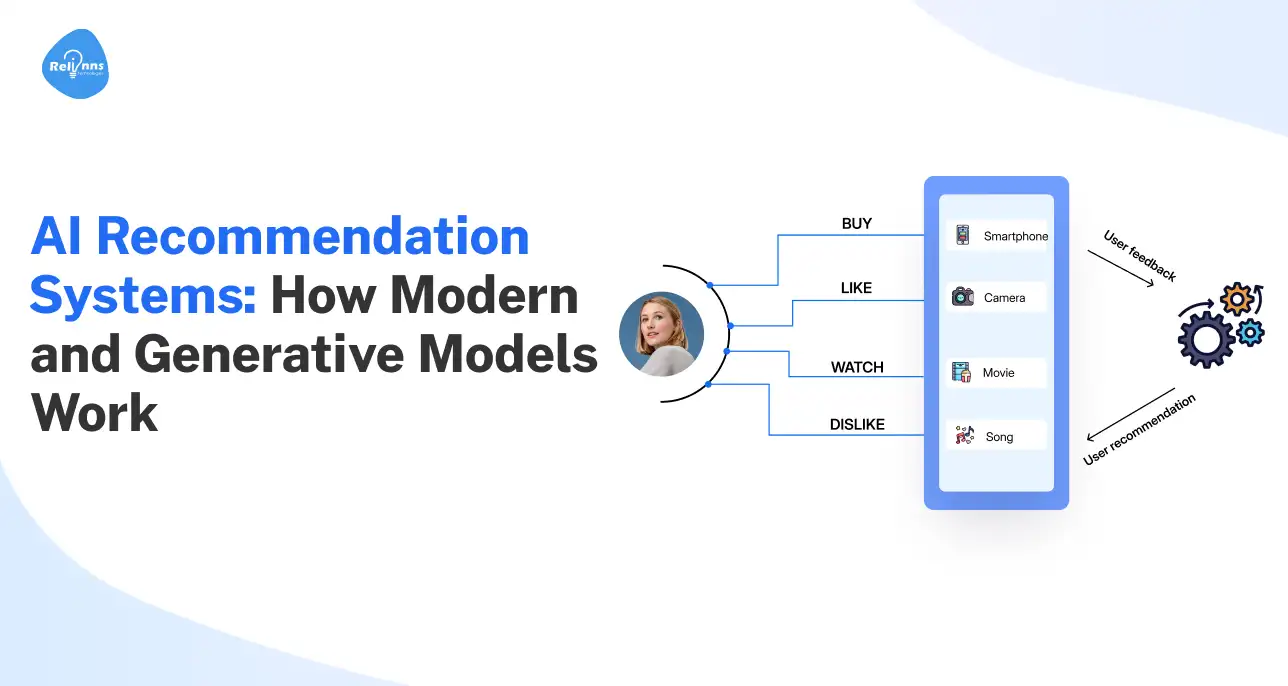
The world is driven by recommendation systems; influencing us long before we notice.
Over 80% of Netflix viewing reportedly comes from recommendations, and apps across e-commerce, social media, and streaming know you better than you think.
Personalization isn’t just convenient now; it drives the economy. AI has quietly reshaped how systems make decisions.
We moved from simple rules to machine learning, then deep learning, and now generative AI. Today, recommendation engines can predict what you want before you even realize it.
In this guide, we’ll explain AI recommendation systems and see how they work, from basics to modern generative approaches shaping personalization.
What is an AI Recommendation System and Why it Matters
Understanding the basics is the first step.
Before exploring how these systems work, let’s define what an AI recommendation system is and why it plays such a critical role today.
What is an AI Recommendation System?
An AI recommendation system is software that predicts what users want or need.
It looks at behavior, preferences, and context to suggest content, products, or services.
Also called an AI recommender system or recommendation system AI, its main goal is to connect users with items they’ll engage with.
Instead of showing the same options to everyone, they personalize experiences and make choices more relevant for each user.
Why AI is Used in Recommendation Systems (Why it Matters)
AI is essential because it can handle scale and complexity that humans cannot. Key benefits of AI recommendation systems include:
- Pattern Recognition at Scale: Detects trends in massive datasets
- Real-time Personalization: Updates recommendations instantly based on user behavior
- Adaptive Learning: Improves predictions over time using feedback
In short, AI recommendation systems help businesses increase engagement, drive sales, and deliver personalized experiences that keep users coming back.
As personalization becomes a competitive advantage, businesses that invest early in intelligent recommendation systems position themselves ahead of the curve.
Working with experienced AI partners like Relinns Technologies can help turn this capability into measurable business growth.
How AI Recommendation Systems Work
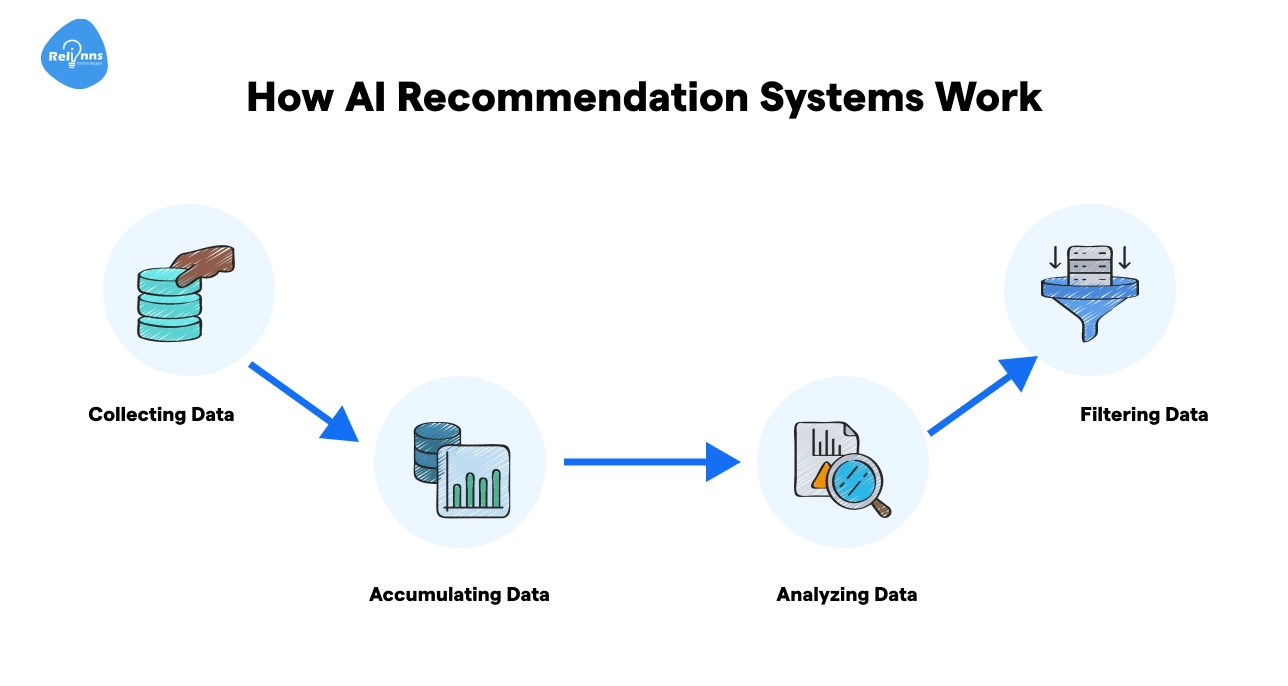
Behind every personalized feed is a simple but powerful process.
Modern AI-driven recommendation systems collect signals, narrow options, rank the best ones, and learn from every interaction.
That’s how they deliver relevant results in seconds.
At a Glance: The 5 Steps That Power AI Recommendation Systems
Ever wonder how your favorite streaming app suggests the perfect movie right when you sit down?
It’s not magic, but a sophisticated pipeline designed to filter billions of options into a handful of “must-sees”.
Here’s a simple and quick overview of how recommendation systems in AI typically operate:
This five-stage pipeline is the foundation of most production-grade AI recommendation systems used across streaming, e-commerce, and social platforms.
Step 1: Data Collection
AI starts by gathering clues.
This includes explicit data (the 5-star review you gave) and implicit data (the fact that you re-watched a specific scene three times).
Context also matters, such as time of day, device, and even location.
Step 2: User and Item Representation
The AI-based recommendation system takes those clues and turns them into mathematical patterns (called embeddings).
If you like 80s synth-pop and sci-fi movies, the AI places you in a “digital neighborhood” with other people who share those specific interests.
In other words, similar behaviors form clusters. This makes preferences measurable.
Step 3: Candidate Selection (or Retrieval)
From millions of options, the system quickly narrows the list.
It uses similarity search and fast indexing methods to find strong matches within seconds.
Step 4: Ranking
Models such as boosted trees or neural networks score each option.
It balances what’s popular globally with what’s specific to you to create that perfectly curated “Recommended for You” list.
Step 5: Feedback Loop & Continuous Learning
Every click or skip teaches the model something new.
For instance, if a streaming platform recommends a horror movie and you immediately click “Not Interested”, the system lowers the weight of similar content and updates your preference profile in future recommendations.
A/B tests and live updates empower these AI-powered recommendation systems to keep getting smarter.
Types of AI Recommendation Systems
Not all AI recommendation systems think the same way. Some rely on crowd behavior. Others focus only on you.
Many combine multiple methods to improve accuracy. Here’s a simple breakdown:
In reality, most modern AI-powered recommendation systems blend several of these approaches.
At this stage, it’s also worth looking at how these models are structured behind the scenes in real-world production systems.
Modern Architecture of AI Recommendation Systems
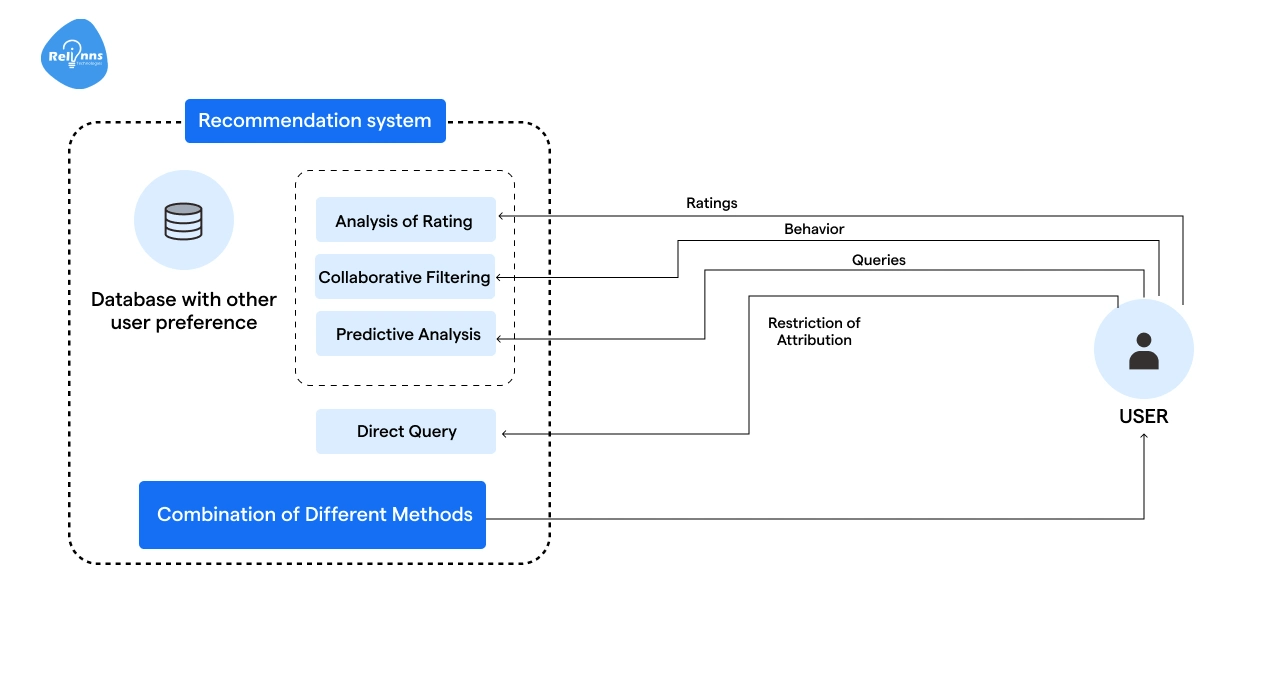
Today’s recommendation engines are not just algorithms.
They are full systems built to respond in milliseconds, handle millions of users, and improve constantly.
Behind every personalized list section is a carefully designed architecture.
Two-Stage Architecture: Retrieval + Ranking
Most production systems follow a two-step process:
- Retrieval: From millions of options, the system quickly pulls a few hundred likely matches.
- Ranking: A stronger model then assesses those matches and decides what appears first.
The first step ensures speed. The second ensures relevance. Together, they balance scale and precision.
Embedding-Based Systems
Modern platforms depend on embeddings, which are dense numerical representations.
- Users are mapped based on behavior, intent, and interests.
- Items are mapped based on features and patterns.
- If a user vector and an item vector sit close to each other in this “vector space”, the system treats them as a strong match.
This makes comparison fast and mathematically precise.
Real-Time Personalization Systems
User behavior changes quickly. Systems must adapt instantly.
- Streaming pipelines process clicks and events as they happen.
- Feature stores keep updated user and item signals.
- Models refresh inputs continuously.
Large-Scale Deployment Considerations for AI Recommenders
Building a model is only half the challenge. Running it at scale is much harder.
When AI recommendation systems move from testing to production, they must handle live traffic, millions of users, and constant behavioral shifts.
At scale, they need to manage:
- Low latency so results appear instantly
- Scalability to support large audiences simultaneously
- Cold start issues for new users or products
- Data drift as preferences and trends evolve
Without these safeguards, even the most advanced model can struggle in production.
This operational layer is what makes modern AI recommenders stable, responsive, and dependable.
Generative AI Recommendation Systems: From Ranking to Reasoning
Traditional recommenders predict and rank. Generative systems explain and interact.
For anyone evaluating modern AI systems, this section breaks down how traditional and generative approaches truly compare.
What is a Generative AI Recommendation System?
A generative AI recommendation system uses Large Language Models (LLMs) to create personalized responses (not just ordered lists).
Unlike traditional systems that simply score and sort items, a gen AI recommendation system can generate explanations and tailored suggestions in natural language.
It does not only decide what to recommend. It decides how to present it in a way that feels relevant and conversational.
How Generative AI Changes Recommendation Logic
Generative AI shifts recommendations from silent predictions to guided interactions.
Instead of only ranking products or content, it explains why something fits your interests.
It enables conversational discovery through chat interfaces and supports multi-modal personalization across text, voice, and images.
The experience feels less mechanical and more like advice.
Retrieval-Augmented Recommendation Systems
Many modern systems combine retrieval models with LLMs in a setup known as Retrieval-Augmented Generation (RAG).
Retrieval narrows options using embeddings (numerical representations of users and items).
The LLM then uses prompts and context to generate a personalized response.
This is the same foundation used in many advanced RAG chatbots, where the system retrieves relevant information first and then generates a conversational answer.
This hybrid design strengthens generative AI for recommender systems while keeping results precise.
Generative AI for Recommender Systems in E-Commerce
In e-commerce, a recommendation system using generative AI can create highly personalized shopping experiences.
It can write tailored product descriptions, generate dynamic bundles, and power conversational shopping assistants that guide customers in real time.
LLM-Based Recommender Architectures
A generative AI recommender system may use prompt-based ranking, fine-tuned LLMs, and reinforcement learning from feedback to continuously improve suggestions.
This is where recommendation systems begin acting like adaptive digital advisors rather than static ranking engines.
Traditional vs Generative AI Recommendation Systems
Not all recommendation engines think the same way.
Some (like traditional systems) simply predict what you might click next.
Others understand intent, generate explanations, and even hold a conversation.
Here’s a clear side-by-side comparison:
In short, traditional AI predicts what you may click, while generative AI understands what you mean and explains why something fits.
Real-World Applications of AI Recommendation Systems
AI recommendation systems quietly power many digital experiences. From shopping to learning, they guide decisions in real time.
Here’s how different industries use them:
Across industries, the goal stays the same: reduce noise and surface what matters most.
The difference lies in the data, context, and level of personalization required.
Key Challenges in AI Recommendation Systems
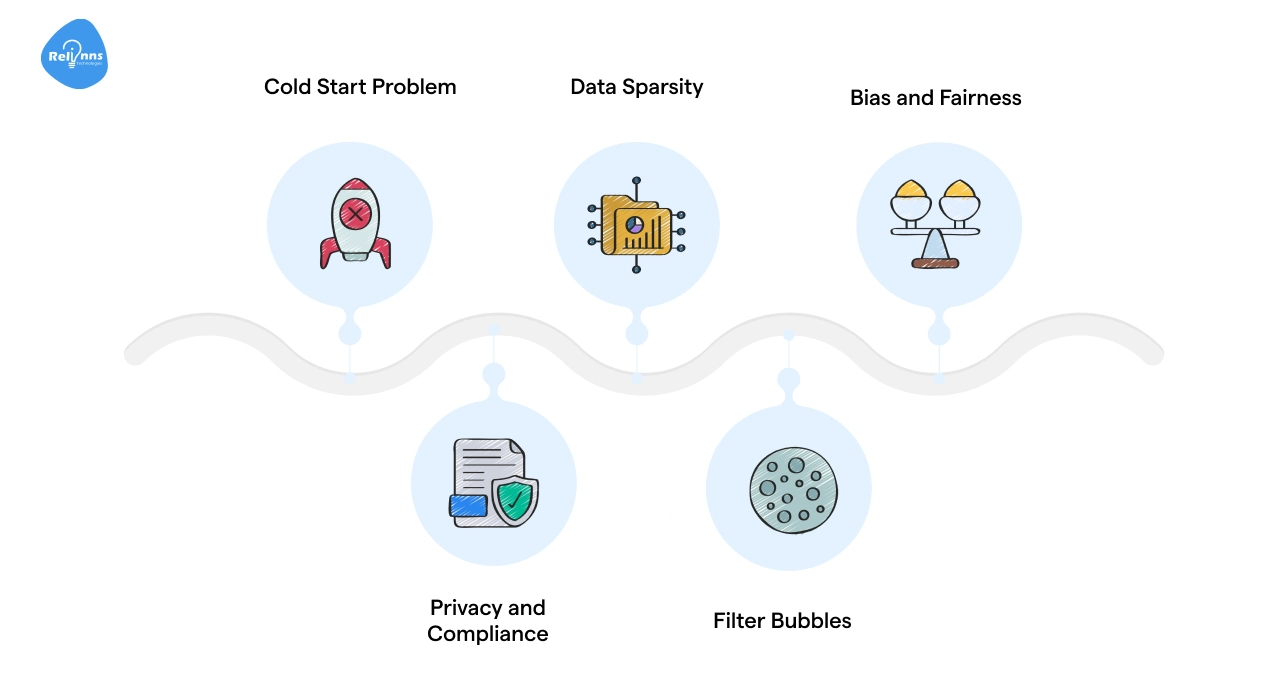
Even advanced recommendation engines face practical limits.
Data gaps, privacy rules, and bias can weaken performance if not handled carefully.
The following list showcases common risk factors:
Cold Start Problem
New users or products have little to no history, making precise suggestions difficult.
The Fix: Use hybrid models, contextual data, and onboarding questions to generate early signals.
Data Sparsity
Most users interact with only a few items, leaving limited data to learn from.
The Fix: Apply embedding models and similarity techniques to uncover hidden patterns.
Bias and Fairness
Models can inherit bias from historical data and amplify unfair outcomes.
The Fix: Audit training data regularly and apply fairness constraints during modeling.
Privacy and Compliance
Personal data powers recommendations but must follow strict regulations.
The Fix: Use anonymization, consent management, and privacy-first data pipelines.
Filter Bubbles
Over-personalization can limit exposure to diverse content.
The Fix: Introduce exploration strategies and diversity-aware ranking methods.
Addressing these challenges is what separates experimental models from production-ready recommendation systems.
Evaluation Metrics for AI Recommender Systems
It is said: if you cannot measure it, you cannot improve it.
Recommendation systems may look smart, but performance must be proven with data.
The right metrics reveal accuracy, ranking quality, and real business impact. These include:
- Precision and Recall: Measure relevance of recommended items. Aim for precision ≥0.6 and recall ≥0.5; top systems often exceed 0.8.
- MAP (Mean Average Precision) and NDCG (Normalized Discounted Cumulative Gain): Evaluate ranking quality and whether top items are relevant. Target MAP 0.3-0.6 and NDCG ≥0.5 at top-10 results.
- CTR (Click-Through Rate) and Conversion Rate: Track clicks and completed actions. Typical CTR 2-5%; conversion rates 1-3%
- Diversity and Novelty: Measure variety and discovery. Target 15-30% new items per session to avoid over-personalization.
- Offline vs Online Evaluation: Offline tests use historical data. Online tests validate performance through live A/B experiments.
Together, these metrics ensure your recommendation system is not just intelligent in theory, but effective, measurable, and impactful in real-world usage.
How to Build an AI Recommendation System
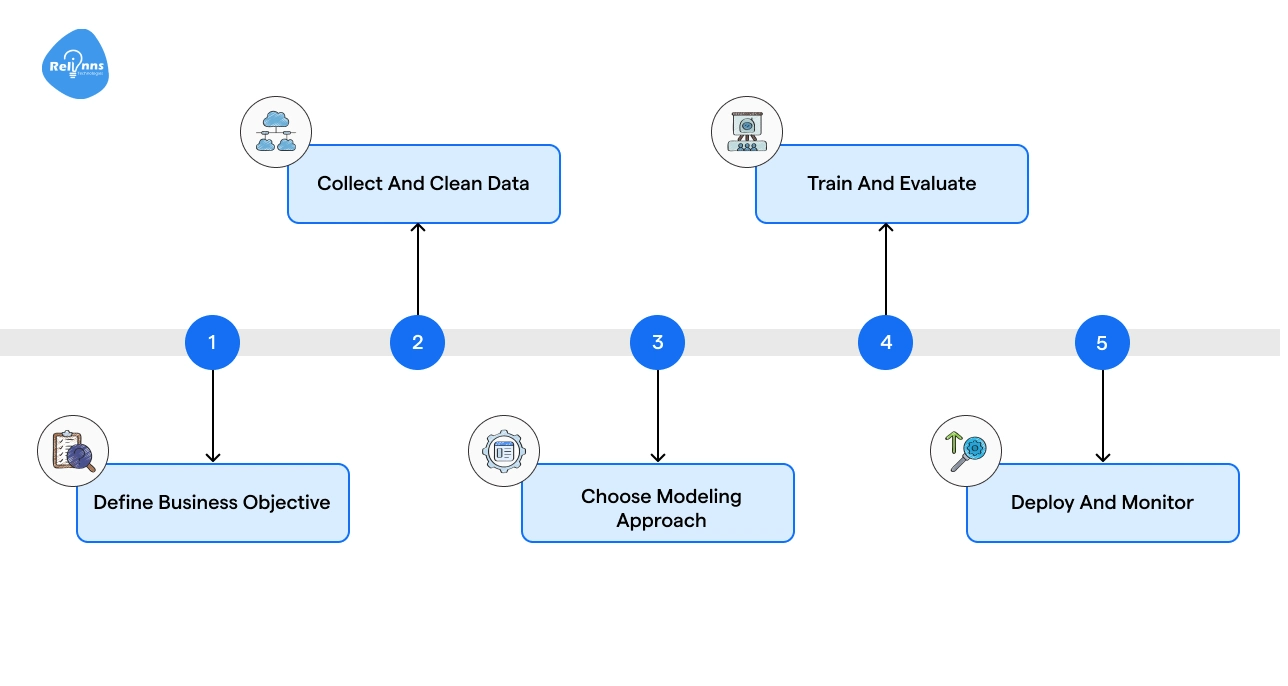
Building a recommendation system is not just about choosing a model.
It starts with a clear goal, strong data, and a plan to improve over time. Each step builds on the previous one.
Define Business Objective
Start with clarity. Are you trying to increase clicks, improve retention, elevate sales, or drive engagement?
The goal shapes everything that follows.
Collect and Clean Data
Gather user activity, product details, and contextual signals.
Remove duplicates, fix errors, and organize the data so the model can learn properly.
Choose Modeling Approach
Pick the right method based on your use case.
This could be collaborative filtering, content-based models, hybrid systems, or generative AI.
Train and Evaluate
Train the model using historical data.
Measure accuracy and real business impact before moving forward.
Deploy and Monitor
Release gradually. Track performance closely. Update the model as user behavior changes.
Many businesses looking to move from experimentation to real-world deployment often collaborate with AI specialists like Relinns Technologies to ensure their recommendation systems are accurate, scalable, and business-aligned.
The Future of AI Recommendation Systems
What began as simple ranking models is turning into intelligent, adaptive decision systems.
The future of AI recommendation systems is multi-modal, where platforms understand text, voice, images, and behavior together.
Agentic recommendation systems will act more independently. They won’t just suggest options, but will guide decisions in real time.
Similarly, on-device personalization will make recommendations faster and more private. Privacy-first AI will become the norm.
Soon, autonomous generative agents will recommend, explain, and even act on a user’s behalf, reshaping how digital experiences are delivered.
Frequently Asked Questions (FAQs)
What is an AI recommendation system?
An AI recommendation system suggests products, content, or services based on your behavior, interests, and context to make digital experiences more personal and relevant.
How do AI recommendation systems work?
They collect user actions, identify patterns, narrow down options, rank the best matches, and learn from feedback to improve future recommendations.
What are the main types of AI recommendation systems?
Common types include collaborative filtering, content-based filtering, hybrid systems, deep learning models, and generative AI systems that add conversational suggestions.
What are generative AI recommender systems?
A generative AI recommender system uses Large Language Models (LLMs) to create personalized suggestions and explanations instead of just showing ranked lists.
What is the difference between traditional and generative AI recommenders?
Traditional systems rank items based on past behavior. Generative AI systems understand intent and provide conversational, context-aware recommendations with explanations.
How are AI recommendation systems evaluated?
They are measured using accuracy metrics like precision and recall, business metrics like click-through rate, and real-time testing through A/B experiments.
What are the biggest challenges in AI recommendation systems?
Key challenges for AI in recommendation systems include cold start issues, limited data, bias, privacy concerns, and avoiding filter bubbles while keeping suggestions accurate and diverse.