AI for Ecommerce: How It's Transforming Online Sales
Date
Mar 27, 26
Reading Time
8 Minutes
Category
Generative AI
Share


Half of today's online stores will be obsolete by 2030.
Not because ecommerce is shrinking, but because AI is redrawing the competitive line.
Customer expectations are rising faster than most teams can keep up. Competition is fiercer than ever. And the old playbook of discounts and email blasts is losing its edge.
The businesses pulling ahead are using AI to personalize at scale, automate the mundane, and predict what customers want before they search.
In this guide, you'll learn what AI for ecommerce actually is, how it works across the customer journey, and how to implement it, step by step.
AI in Ecommerce: What It Is and Why You Can’t Ignore It
AI is no longer just a buzzword in ecommerce. It’s the engine that helps stores understand customers, personalize experiences, and make smarter decisions. From suggesting products to predicting demand, AI touches almost every part of online shopping.
Think of it as your store’s smartest employee; one who never sleeps, remembers every customer, and keeps improving every day.
Understanding AI for Ecommerce
AI for ecommerce means using technology to analyze online retail data and automate tasks. It includes machine learning, natural language processing, deep learning, and generative AI.
These tools help you know what your customers want, show them the right products, and even handle repetitive tasks automatically.
For example, AI can recommend products based on a shopper’s past purchases or browsing behavior.
Why AI Is No Longer Optional for Online Retail
Today’s shoppers expect fast, seamless, and personalized experiences. Ignoring AI can cost you customers, revenue, and growth. Key reasons why AI has become non-negotiable include:
- Customers expect personalization: Shoppers now want tailored recommendations and seamless experiences that match their interests, past behavior, and real-time shopping needs.
- Competition is fierce: Stores using AI move faster, adjust prices smartly, and win more sales. This is shown by Amazon, which uses AI across recommendations, pricing, inventory, and logistics, helping it drive billions in additional annual revenue.
- Revenue impact: Businesses adopting AI often see stronger sales performance. This shows that AI isn’t just a nice-to-have; it plays a real role in driving growth.
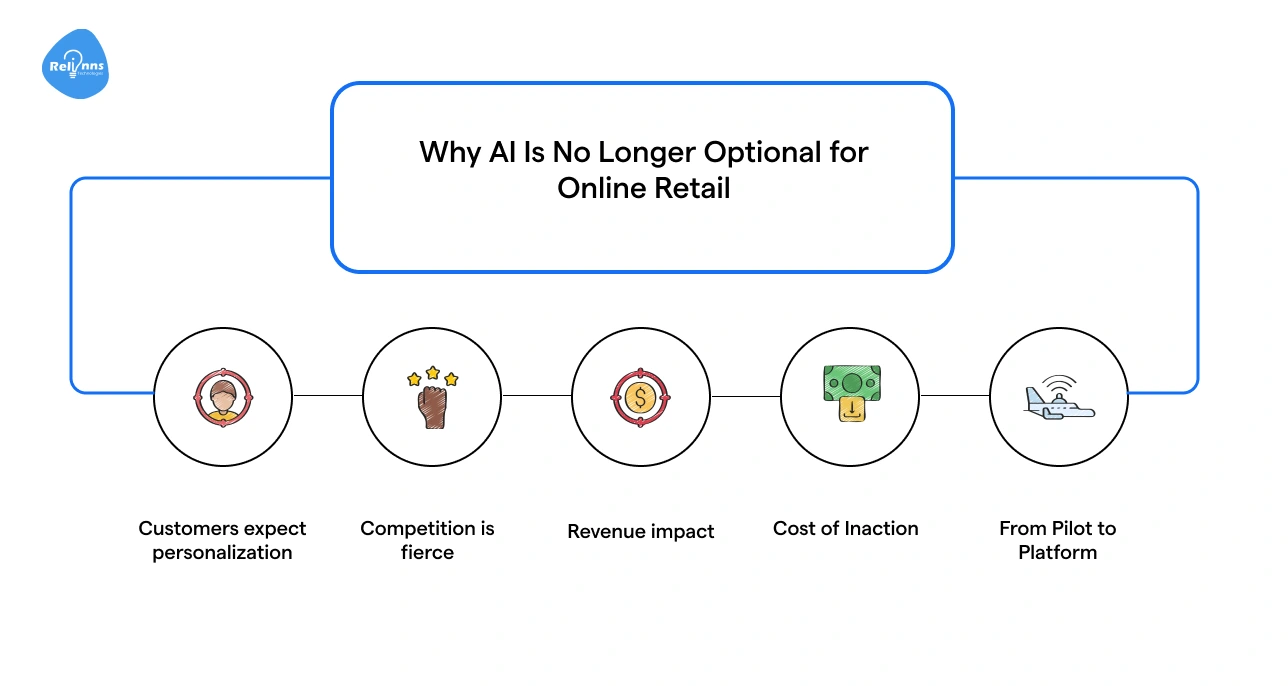
- Cost of Inaction: 84% of ecommerce companies treat AI as a top priority. (Source: Shopify) Ignoring it means falling behind. That means, if a shopper sees a better, faster, or more personalized experience elsewhere, they’ll leave your store without a second thought.
- From Pilot to Platform: Small experiments aren’t enough. Testing a single feature or campaign can show promise, but real impact comes from applying AI across your entire store. Full-scale adoption is what drives measurable results and long-term growth.
Using AI in ecommerce today isn’t just smart. It’s survival.
Many companies looking to implement AI across their online stores often partner with technology experts like Relinns Technologies that help them deploy practical AI solutions that improve personalization, automation, and overall digital commerce performance.
The Key AI Technologies Behind Smarter Ecommerce
AI powers smarter, faster, and more personalized online stores. Different technologies focus on different tasks, from understanding customers to automating workflows.
Here’s a clear breakdown of the main AI technologies powering modern ecommerce platforms:
| Technology | How It Helps Ecommerce | Example |
| Machine Learning | Learns customer behavior to make predictions | Product recommendation engines that power “Customers Also Bought” and “Recommended For You” sections |
| Natural Language Processing (NLP) | Understands human language for better interaction | AI chatbots answering customer questions and search tools interpreting queries like “red summer dress under $50” |
| Generative AI | Creates new content from patterns in data | AI-generated product descriptions, marketing copy, and catalog images |
| Deep Learning | Processes complex data for accuracy | Visual search tools where shoppers upload a photo to find similar products instantly |
| Agentic AI | Executes multi-step workflows with minimal human input | AI agents that monitor inventory, trigger restocking, and assist with automated return handling |
Together, these technologies make ecommerce faster, smarter, and more personal.
Agentic AI, in particular, moves beyond just suggestions, executing actions automatically and saving teams countless hours, a feature almost no competitor highlights.
10 Ways AI Is Transforming Ecommerce Right Now
AI isn’t just a back-end tool; it’s changing the way customers shop and how stores operate.
Here are the 10 ways it’s making an impact today in the online retail world:
1. Hyper-Personalized Shopping Experiences
AI studies past purchases, browsing habits, and preferences. Stores like Amazon and Etsy use it to show products shoppers are most likely to buy.
Personalized recommendations can increase revenue by up to 40%, making every interaction feel tailored. (Source: McKinsey & Company)
2. Conversational AI and AI Chatbots for Ecommerce
Chatbots answer questions reactively, while conversational AI handles multi-step conversations.
Customers can track orders, check stock, recover carts, or request refunds instantly. This boosts engagement and reduces support load.
Many ecommerce companies are now using RAG chatbots to answer complex questions instantly by pulling info from multiple sources.
3. Generative AI for Ecommerce
Generative AI creates product descriptions, ad copy, AI imagery, and personalized emails. Stores can produce content at scale, keeping messaging fresh without extra staff.
To learn more about how generative AI boosts ecommerce content and personalization, read our generative AI in ecommerce article.
4. Intelligent Search and Visual-Voice Discovery
AI powers visual search and voice commands, helping shoppers find exactly what they want.
Example: A shopper uploads a TikTok screenshot and instantly finds similar “quiet luxury” linen blazers available in the store.
Stores using visual search see higher engagement, making discovery faster and more intuitive.
5. Dynamic Pricing Optimization
AI analyzes demand, competitor prices, and inventory in real time. This helps stores adjust prices dynamically, improving profit margins significantly.
For instance, a retailer can automatically lower prices on overstocked items or raise prices on high-demand products, increasing sales and margins without manual intervention.
6. Predictive Analytics and Demand Forecasting
AI predicts what will sell and when. Companies using it improve inventory planning, reduce stockouts, and optimize supply chains.
Lower logistics costs and better inventory levels help stores save money and keep products in stock when customers want them.
7. AI-Powered Post-Purchase Experience
AI keeps customers happy after purchase. Real-time tracking, return automation, reorder reminders, and loyalty nudges all improve retention.
8. Fraud Detection and Security
AI spots unusual buying patterns using behavioral analytics. This reduces fraud losses, protecting both the store and the customer.
A prominent example is PayPal, which uses AI to detect suspicious transactions in real time, flagging potential fraud before money changes hands and reducing losses for both buyers and sellers.
9. AI for Email Marketing and Retention Automation
Artificial intelligence personalizes email flows, cart abandonment sequences, and lifetime value optimization. This directly increases AI ecommerce sales and repeat purchases.
10. Agentic AI Agents for Ecommerce Automation
Unlike chatbots, agentic AI works autonomously. It can reorder inventory, handle returns, recover carts, and even negotiate with suppliers.
Think of a chatbot as a helpful store assistant; agentic AI is the store manager who actually gets things done.
Curious how to develop AI agents for your ecommerce store? Read our AI agent development guide to learn step by step.
These examples show how AI isn’t just improving individual tasks; it’s transforming the entire ecommerce experience.
AI in Ecommerce Across Industries: Top Use Cases
AI adoption in ecommerce varies across industries. Each sector uses it to solve different problems, from product discovery to supply chain planning.
The examples below show how AI in ecommerce delivers real business impact:
| Industry | Use Case | Example | Impact |
| Fashion & Apparel | Personalized recommendations, visual search | Outfit suggestions based on browsing history | Higher conversions, better product discovery |
| Electronics & Tech | AI-powered product search and comparisons | Smart comparison of specs, prices, and reviews | Faster purchase decisions |
| Grocery & FMCG | Demand forecasting and inventory planning | Predicting demand for perishable items | Less waste, fewer stockouts |
| B2B Ecommerce | Automated reordering and dynamic pricing | AI suggests bulk reorders for business buyers. | Faster procurement, stronger retention |
These examples show how AI-powered ecommerce is helping businesses personalize experiences, improve operations, and drive smarter decisions across industries.
How to Implement AI in Ecommerce: A Practical Step-by-Step Guide
Adopting AI may seem complex, but the process becomes manageable when broken into clear steps. The goal isn’t to deploy AI everywhere at once. Start small, focus on impact, and scale gradually.
Here’s a step-by-step guide on how to use AI in ecommerce:
| Step | What to Do | Why It Matters |
| 1. Audit Your Tech Stack & Data | Review your ecommerce tools, integrations, and customer data. | AI needs clean, reliable data to work well. |
| 2. Pick a High Impact Use Case | Start with one problem like product recommendations, smarter search, or automated support. | A focused use case helps deliver faster results. |
| 3. Choose the Right AI Approach | Decide whether to build, buy an AI platform, or partner with experts. | The right approach saves time and aligns with business goals. |
| 4. Run a Pilot | Test AI on a small workflow first. | Pilots validate results and reduce risk. |
| 5. Train Teams and Scale | Train teams and expand AI gradually across operations. | Adoption ensures long term impact. |
Let’s look at each of these steps in more detail.
Step 1: Audit Your Current Tech Stack and Data Quality
Start by reviewing your ecommerce platform, analytics tools, CRM, and data sources. AI systems rely on accurate data. If product catalogs, customer records, or inventory data are incomplete, results will suffer.
For instance, if product information is missing attributes like size, color, or category, AI recommendation engines may suggest irrelevant items to shoppers.
Step 2: Identify Your Highest-Impact Use Case First
Focus on one area where AI can deliver immediate value.
Common starting points include product recommendations, customer support automation, or demand forecasting. Starting small makes adoption easier and proves ROI quickly.
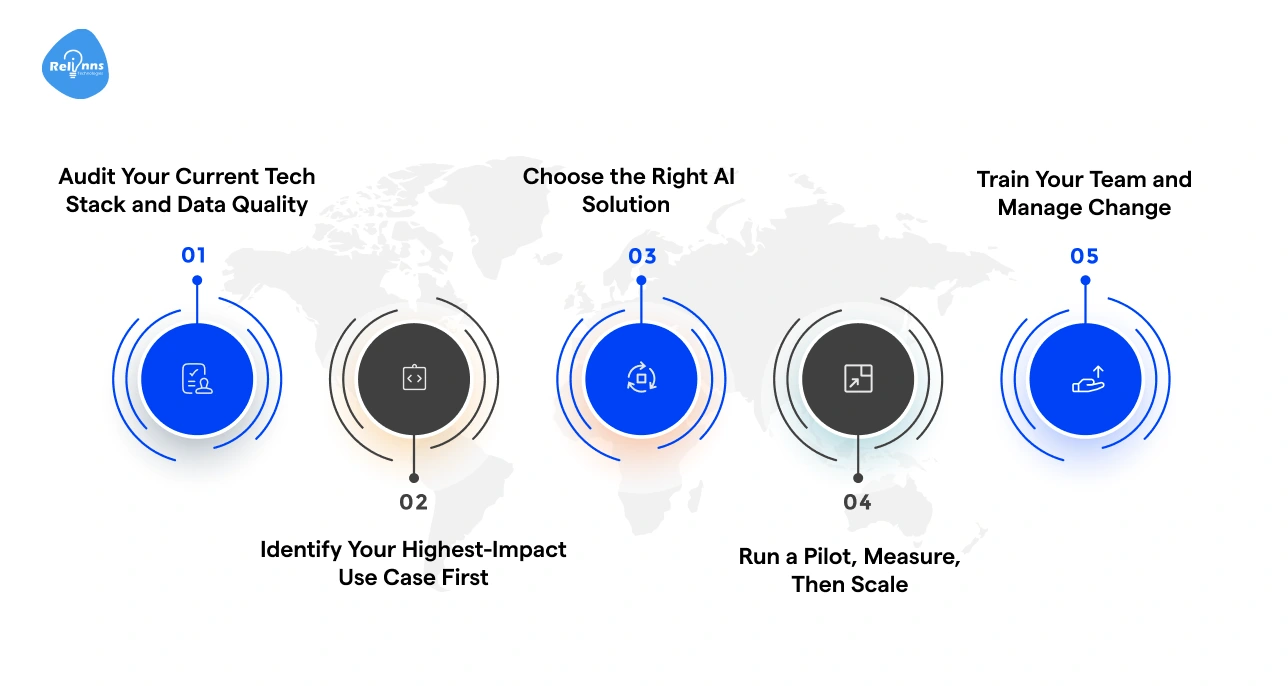
Step 3: Choose the Right AI Solution (Build vs Buy vs Partner)
Some businesses build custom models, while others use ready-made tools. Smaller stores often adopt AI platforms, while larger companies may build tailored systems or partner with AI specialists.
A Simple Rule of Thumb: Buy when speed matters, build when customization is critical, and partner when expertise is needed.
Step 4: Run a Pilot, Measure, Then Scale
Test AI in a limited environment first. Track metrics like conversion rate, customer engagement, or operational efficiency.
If the pilot succeeds, expand the system across more workflows.
Step 5: Train Your Team and Manage Change
AI adoption isn’t just about technology. Teams need training to use new tools effectively.
When employees understand how AI supports their work, adoption becomes faster and more successful.
On the whole, AI implementation doesn’t have to be overwhelming. By starting with the right data, focusing on one high-impact use case, and scaling gradually, ecommerce businesses can adopt AI with measurable results.
Choosing AI Ecommerce Platforms: Core Features to Consider
The right e-commerce platform should solve everyday retail problems, helping you understand customers better, automate repetitive work, and make smarter decisions.
When comparing AI solutions for ecommerce, look for features that directly improve how your store runs.
- Smart Product Recommendations: Tools should analyze browsing and purchase behavior to show shoppers items they’re most likely to buy.
- Customer Support Automation: Built-in chat assistants can answer common questions, track orders, and guide customers through purchases.
- Actionable Insights: Look for dashboards that clearly show trends in sales, customer behavior, and campaign performance.
- Easy System Connections: The tool should connect smoothly with your ecommerce platform, CRM, and marketing tools without complex setup.
- Flexible Pricing and Growth Support: Choose a platform that fits your current needs but can handle higher traffic and product catalogs later.
- Data Privacy and Security: Make sure customer information is protected and the platform follows privacy regulations.
The best platforms are simple to adopt and deliver visible improvements quickly.
How to Measure the ROI of AI in Online Stores
To understand how AI improves e-commerce sales analysis, businesses need to track the right performance metrics.
While results vary by industry and implementation, many ecommerce businesses report improvements within the following benchmark ranges:
- Conversion Rate Lift (5-20%): Measures how many visitors complete a purchase. AI-powered recommendations and smarter search often increase conversions.
- Average Order Value - AOV (10-20% increase): Tracks how much customers spend per order. Personalized bundles and cross-sell suggestions usually raise order value.
- Cart Abandonment Rate (10-20%): AI-driven reminders, dynamic offers, and chat assistance help recover abandoned carts.
- Customer Satisfaction Score - CSAT (5-15% improvement): Faster responses and better recommendations improve the shopping experience.
- Fraud Loss Reduction (20-40%): AI fraud detection systems identify suspicious activity before transactions are completed.
Tracking these metrics consistently helps businesses understand where AI delivers measurable value.
Businesses looking to optimize their online stores often work with experienced AI partners like Relinns Technologies to identify high-impact opportunities and implement solutions that drive measurable growth.
Common AI Implementation Mistakes in Ecommerce (and How to Avoid Them)
AI can improve many parts of an online store, but poor implementation often leads to disappointing results. Many businesses rush into adoption without the right preparation.
Understanding these common challenges and how to address them can help you use AI more effectively.
Poor Data Quality
Challenge: Incomplete product catalogs, inaccurate inventory data, or outdated customer records can lead to poor recommendations and incorrect insights.
The Fix: Clean and organize your data before deploying AI. Standardize product attributes, maintain accurate inventory records, and ensure customer data is regularly updated.
Over-Automating Customer Interactions
Challenge: Too much automation can make customer interactions feel impersonal or frustrating, especially when shoppers need help with complex issues.
The Fix: Use AI for simple tasks like order updates or FAQs, and let human agents handle more complex conversations.
Ignoring Privacy Compliance
Challenge: AI tools often process large amounts of customer data. Failing to follow privacy laws like GDPR or CCPA can lead to legal risks.
The Fix: Choose platforms that prioritize data protection and clearly communicate how customer data is used.
Skipping Change Management
Challenge: Teams may resist new AI tools if they don’t understand how they work or how they help. It’s critical to bring employees into the process early and clearly show how the tools will support their work.
The Fix: Train employees early, explain the benefits, and involve teams in the adoption process.
Choosing a Tool Before Defining the Use Case
Challenge: Many companies select AI tools before identifying the problem they want to solve.
The Fix: Start with a clear goal, such as improving recommendations or forecasting demand, and then select the right technology.
Avoiding these mistakes can make the difference between AI that disappoints and AI that drives real results. With the right planning and strategy, ecommerce businesses can turn AI into a reliable growth engine.
The Next Era of Online Retail: How AI Will Transform It
The next phase will reshape how people discover, evaluate, and buy products online. New systems will make shopping faster, more immersive, and more efficient.
The future of AI in ecommerce will be defined by smarter tools that act, predict, and assist in real time.
Agentic AI Becomes Mainstream
Agentic AI systems can take action without constant human instructions.
In online retail, this means software that monitors inventory, triggers restocking, resolves support requests, and manages workflows automatically.
These systems turn AI into an active operator rather than just an assistant.
Autonomous Shopping Assistants
Personal shopping assistants powered by AI are becoming more common. These tools learn user preferences, compare products, track prices, and recommend purchases.
Instead of browsing dozens of pages, shoppers may simply ask an assistant to find the best option.
AI + AR/VR Shopping Experiences
AI is also merging with augmented and virtual reality. Shoppers can visualize furniture in their homes, try on clothes virtually, or explore digital stores.
AI helps personalize these experiences in real time.
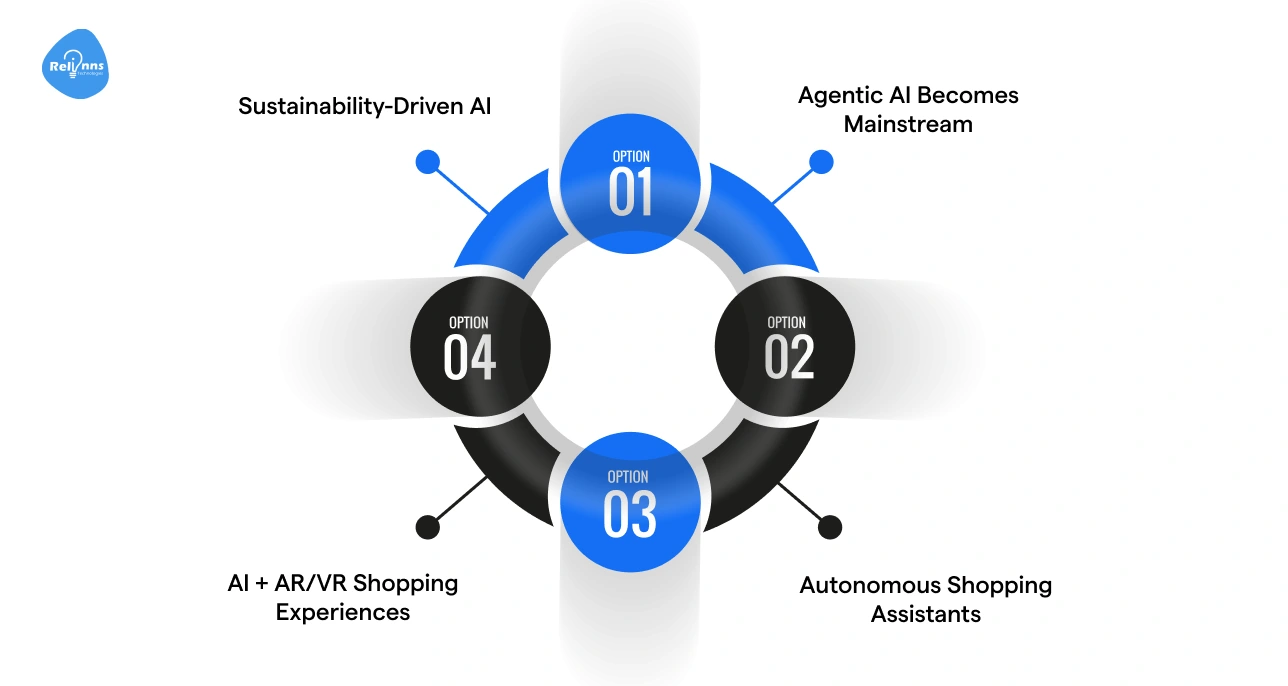
Sustainability-Driven AI
AI is helping ecommerce become more sustainable. Retailers are using it to optimize delivery routes, reduce packaging waste, and improve demand planning.
This lowers costs while also reducing environmental impact.
On the whole, the future is intelligent, automated, and highly personalized, reflecting a shift toward smarter, AI-powered commerce.
Final Thoughts
From static product pages and basic search bars, we’ve come to a world where online stores can understand shoppers, anticipate needs, and respond instantly. AI is helping retailers personalize experiences, automate everyday tasks, and make smarter decisions using real data.
But success with AI isn’t about adopting every new tool. It’s about solving real problems, starting small, and scaling what works. Businesses that combine the right technology with thoughtful strategy will see the biggest gains.
As digital commerce continues to evolve, AI will play a central role in shaping faster, smarter, and more intuitive shopping experiences for customers everywhere.
Frequently Asked Questions
How can AI be used in ecommerce?
AI can be used in ecommerce for product recommendations, chatbots, dynamic pricing, demand forecasting, fraud detection, personalized marketing, and smarter search experiences that increase conversions.
What are examples of AI in ecommerce?
Common examples include Amazon product recommendations, AI chatbots for customer support, visual search in fashion stores, automated pricing tools, and demand forecasting systems.
What is AI in ecommerce?
AI in ecommerce refers to technologies like machine learning and natural language processing that analyze shopper data, automate tasks, personalize experiences, and improve decision-making for online stores.
How is AI used in online retail?
Retailers use AI to recommend products, automate customer support, optimize pricing, forecast demand, detect fraud, personalize marketing campaigns, and improve search experiences for shoppers.
What are the benefits of AI for ecommerce businesses?
AI helps businesses increase conversion rates, personalize shopping journeys, automate repetitive work, reduce fraud, optimize pricing strategies, and generate insights that support smarter decisions.
Can small ecommerce businesses use AI?
Yes. Many AI platforms now offer affordable tools for chatbots, marketing automation, analytics, and recommendations, allowing smaller stores to improve operations without complex development.
What is the future of AI in ecommerce?
The future includes autonomous shopping assistants, AI agents managing operations, immersive AR shopping experiences, and smarter logistics systems that improve efficiency, personalization, and sustainability.