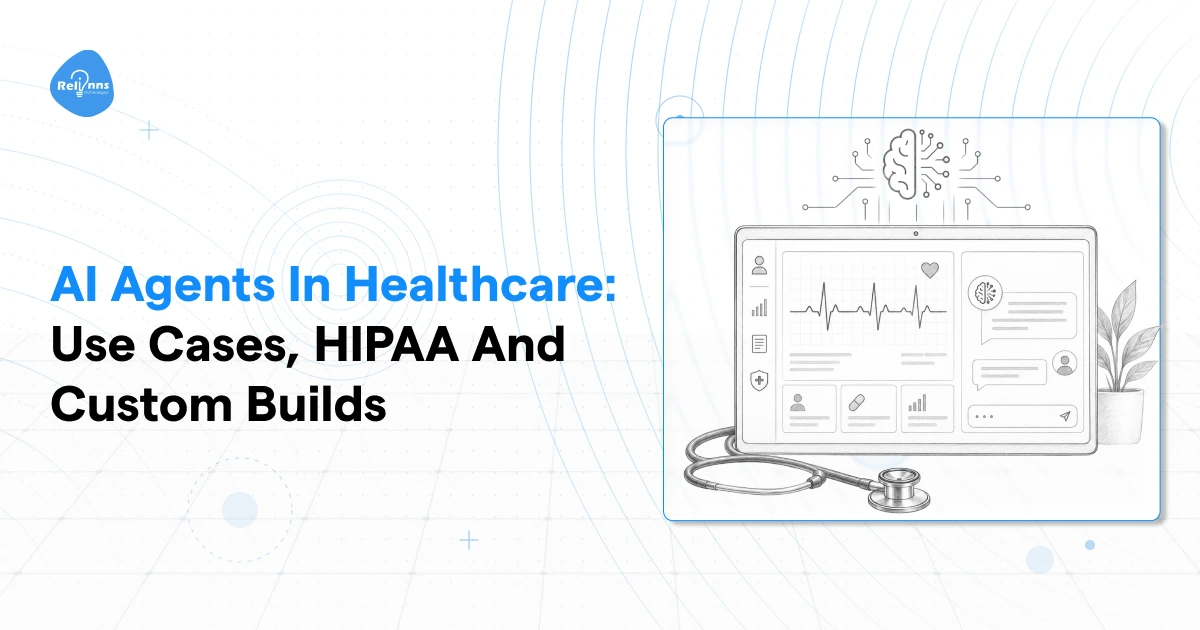
AI Agents in Healthcare: Use Cases, HIPAA and Custom Builds
Date
Oct 26, 26
Reading Time
7 Minutes
Category
AI Agents
Share


Answer Box
AI agents in healthcare are autonomous systems that manage clinical and administrative workflows across connected healthcare systems. They can retrieve data, use tools, update records, process claims, support prior authorization, and assist with documentation. Because they may handle PHI and sensitive actions, HIPAA controls, permissions, audit trails, limited system access, and human oversight must be built into the system from the start.
Healthcare organizations are beginning to use AI agents in healthcare to handle claims, documentation, prior authorization, and other operational workflows. The value comes from getting work done across connected systems, not just generating responses.
That also raises the stakes. The more an agent can access or change, the more important PHI controls, permissions, auditability, accuracy, and human oversight become.
McKinsey reported in 2025 that 85 percent of 150 US healthcare leaders surveyed were exploring or had already adopted generative AI capabilities, showing how quickly healthcare AI is moving from experimentation toward implementation. (McKinsey & Company)
This guide focuses on custom healthcare AI agents and the controls needed to use them safely across clinical and administrative workflows.
What AI Agents Do in Healthcare Beyond Chatbots
Healthcare workflows rarely stop after a question is answered. Claims, documentation, approvals, and administrative tasks often require data retrieval, rule checks, system updates, and human review. This is where healthcare AI agents become useful.
A healthcare AI agent can understand the intended outcome and coordinate the actions required to complete it. Depending on its permissions, it can:
- Retrieve approved healthcare data
- Call APIs and use connected tools
- Apply workflow and validation rules
- Update authorized systems
- Coordinate several workflow steps
- Request human approval when required
- Escalate incomplete or sensitive cases
- Record actions for auditing and review
Consider claims processing. A claims agent could:
Receive claim information
Validate required fields
Check supporting documentation
Identify missing information
Route exceptions to the appropriate team
Update the claims system
Request human review where required
This ability to act across systems is why healthcare agent design requires more than conversational AI. Businesses evaluating these workflows can explore Relinns AI agent development services for custom integrations, permissions, workflow controls, and human review requirements.
High Value Healthcare AI Agent Use Cases
The strongest healthcare use cases are workflows where teams repeatedly collect information, verify requirements, update systems, and route exceptions. Custom AI agents can coordinate these steps while keeping approvals and sensitive decisions under human control.
For a broader view of where autonomous systems can support business workflows, explore these AI agent use cases across different industries and functions.
Claims Processing Agents
Claims involve structured checks across documents, payer requirements, and internal systems. An agent can manage the administrative sequence before a claim reaches human review.
- Receive and organize claim information
- Check whether required documents are present
- Detect missing or inconsistent information
- Apply defined validation rules
- Route exceptions to the appropriate team
- Update claim status across authorized systems
This reduces repeated manual checking while keeping complex cases visible to staff.
Prior Authorization Agents
Prior authorization requires accurate information from several sources before submission. AI agents can coordinate the administrative work without making clinical decisions.
- Collect required patient and procedure information
- Check submission requirements
- Identify incomplete cases
- Gather and organize supporting documents
- Route cases requiring clinical judgment to qualified reviewers
The agent supports preparation and coordination. Medical necessity and other clinical decisions remain with authorized professionals.
Clinical Documentation Agents
Documentation agents can help clinicians organize information without replacing clinical judgment.
- Structure clinical notes into required formats
- Retrieve permitted patient context
- Prepare visit or case summaries
- Draft documentation for clinician review
When approved internal knowledge must be retrieved across several sources, agentic RAG can support retrieval before the agent proceeds with the next permitted action.
Final documentation should remain subject to appropriate clinical verification before it enters the patient record.
Revenue Cycle Management Agents
Revenue cycle workflows involve repeated administrative actions across billing, claims, and payment systems.
Agents can support:
- Claim preparation and validation
- Denial investigation
- Follow up task coordination
- Payment status checks
- Administrative routing between teams
This is especially useful when information must move between several authorized systems.
Patient Intake and Administrative Agents
Patient intake agents can collect structured information, verify required documents, update approved systems, and route requests to the correct department.
For service-focused workflows beyond healthcare administration, an AI agent for customer service can also support repetitive requests, routing, and customer interactions.
When the workflow depends mainly on phone conversations, AI voice agents for healthcare are a better fit than expanding a general agent into a voice focused role.
Organizations evaluating these workflows can explore top AI agent developers for healthcare when their use case requires custom integrations, permissions, workflow rules, and human approval controls.
The Compliance Layer for Healthcare AI Agents
Healthcare AI agents may access sensitive records, update systems, and support regulated workflows. That makes compliance a system design requirement, not a feature added after development.
The US Department of Health and Human Services states that the HIPAA Security Rule requires regulated entities to use reasonable and appropriate administrative, physical, and technical safeguards to protect electronic PHI. It specifically addresses areas such as access controls, audit controls, authentication, and transmission security. (HHS.gov)
HIPAA and PHI Handling
A HIPAA compliant AI agent depends on how the complete system handles protected health information throughout the workflow.
Organizations need to define:
- What healthcare data the agent can access
- Where PHI is stored
- How data moves between systems
- Which permissions the agent receives
- Which integrations can process PHI
- What activity logs are maintained
- Where supporting infrastructure operates
- Which vendors can access protected information
Each component handling PHI must fit within the organization’s security, privacy, and compliance requirements.
Access Controls
Access should match the exact responsibilities assigned to the agent. Broader permissions create unnecessary exposure and increase operational risk.
Organizations should define:
- Which records the agent can read
- Which systems it can access
- What information it can create or update
- Which actions need additional authorization
- Which actions remain restricted
A claims agent should not receive access to unrelated clinical records simply because both exist within the same organization.
Audit Trails
Healthcare teams need a clear record of agent activity so actions can be reviewed, investigated, and verified when necessary.
Audit records should capture:
- What information the agent accessed
- Which system or tool it used
- What action it performed
- What information it changed
- When the action occurred
- Where human intervention took place
This creates accountability across automated workflows and supports internal compliance reviews.
Human Oversight
Automation should stop where professional judgment or sensitive authorization becomes necessary.
Human review should be required for:
- Clinical decisions
- Ambiguous information
- Sensitive approvals
- High impact actions
- Cases outside defined workflow rules
- Exceptions that the agent cannot resolve safely
The agent can prepare information and coordinate tasks, while qualified professionals retain authority over decisions that require clinical or organizational judgment.
GDPR and PDPL Requirements
Healthcare organizations may also need to consider GDPR or PDPL depending on where patients, systems, and data processing activities are located.
They should assess:
- Applicable regional privacy requirements
- Data processing permissions
- Storage and transfer requirements
- Patient rights
- Retention rules
- Vendor responsibilities
For deeper guidance on permissions, safeguards, monitoring, and governance, read AI agent security and governance.
Custom AI Agents vs Voice Agents vs Low Code Healthcare Automation
The right approach depends on how the workflow operates, which systems it touches, and how much customization or control is required. Healthcare teams should choose based on the work the system needs to perform rather than the technology category itself.
| Choose This | When It Fits Best | Typical Healthcare Workflows |
|---|---|---|
| Custom AI Agent | Several systems are involved, custom logic is required, PHI access needs detailed controls, or human approvals must be built into the workflow | Claims processing, prior authorization, clinical documentation, revenue cycle workflows |
| AI Voice Agent | Spoken interaction is the main interface and the workflow primarily happens through phone conversations | Appointment scheduling, reminders, patient calls, inbound support |
| Low Code Automation | The process follows predictable steps and can be represented through forms, rules, approvals, and visual workflows | Internal approvals, document routing, structured administrative processes |
What to Choose for Common Healthcare Requirements
| Requirement | Best Fit |
|---|---|
| Claims processing across several systems | Custom AI Agent |
| Prior authorization workflow | Custom AI Agent |
| Clinical documentation workflow | Custom AI Agent |
| Custom healthcare system integrations | Custom AI Agent |
| Detailed PHI permissions and audit controls | Custom AI Agent |
| Patient phone conversations | AI Voice Agent |
| Appointment calls and reminders | AI Voice Agent |
| Simple internal approval workflow | Low Code |
| Visual workflow with limited custom logic | Low Code |
For structured processes with predictable rules, low code healthcare workflow automation can be a better fit.
When the workflow requires several systems, custom integrations, detailed permissions, reasoning, and human approval, AI agent development services are the stronger option.
How to Build a Compliant Healthcare AI Agent
A compliant healthcare AI agent should be designed around a clearly defined workflow before any system access is granted. The goal is to control what the agent can access, what it can change, and when human review is required.
Define the Workflow
Start by documenting the complete process the agent will support.
Identify:
- What triggers the workflow
- Which inputs are required
- Which systems are involved
- What actions the agent can perform
- Where human responsibility begins
- How success will be measured
This prevents the agent from receiving broader responsibilities than the workflow actually requires.
Map PHI and Data Access
Define exactly which protected health information the agent needs to complete its task.
Document:
- Data sources the agent can access
- Records it needs to retrieve
- Information it can process
- Where data is stored
- Which systems receive the data
Access should remain limited to the minimum information required for the assigned workflow.
Set Permission Boundaries
Every possible action should have a clear permission level.
Classify actions as:
- Read only
- Automatically permitted
- Human approval required
- Restricted
Clinical decisions, sensitive record changes, and actions outside defined rules should remain under appropriate human authority.
Connect Healthcare Systems
Healthcare AI agent development often requires controlled connections between several systems.
Common integrations may include:
- EHR systems
- Claims platforms
- Payer systems
- Internal databases
- Document management systems
- Relevant APIs
Each integration should use defined authentication, permissions, logging, and access controls.
Test Failure and Exception Handling
Testing should cover normal workflows as well as situations where the agent cannot safely continue.
Test:
- Missing records
- Incorrect information
- Failed APIs
- Unauthorized requests
- Ambiguous cases
- Human escalation paths
The system should stop or escalate instead of making unsupported decisions.
Start With a Controlled Pilot
Begin with one narrow workflow and limited permissions. Measure accuracy, completion rates, failures, escalations, and compliance performance before increasing responsibility.
Expand only when evidence shows the workflow is operating reliably and within defined controls.
Frequently Asked Questions
What are AI agents used for in healthcare?
AI agents in healthcare can support claims processing, prior authorization, clinical documentation, revenue cycle management, patient intake, and administrative coordination. Their role is to complete defined workflow steps across connected systems while keeping sensitive decisions, exceptions, and clinical judgment under appropriate human control.
Are AI agents HIPAA compliant?
AI agents can support HIPAA compliant workflows when the complete system is designed appropriately. Compliance depends on PHI handling, access controls, data storage, infrastructure, integrations, activity logging, permissions, security safeguards, and vendor arrangements. Using a particular AI model alone does not make an implementation HIPAA compliant.
What is the difference between a healthcare AI agent and a chatbot?
A healthcare chatbot mainly handles conversations and provides information. An AI agent can retrieve approved data, use tools, update connected systems, apply workflow rules, coordinate several tasks, and request human approval. This broader operational role requires stronger permissions, monitoring, governance, and auditability.
Should healthcare AI be custom built or off the shelf?
The choice depends on workflow complexity. Ready made tools may suit predictable tasks with limited integrations. Custom development is better suited when healthcare organizations need proprietary integrations, detailed PHI controls, specific approval rules, organization specific logic, custom audit requirements, or coordination across several systems.
How do you keep a clinical AI agent safe?
Clinical AI agents need restricted permissions, clear action boundaries, human oversight, audit logs, ongoing testing, monitoring, and defined escalation paths. High impact decisions and cases involving clinical judgment should remain under qualified human authority, while the agent handles approved administrative or information processing tasks.
Final Verdict
AI agents can take on meaningful healthcare workflows, but greater autonomy requires stronger controls. Effective implementations combine controlled data access, reliable system integrations, clear permissions, auditability, continuous monitoring, human oversight, and defined escalation paths.
Healthcare organizations should start with a specific workflow, limit the agent to necessary data and actions, and expand responsibility only after performance and safety are validated. Relinns focuses on custom healthcare AI agent development for organizations that need controlled integrations, workflow specific logic, PHI safeguards, and human approval built into the system.