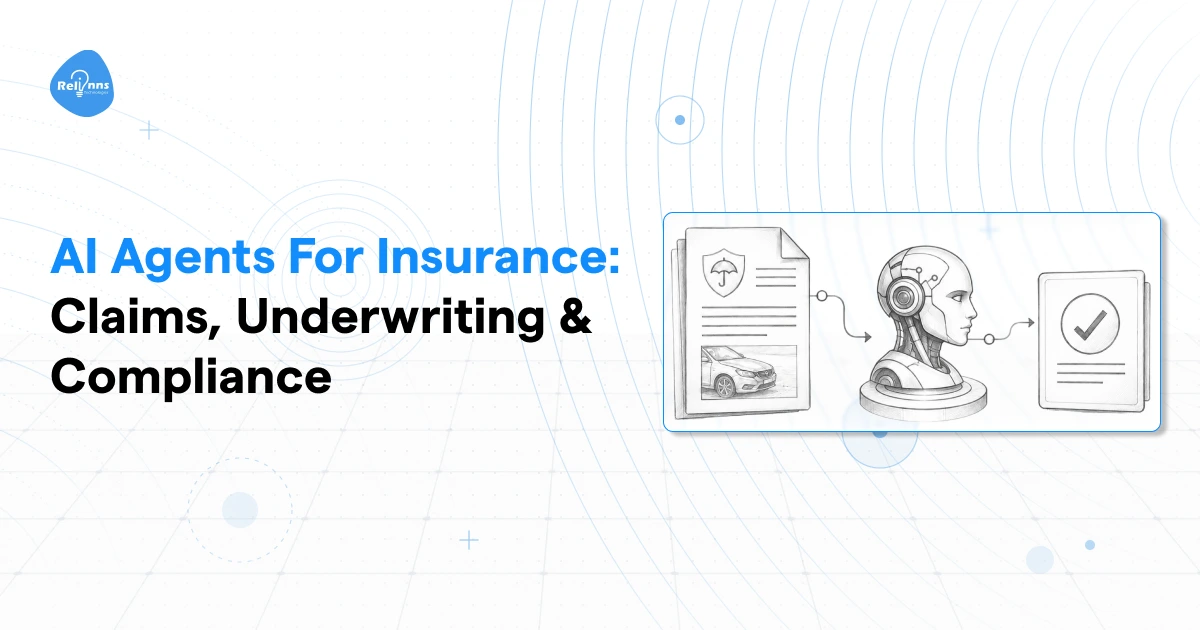
AI Agents for Insurance: Claims, Underwriting & Compliance
Date
Sep 23, 26
Reading Time
8 Minutes
Category
AI Agents
Share


TL;DR
- AI agents are best suited to insurance workflows that require document interpretation, contextual reasoning, several systems, and controlled decisions.
- Core applications include claims triage, underwriting preparation, fraud investigation support, policy servicing, and document-based administrative work.
- Agents can retrieve approved data, interpret documents, compare information, use connected tools, recommend permitted actions, and escalate exceptions.
- Claims outcomes, underwriting judgment, fraud conclusions, and other sensitive decisions should remain under appropriate human authority.
- Compliance depends on data access, permissions, auditability, privacy controls, governance, integrations, infrastructure, and human oversight.
- Low code automation fits structured and predictable insurance workflows, while AI voice agents fit processes centered on phone conversations.
- Start with one narrow workflow and limited permissions before expanding an agent's responsibility.
Insurance teams already automate forms, approvals, and routine processing, but many workflows still depend on context. Claims staff must read documents, compare policy language, review supporting evidence, identify unusual patterns, and coordinate information across several systems.
This is where fixed rule automation becomes limited. AI agents for insurance can reason over documents, retrieve permitted data, use connected systems, and prepare cases for human review within defined controls.
This article focuses on custom insurance AI agents, while predictable forms and approval processes may fit low code automation better.
What AI Agents Do in Insurance Beyond Workflow Automation
Traditional workflow automation works well when inputs are structured, rules are known, and decision paths stay predictable. Insurance processes become harder to automate when documents, context, exceptions, and several possible next actions determine what should happen.
Workflow automation usually follows predefined conditions. An insurance AI agent can interpret information and determine the next permitted step within defined controls.
An agent can work with:
- Unstructured claim documents
- Policy language
- Medical and supporting documents
- Adjuster notes
- Emails and attachments
- Images and supporting evidence
- Several possible next actions
- Context-dependent decisions
Based on its assigned permissions, the agent can:
- Understand the workflow objective
- Retrieve permitted policy and customer data
- Read and classify documents
- Compare information across several sources
- Apply defined business rules
- Use connected tools and APIs
- Flag missing or conflicting information
- Recommend the next permitted action
- Request human approval
- Escalate exceptions
- Record actions for later review
Consider claims triage. An agent could receive claim documents, identify the claim type, retrieve relevant policy information, and check whether required evidence is present.
It could flag missing information, assign a priority based on approved criteria, and route the case to the appropriate reviewer.
The agent does not need unrestricted authority to provide value. Its role can stop at analysis, preparation, recommendation, or routing whenever human judgment is required.
Insurers building workflows with custom reasoning, integrations, permissions, and approval controls can consider AI agent development services for implementation support.
High Value Insurance AI Agent Use Cases
The strongest insurance use cases involve large document volumes, several data sources, and decisions that depend on context. AI agents can prepare, analyze, and route this work while keeping final authority with the appropriate insurance professional.
Claims Triage Agents
Claims teams often receive information in different formats and from several sources. A claims triage agent can organize that material before an adjuster begins detailed review.
It can:
- Receive and classify incoming claims
- Identify the claim type
- Check required fields and documents
- Detect missing supporting evidence
- Retrieve permitted policy information
- Assign priority using approved criteria
- Route exceptions to the correct team
- Escalate complex cases to a human adjuster
The agent supports triage and preparation. It should not independently approve or deny complex claims that require professional judgment.
Underwriting Support Agents
Underwriting depends on accurate information, supporting documents, risk context, and defined guidelines. An underwriting agent can prepare this information before a qualified reviewer makes the final decision.
It can:
- Collect applicant information from approved sources
- Retrieve permitted customer and policy data
- Review submitted documents
- Identify missing inputs
- Summarize relevant risk information
- Compare information against underwriting guidelines
- Prepare cases for underwriter review
This reduces repeated information gathering while keeping final underwriting authority with qualified professionals where required.
AI Agents for Fraud Detection
AI agents for fraud detection can help investigation teams identify cases that deserve closer review. Their role is to surface risk indicators, not determine that fraud has occurred.
An agent can:
- Compare claim information across connected systems
- Identify conflicting or unusual details
- Review document patterns and supporting evidence
- Check relevant historical context
- Flag suspicious combinations of information
- Prioritize cases based on approved risk criteria
- Route flagged cases to investigators
This helps investigators focus attention on cases with stronger risk signals while preserving human judgment throughout the investigation.
Policy Servicing Agents
Policy servicing often requires retrieving policy information, checking requirements, coordinating documents, and updating several systems.
A servicing agent can:
- Retrieve current policy information
- Check servicing requirements
- Process permitted policy changes
- Coordinate required documents
- Update authorized systems
- Route exceptions for review
- Prepare renewal and servicing tasks
When servicing happens mainly through phone conversations, AI voice agents for insurance are better suited to that interaction layer.
These use cases become custom development requirements when several systems, document types, permissions, business rules, and approval stages must work together.
Compliance and Governance for Insurance AI Agents
Insurance AI can influence claims, underwriting, policy servicing, financial decisions, and sensitive customer records. That makes governance part of the system architecture.
Controls should determine what the agent can access, what it can do, and when human authority must take over.
Data Access and Privacy
An insurance agent should receive only the information required for its assigned workflow.
Teams should define:
- Which customer records it can access
- Which claims information it can process
- Whether financial or sensitive personal data is involved
- Where information is stored
- How data moves between connected systems
- How long information is retained
- Which vendors or external services can access it
These rules should reflect the privacy and security requirements that apply to the organization and processing activity.
Permission Boundaries
Permissions should be defined at the action level rather than giving the agent broad system access.
Each action should specify whether the agent can:
- Read information
- Analyze data or documents
- Create records
- Update existing information
- Send information
- Recommend an action
- Approve an action
- Never perform the action
Actions involving financial impact, claim outcomes, sensitive policy changes, or customer rights should have stricter controls.
Auditability
Insurance organizations should be able to reconstruct important agent activity.
Audit records should show:
- What information the agent accessed
- Which documents it reviewed
- Which systems or tools it used
- What action it performed
- What recommendation it generated
- Who approved or changed the action
- When each step occurred
This makes automated workflow actions easier to review and investigate.
Human Oversight
Human review should remain available or mandatory for ambiguous claims, underwriting judgment, suspected fraud, sensitive policy changes, regulatory exceptions, and cases outside approved rules.
The agent can prepare information, recommend actions, and route cases. Final authority should remain with qualified professionals where judgment or regulation requires it.
GDPR and PDPL Requirements
GDPR or PDPL may apply depending on customer location, data processing activity, storage, and organizational responsibilities.
Insurers should assess applicable privacy obligations before deployment. Requirements may differ according to jurisdiction, the information being processed, and the organization's role in that processing.
Organizations operating in the EU should also understand the EU AI act for AI agents and how its requirements may affect deployment.
For deeper guidance on permissions, monitoring, safeguards, and governance, read AI agent security and governance.
Custom AI Agents for Insurance vs Low Code Automation vs Voice Agents
Insurance teams should choose technology based on workflow behavior, not category labels. The key questions are whether the process needs reasoning, whether information is structured, and whether the main interaction happens through spoken conversations.
| Choose This | When It Fits Best | Insurance Workflows |
|---|---|---|
| Custom AI Agent | The workflow requires reasoning, unstructured documents, several systems, custom permissions, or human approval | Claims triage, underwriting support, fraud investigation support, complex policy servicing |
| Low Code Automation | The process follows predictable rules, forms, approvals, and structured inputs | Internal approvals, structured KYC workflows, renewal workflows, document routing |
| AI Voice Agent | Spoken interaction is the main interface | Claims calls, policy servicing calls, renewal conversations, customer support |
What to Choose for Common Insurance Requirements
The workflow requirement usually makes the right choice clearer.
| Requirement | Best Fit |
|---|---|
| Read and interpret claim documents | Custom AI Agent |
| Support underwriting across several data sources | Custom AI Agent |
| Flag fraud indicators from contextual data | Custom AI Agent |
| Coordinate several insurance systems | Custom AI Agent |
| Structured approval workflow | Low Code |
| Predictable policy renewal workflow | Low Code |
| Customer claims calls | AI Voice Agent |
| Policy servicing calls | AI Voice Agent |
Custom agents make the most sense when document interpretation, contextual reasoning, integrations, permissions, and human review must work together.
When customer interaction happens mainly by phone, AI voice agents for insurance are the better fit.
If neither structured automation nor voice alone can handle the workflow, custom agent development is usually the next option.
How to Build an Insurance AI Agent
Building an insurance AI agent should begin with one clearly defined workflow. Starting narrow makes permissions, data access, system connections, evaluation, and human responsibility easier to control before the agent receives broader operational authority.
Define One Insurance Workflow
Avoid goals such as automating claims. Define the exact process the agent will support.
Document:
- What triggers the workflow
- Which inputs and documents are required
- Which systems are involved
- Which decisions occur
- What actions the agent can perform
- Where human responsibility begins
- Which exceptions require escalation
- How success will be measured
A focused workflow also makes testing more meaningful.
Map Documents and Data Sources
Identify every information source the agent needs before granting access.
This may include:
- Claims documents
- Policy information
- Customer records
- Underwriting guidelines
- Supporting evidence
- Internal knowledge
- Historical records
Each source should have a clear purpose within the workflow. Unnecessary access increases governance and security risk.
Define Agent Permissions
Every action should have an explicit permission level.
Classify actions as:
- Read only
- Automatically permitted
- Recommendation only
- Human approval required
- Restricted
Sensitive claim outcomes, underwriting decisions, fraud conclusions, and high impact policy actions should remain under appropriate human authority.
Connect Insurance Systems
AI agent development for insurance often requires controlled access across several applications.
Relevant systems may include:
- Claims platforms
- Policy administration systems
- CRM systems
- Document repositories
- Underwriting systems
- Fraud systems
- Internal databases
- Relevant APIs
Authentication, permissions, logging, and failure handling should be defined for every connection.
Build Evaluation and Exception Handling
Testing should cover normal cases and conditions where the agent cannot continue safely.
Evaluate:
- Missing documents
- Conflicting information
- Incorrect data
- Failed integrations
- Unsupported requests
- Ambiguous cases
- Unauthorized actions
- Escalation paths
The agent should stop or request human review when required information or authority is missing.
Start With a Controlled Proof of Concept
Begin with limited permissions and one measurable workflow.
Track task completion, accuracy, escalation rate, failure rate, processing time, human correction rate, and compliance exceptions.
Expand responsibility only after the workflow performs reliably within approved controls.
Frequently Asked Questions
Insurance teams evaluating AI agents usually need clarity on practical use, governance, decision authority, and build choices. These questions address the main issues buyers should resolve before moving from exploration to implementation.
What are AI agents used for in insurance?
AI agents support claims triage, underwriting preparation, fraud investigation support, policy servicing, document handling, and administrative coordination. They can retrieve approved information, interpret documents, compare records, prepare recommendations, route exceptions, and coordinate systems while keeping sensitive decisions under appropriate human control.
How is an AI agent different from low code workflow automation?
Low code automation follows predefined rules, forms, conditions, and structured process paths. An AI agent can interpret unstructured information, understand context, select permitted next actions, coordinate tools, and work across connected systems. Low code fits predictable workflows better, while agents suit reasoning-intensive processes.
Can AI agents help with claims and underwriting?
Yes. AI agents can collect information, review documents, validate required inputs, summarize relevant findings, identify inconsistencies, and prepare cases for adjusters or underwriters.
They can support decision preparation, but final claims outcomes and underwriting decisions should remain with authorized professionals where judgment or regulation requires it.
Are insurance AI agents compliant?
Compliance depends on the complete implementation, not on the agent alone. Insurers need appropriate data handling, permissions, auditability, infrastructure, integrations, governance, security controls, and human oversight.
Applicable requirements may also vary by jurisdiction, customer location, data type, and the specific insurance workflow involved.
Should we build a custom insurance AI agent or use a platform?
The choice depends on workflow complexity and control requirements. Custom development is more effective when insurers need proprietary integrations, document reasoning, specific permissions, custom logic, detailed governance, or coordination across multiple internal systems.
Teams researching for AI agent platforms built for financial compliance can also compare platforms based on governance, integrations, and control requirements.
Platforms may fit standardized workflows where existing capabilities already match operational requirements.
Final Verdict
The strongest insurance AI agent use cases are workflows where employees must interpret documents, gather information from several systems, apply context, and route exceptions before work can continue.
Custom agents can support these processes by combining document reasoning, controlled system access, workflow logic, and human review. Greater autonomy also increases the need for clear permissions, auditability, governance, and defined escalation rules.
Relinns focuses on custom insurance AI agent development for organizations that need agents built around existing systems, specific business rules, document workflows, and controlled decision processes.