Human in the Loop AI Agents: What It Means and How It Works
Date
Oct 27, 26
Reading Time
11 Minutes
Category
AI Agents
Share


40% to 25%. That's how far the share of organizations requiring human review before high-risk AI actions fell in six months.
Meanwhile, agents running fully autonomous, no review at all, more than doubled: 11% to 26% (JumpCloud, Q3 2026 IT Trends Report). Teams are handing agents write access faster than they're building oversight.
Gartner sees where this ends. It predicts more than 40% of agentic AI projects get cancelled by the end of 2027, and inadequate risk controls are named as one reason (Gartner press release, June 25, 2025).
Here's the actual problem. An agent that drafts an email is a different risk class from one that sends it, moves money, or edits a record on its own. That's the gap where human-in-the-loop for AI agents needs to live.
This piece maps where that approval checkpoint sits, when to trigger it, and how to tell a real one from theater.
The pause has an exact spot in an agent's execution, and most teams put it in the wrong place.
What Does Human in the Loop Mean for an AI Agent?
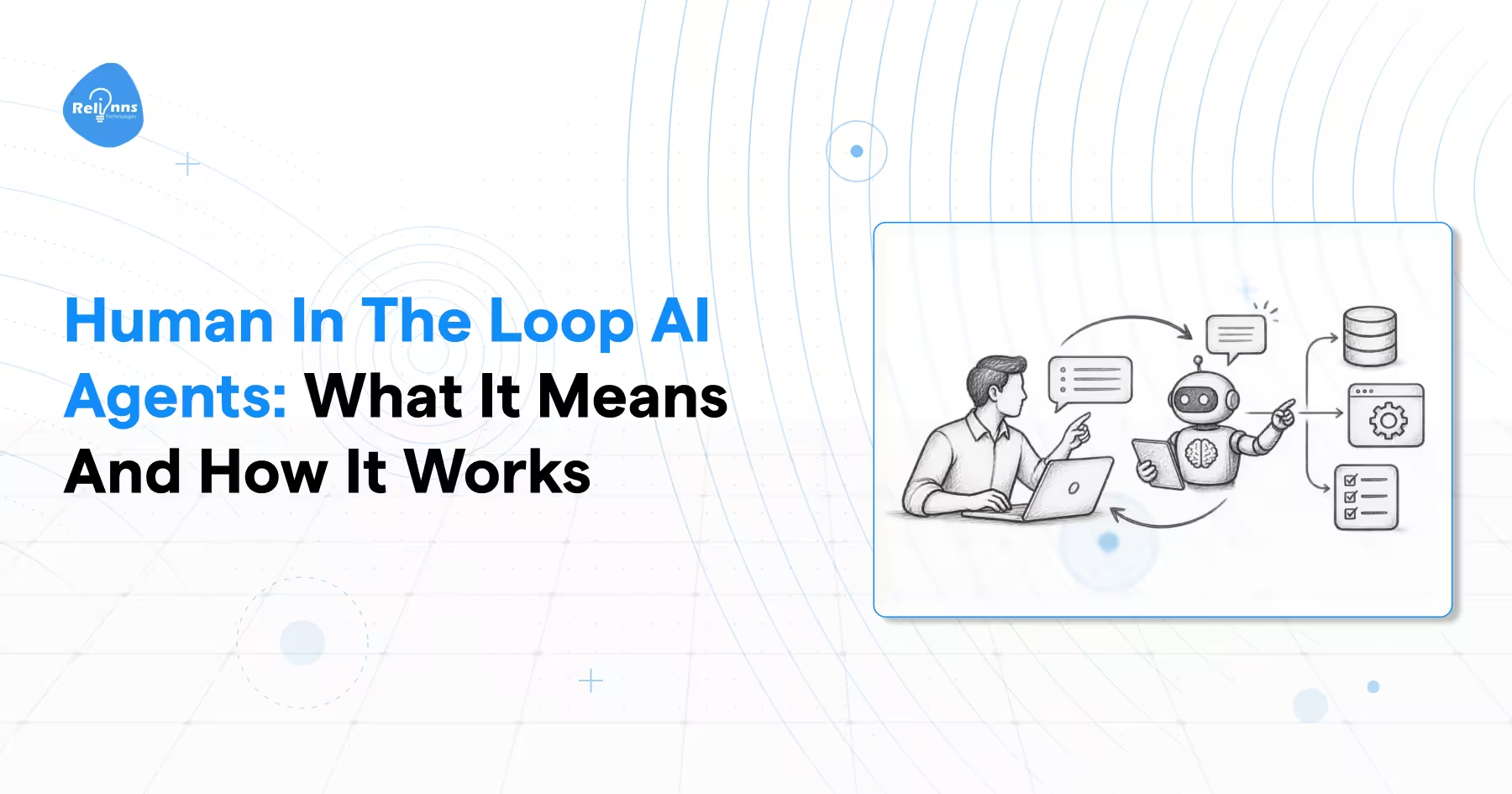
An AI agent with human in the loop runs on its own until it hits an action that needs a person, then it stops, saves its exact state, and waits. Someone approves, edits, or rejects before it moves again. IBM defines HITL as a human actively taking part in the operation, supervision, or decision making of an automated system. That's the whole idea, in one line.
Think cruise control, not autopilot. The agent drives. It hands you the wheel the second conditions get risky. It's not running the whole trip blind, and it's not asking you to steer every single turn either.
Here's the part most teams get wrong: the approval checkpoint has to sit between the agent deciding to call a tool and the tool actually executing. Not before. Not after. That gap is the whole design.
And the state has to be saved, properly. A person might approve in four minutes or four days. If the agent's memory disappears the moment the process restarts, you don't have a loop, you have a dropped task. LangChain's own docs are blunt about this: HITL needs the graph compiled with a checkpointer, and skipping that is the single most common reason beginner HITL code breaks.
Here's what that looks like in practice. A support agent drafts a $4,000 refund. It holds. A person clicks approve. The refund fires.
Expert Tip: If your "human in the loop" is just an engineer watching logs in a terminal, you don't have a loop. You have a person who happens to be awake.
Three different things get called human oversight, and picking the wrong one is how teams end up with a bottleneck they never budgeted for.
Human in the Loop vs Human on the Loop vs Human in Command
These three get used like synonyms. They're not. The difference comes down to when the human acts.
Human in the loop means the agent cannot finish without you. Human on the loop means the agent finishes on its own and you watch, stepping in only when something looks wrong. Human in command means you set the policy upfront, decide what the system is even allowed to run, and can pull that permission later. The EU AI Act's Article 14 asks for the capability to intervene and halt. Not a review of every single decision.
| Human in the loop | Human on the loop | Human in command | |
|---|---|---|---|
| When you act | Before the action | While it runs | Before deployment, and after |
| Agent can complete alone | No | Yes | Yes |
| Best for | Irreversible, regulated, high value | Fast, reversible, high volume | Policy and risk ownership |
| Real example | Clinician signs off before an order enters the EHR | Fraud analyst watching a dashboard of automated blocks | Compliance team approving what the agent can touch |
| Fails when | Volume outruns reviewers | The human has no time to act | Nobody re-checks the policy |
Two mix-ups worth killing right now. RLHF is not HITL. RLHF happens at training time, shaping the model before it ever ships. HITL is a runtime control, active while the agent works. People conflate these constantly, and it's wrong every time.
And plenty of systems labeled human in the loop AI agents are actually running backwards: AI in the loop, where the human decides, and the AI just recommends. One test cuts through it: who actually holds decision authority?
The Stanislav Petrov case is the permanent warning about "on the loop." Oversight only counts if the human has time to use it.
Once you know which posture you need, the next question gets mechanical: where in the agent's code does it actually stop?
Where Does the Agent Actually Pause?
Four spots, and that's it. Before the tool runs (a pre-action gate), after it runs (a post-action audit), only when the model's own uncertainty crosses a line (confidence-gated), or dropped into a queue someone works through later (async review). The pre-action gate is what most production systems actually use. It's built as a durable interrupt, meaning the agent's state gets written to a database, not held in memory somewhere waiting to vanish.
Here's how the four stack up:
| Pattern | Agent behavior | Use when | Cost |
|---|---|---|---|
| Pre-action approval gate | Proposes the tool call, halts, waits | Action is irreversible or high value | Latency on every gated action |
| Post-action review | Executes, logs, gets sampled later | Action is reversible and low stakes | Errors reach production first |
| Confidence-gated interrupt | Halts only when uncertainty crosses a threshold | Mixed risk, high volume | Only as good as your calibration |
| Async review queue | Proposal sits in a queue | Nothing is time-critical | Needs durable state, drifts stale |
And the frameworks handle this differently enough that picking one matters:
| Framework | Mechanism | Note |
|---|---|---|
| LangGraph | interrupt() plus Command(resume=...), needs a checkpointer | On resume, the whole node re-runs, so put side effects after the interrupt |
| Temporal | Workflow waits on an external Signal, durable timers survive crashes | Persists the whole system, not just the graph. Make signal handlers idempotent |
| AWS Bedrock Agents | User confirmation and return of control; AgentCore adds temporal policies at the gateway | Policies sit outside the agent, so the agent can't edit its own rules |
| CrewAI / AutoGen | human_input=True on a task; human_input_mode on a UserProxyAgent | Simplest to start, weakest for long waits. Teams end up writing custom wrappers |
Expert Tip: Ask "how long can this agent wait?" before you pick a framework. A four-hour wait is a database problem, not a prompt problem.
All four patterns share one assumption: that the person on the other end of the approval checkpoint is actually reading carefully, not just clicking approve on autopilot. That assumption is where most human-in-the-loop AI agent setups quietly fall apart.
Why Does Adding a Human Approval Step Still Fail?
Here's the uncomfortable part. The better your agent gets, the worse your human approval checkpoint performs. In a study of 27 radiologists reading 50 mammograms, inexperienced readers were right 79.7% of the time when the AI was right, and only 19.8% right when it was wrong. Very experienced readers fell too, from 82.3% down to 45.5% (Dratsch et al., Radiology, May 2023). The real question was never "is there a human in the loop." It's whether that human can actually catch a mistake in time.
Most teams assume an approval button transfers accountability to whoever clicks it. It doesn't.
Human approval can catch risky actions, but it cannot compensate for flawed reasoning, unreliable tool calls, or missing safeguards across the agent's workflow. Understanding why AI agents fail helps teams identify these underlying weaknesses instead of relying on human review to catch every mistake.
Automation bias isn't something you train away. Experience slowed the decline in that radiology study. It didn't stop it. Parasuraman and Manzey tied this to attention back in 2010: when a system is usually right, people stop genuinely checking. Bainbridge flagged the same trap in 1983, decades before agents existed.
The math doesn't scale gracefully either; it just breaks. Fifty agents making twenty tool calls an hour is 1,000 gate-eligible events an hour. Route even 10% of those to a human and you need roughly 100 approvals an hour, close to three full-time people doing nothing but clicking approve. Treat that as a rough model, not a measured figure.
And approval fatigue is now an attack surface. Malicious instructions embedded in user inputs or retrieved content can manipulate an agent's behavior, making AI agent prompt injection another security risk teams need to account for. Separately, a recent DeepMind paper on agent traps found that dense, benign-looking summaries can be engineered to push a human straight into approving something malicious, with reported success rates over 80% across five agent platforms.
Then there's the one nobody talks about: the stale world model problem. The approval sits in a queue while the world keeps moving. Someone updates the row, a file changes, a permission gets pulled. The human approves at 2 pm an action the agent reasoned about at 10 am, and it overwrites fresh data with a stale premise. The fix is boring, but it works: re-check the target resource right before the write fires, and abort if anything changed.
We took a governance model built for rare, careful human judgment and pointed a firehose at it.
Klarna's AI assistant handled 2.3 million conversations in its first month and cut resolution time from 11 minutes to under 2. Over a year later, its CEO admitted the cost-cutting had gone too far. The automation didn't break. The handoff to a human did.
If you can't review everything, the real job is picking what actually deserves a human on the loop. That comes down to four questions.
How Do You Decide Which Decisions Need a Human?
Gate an action if any one of four things is true. It's irreversible. The agent has write access to production or money. The consequence matters to a customer or a regulator. Or the situation is one the agent hasn't seen before. Stripe Radar's own thresholds show what this looks like in practice: scores of 65 and up get routed to manual review, 75 and up get blocked automatically, no human needed.
Effective AI agent security requires defining which actions an agent can perform autonomously, which require human approval, and which must be blocked by policy. This is particularly important when agents can modify production systems, initiate payments, or perform other high-impact actions.
Run every action through this before you build anything:
- Is it irreversible? Payments, deletions, deployments, config changes.
- Does the agent have write access to production systems or money?
- Is the outcome material to a customer or a regulator?
- Is this novel, outside what the agent has actually seen before?
Yes to any one of these means it goes behind a gate. No to all four, and monitoring is probably enough.
Here's the sharpest idea in this whole piece: if a tired human can't realistically catch the mistake, don't gate the action. Block it. Spend caps, allow lists, gateway policies, these stop the entire class of action before it's even a decision. A gate nobody can meaningfully read is worse than no gate at all, because it just manufactures a paper trail of consent nobody actually gave.
And don't trust confidence scores blindly. A model's stated confidence is a generated token, not a real probability. One post-mortem found a model claiming 0.9 confidence was actually right 64% of the time, and an "escalate below 0.5" rule almost never fired because the model rarely dipped under 0.7. Calibrate against a labeled holdout set first. Semantic entropy is the better peer-reviewed approach here.
| Sector | Agent handles | Human decides |
|---|---|---|
| Customer support | Common queries, context summary, handoff packet | Anything escalated, or sensitive accounts. Roughly 20-30% of contacts need a person |
| Insurance claims | Clean claims within authority, evidence pre-assembled | Total loss disputes, injury severity, bad faith exposure |
| Fraud and AML | Scoring and alert triage | SAR consideration. The boundary stays human, never automated filing |
| Healthcare | Draft notes, prior auth, coding suggestions | Every write-back to the record |
Picking the right gates is half the job. The other half is proving your reviewers are actually reviewing, not just clicking through.
How Do You Know Your Oversight Is Real and Not a Rubber Stamp?
Watch the reviewers, not the model. The clearest warning sign is approval latency sitting near zero and staying flat across every decision, because real reading time should move depending on what's being decided. And when override rates trend toward zero while errors keep slipping through, that's not the agent getting better. That's automation bias, plain and simple.
| Metric | What it tells you | Red flag |
|---|---|---|
| Escalation rate | Are your approval checkpoints firing sensibly | Very low means the trigger never fires. Very high means it's just noise |
| Override rate | Model and reviewer alignment | Near zero alongside rising errors means rubber-stamping |
| Approval latency distribution | Whether people are actually reading | Flat and near zero across all complexity levels |
| Time to human response | Whether the queue is real | Growing backlog, abandoned items |
| Override pattern drift | Early signal of model or data shift | Reviewers suddenly correcting a new category |
| HITL necessity rate | Share of escalations that genuinely needed a person | Below 15% means you're interrupting people for nothing |
Two things worth doing. Slip deliberate, subtle defects into the review queue at random. If a reviewer approves a known canary, that's your agent kill switch moment; pull their session and flag fatigue. It's the only test on this list that actually tests the human. Second, kill one-click bulk approval. Make reviewers open the diff, tag what's affected, write one line before the lock releases.
For traces: LangSmith if you're LangGraph-native, Langfuse for open source and self-hosted, Arize Phoenix if you need framework-agnostic drift detection.
If your team is building agent oversight into a system that's still taking shape, that's the kind of design work we do at Relinns. Worth a conversation before the gates get bolted on after the fact.
Some of these controls aren't optional anymore. Regulators are starting to name automation bias directly in statute.
What Do Regulators Actually Require?
The capability to oversee. Not review of every single decision. EU AI Act Article 14 requires high-risk systems to be built so a person can understand their limits, stay aware of automation bias, read the output, override or ignore it, and halt the whole system with a stop button. That's it. It does not say a human has to sign off on every output the system produces.
A lot of posts on this get it backwards. Article 14 is about capability, not universal sign-off.
The five things a system has to support:
1. Understand the system's limits
2. Stay aware of automation bias
3. Correctly interpret the output
4. Disregard or override the output
5. Halt the system entirely
The statute names automation bias directly, which is rare for a regulation to do. Worth sitting with that for a second.
A few things worth knowing. Biometric identification needs two-person verification under Article 14, with carve-outs for law enforcement and migration. Credit scoring counts as high risk under Annex III, and in the US, adverse action reason codes have to stay specific no matter how complex the model gets. NIST's AI RMF (Govern, Map, Measure, Manage) is voluntary but fast becoming the US default, and banks already answer to SR 11-7 on top of it.
One thing to verify before you quote it anywhere: reporting suggests the EU's human oversight deadline for high-risk systems may be pushed toward December 2027. Treat that as a later date, not a reason to wait on building this.
Compliance tells you what you have to be able to do. It won't tell you how to expand autonomy without breaking something.
How Do You Expand Agent Autonomy Without Breaking Things?
Move up a ladder. One level at a time, and only when your own numbers back the promotion, not gut feeling. Start in shadow mode, where the agent proposes and a person still executes everything. Widen the boundary category by category as reviewer agreement data holds up. Every level has a number you clear before you move to the next one.
| Level | Pattern | Who acts | Clear this before promoting |
|---|---|---|---|
| 1 | AI suggests, human acts | Human executes everything | Suggestion acceptance rate holds on a real sample |
| 2 | AI acts, human confirms | Agent queues, waits for sign-off | Zero missed catastrophic errors, override rate stabilizes |
| 3 | AI acts, human intervenes | Agent executes, operator monitors | Automated checks pass, rollback proven to work |
| 4 | AI acts, human audits | Agent runs, humans sample batches | Post-audit defect rate under target |
| 5 | Full task autonomy within policy | Agent sets sub-goals inside bounded rules | Continuous verification under changing conditions |
Three things worth doing on the way up. Run shadow mode first, agent recommends, human executes, everything logged. Replay the agent against past human decisions before it ever touches write access. And auto-approve the long tail: if you've approved the same low-risk action fifty times, that gate isn't oversight anymore, it's theater. Classify it and let it through.
If sustained approval volume crosses roughly 30 to 50 meaningful reviews per person per hour, your gate is already decaying. Tighten the autonomy policy. Don't just hire more reviewers.
The questions left are the ones that come up in every implementation review.
FAQ
What is the difference between human in the loop and human on the loop?
Human in the loop means the agent stops and waits for approval before it acts. Human on the loop means the agent acts first and a person watches, stepping in only when something looks wrong. The difference comes down to timing, before the action or during it.
Is human in the loop the same as RLHF?
No. RLHF happens during training and shapes the model before it ever ships. Human in the loop is a runtime control, active while the agent works in production. Mixing the two up is one of the most common mistakes people make with this topic.
What is an agent kill switch and does the EU AI Act require one?
An agent kill switch is a stop button that halts the whole system, not just one action. The EU AI Act's Article 14 requires this halt capability for high-risk systems, though it doesn't require a human to review every individual decision.
How much of an agent's work should route to a human?
There's no fixed number. Route an action to a person if it's irreversible, touches production or money, matters to a customer or regulator, or the situation is genuinely new. Everything else can run under monitoring instead of a hard gate.
Does human in the loop slow the agent down?
Yes, on whatever it gates, because waiting on a person adds latency by design. The fix isn't ripping the check out. It's narrowing what actually gets gated so only the actions that need a person get held up.
Where This Leaves You
The real question was never whether a human sits somewhere in the loop. It's whether that person can catch the mistake before it ships, and you won't know that from a vendor's benchmark. You'll know it from your own override rates, your own approval latency, your own escalation numbers.
Monday, pick the riskiest thing your agent can do. Decide right there whether it deserves a gate or a hard block. Then start logging how long people actually take to approve it.
If you're building this into an agent that's still taking shape, Relinns works on exactly this kind of oversight architecture. Worth a conversation before the gates get bolted on after the fact.