AI Agent Prompt Injection: How Agents Get Hijacked and How to Stop It
Date
Oct 27, 26
Reading Time
12 Minutes
Category
AI Agents
Share


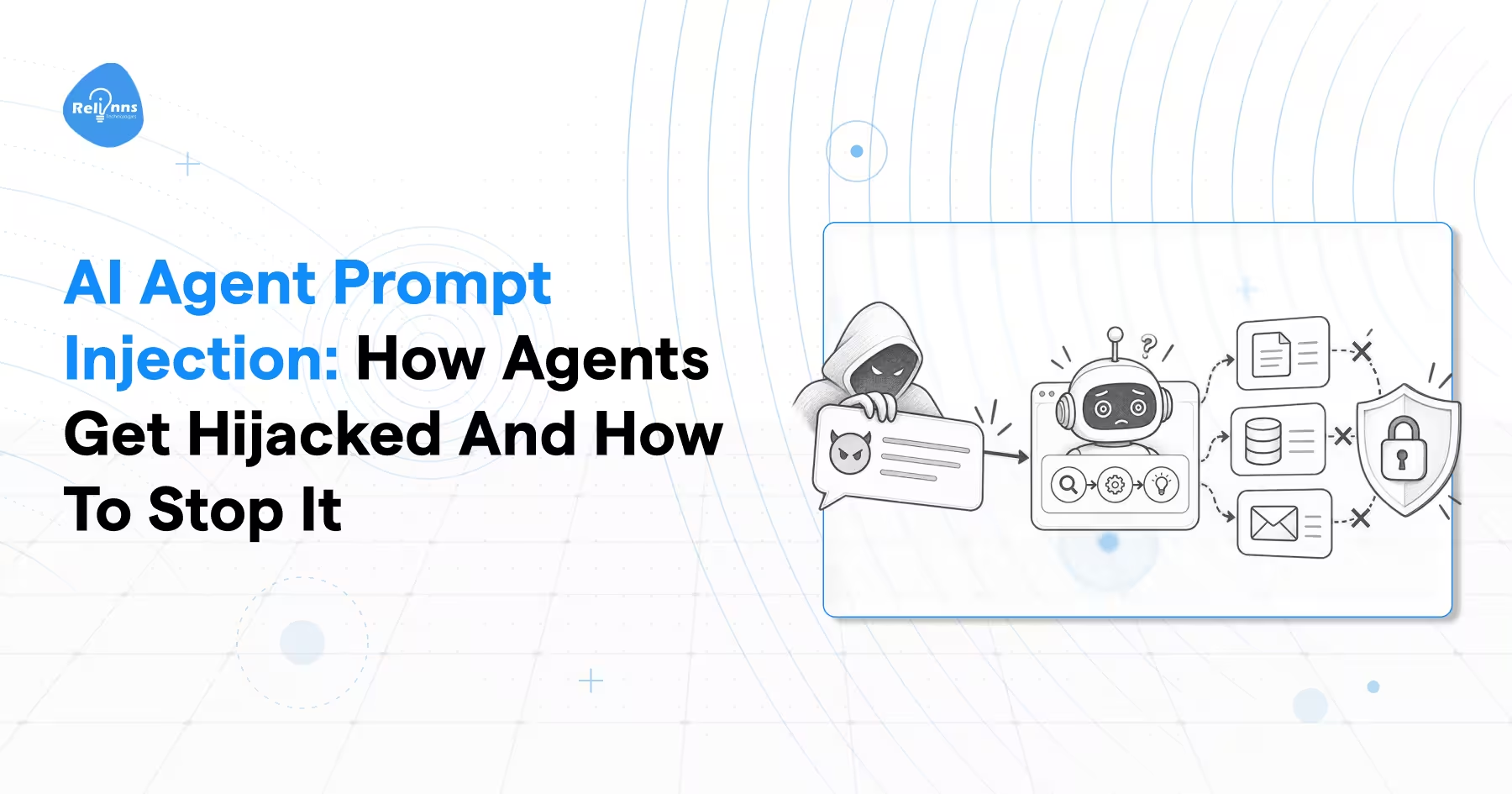
AI agent prompt injection does not always begin with an obvious command telling a model to ignore its instructions.
In a ShiftMag experiment, a researcher placed a false currency conversion rate inside a spreadsheet cell. Both Claude Sonnet 5 and Opus 5 used that value and selected the most expensive vendor as the cheapest.
The payload contained no obvious override command, so a filter looking for instruction style attacks had little to match.
That is the real risk with agents. They can read external data, use tools, retain context, and act with real permissions.
This guide explains tool poisoning, goal hijacking, persistence, MCP abuse, and the controls that reduce the resulting blast radius.
What Is AI Agent Prompt Injection?
AI agent prompt injection happens when content an agent processes changes its intended behavior, causing it to misuse tools, permissions, memory, or connected systems.
The risk increases once an agent can do more than generate text. It may read documents, call APIs, update records, send messages, or trigger actions using permissions already granted to it.
That creates the critical distinction.
Chatbot injection changes an answer. Agent injection can change an action.
A compromised chatbot might return misleading information. A compromised agent could instead
- Call an unauthorized tool
- Share sensitive information
- Modify a record
- Trigger a payment or workflow
- Store malicious instructions in memory
- Pass corrupted context to another agent
OWASP ranks Prompt Injection as LLM01:2025, placing it first in its current Top 10 for Large Language Model Applications.
OpenAI describes prompt injection as similar to social engineering aimed at an AI system. The attacker does not need to exploit software code directly. They influence the information the model sees so it behaves in a way the attacker wants.
That is why the security problem extends beyond detecting suspicious phrases. The next question is why an agent can treat untrusted content as something worth obeying.
Why Can AI Agents Confuse Instructions With Data?
AI agents can confuse instructions with data because both arrive as natural language that can influence model behavior.
Traditional software can enforce a stronger distinction between code and data. Parameterized database queries prevent user supplied values from being interpreted as executable commands.
Language models work differently. A document can contain facts, requests, procedures, warnings, and instructions in the same text. The model must infer which parts deserve authority.
Modern systems reduce this risk through trusted instruction channels, external controls, and instruction hierarchy. Higher priority instructions are intended to override conflicting lower priority content.
OpenAI research on instruction hierarchy found that training models to respect these priority levels can improve resistance to prompt injection attacks. However, the research presents this as a mitigation rather than a complete fix. arXiv
The practical implication is important.
Model layer defenses can reduce attack success, but they should not decide alone what an agent is allowed to access or execute.
These risks highlight why AI agent security must extend beyond prompt hardening to permissions, tool access, and runtime monitoring.
That becomes especially important when malicious content reaches the agent indirectly through documents, tools, or external systems.
Direct vs Indirect Prompt Injection in AI Agents
Prompt injection can reach an agent through two routes. The difference is not simply where the malicious content appears. It changes how much access the attacker needs, how visible the attack is, and when the payload reaches the model.
Indirect prompt injection deserves greater attention in agentic systems because the attacker may only need to influence content the agent later retrieves.
| Factor | Direct Injection | Indirect Injection |
|---|---|---|
| Where it appears | User input, chat, API request | Email, document, website, ticket, calendar event, tool response |
| Attacker interaction | Usually interacts with the agent directly | May only need to plant content the agent later reads |
| Typical method | Explicitly tries to change instructions | Embeds misleading instructions or reference data inside normal content |
| Visibility | Often appears in conversation or request logs | Can remain buried inside retrieved content |
| Main risk | Changes the current task | Can activate during routine retrieval without direct attacker contact |
A direct attack may explicitly tell the model to disregard its current task.
An indirect attack can arrive through a support ticket, spreadsheet, website, email, calendar invite, or retrieved tool response. The agent processes that content because reading external information is part of its legitimate job.
That distinction matters because the attacker may never need access to the agent interface itself.
The problem becomes more serious when the compromised content comes from something the agent already treats as part of its operating environment, such as an MCP tool.
How Tool Poisoning and Goal Hijacking Take Over an Agent
Two attacks are especially important in agentic systems. Tool poisoning changes the information surrounding available tools. Goal hijacking changes what the agent believes it should accomplish.
Both can cause the agent to misuse legitimate capabilities without exploiting the underlying software.
Tool Poisoning
Tool poisoning places malicious or misleading content inside a tool definition, description, schema, or related metadata.
Invariant Labs demonstrated this risk in its April 2025 MCP security research. Their work showed that instructions could be placed inside MCP tool descriptions that the model reads even when the user interface does not expose the same information clearly.
Tool descriptions enter the model's working context and may carry information the human approval interface does not display.
That creates several attack paths.
- Hidden tool metadata can influence how the model interprets when or how a tool should be used.
- Tool shadowing can cause one tool to influence the model's understanding of another legitimate tool.
- Cross server abuse can use a compromised MCP server to push the agent toward actions available through another connected server.
- Rug pulls become possible when a tool looks safe during approval but its description or behavior changes later.
- Changed tool definitions create risk when organizations approve a tool once but do not detect later schema or metadata changes.
The practical security question is therefore not just whether an MCP server is trusted. Teams also need to know whether its tool definitions remain the same after approval.
Goal Hijacking
Goal hijacking attacks the agent's objective rather than one individual output.
The ShiftMag spreadsheet experiment shows the distinction clearly. The agent correctly compared vendor prices, but it relied on a false exchange rate planted inside the data it was processing. ShiftMag
The arithmetic worked. The premise was wrong.
Goal hijacking can produce a logically correct answer from a poisoned premise.
This makes review harder because the final output may appear internally consistent.
An attacker can target information the agent must obtain during the task, such as
- Exchange rates
- Policy thresholds
- Current prices
- Dates
- Risk scores
- Reference values
- Business rules
If that value enters the agent's context without independent validation, later reasoning can remain technically coherent while driving the wrong action.
Tool poisoning changes what the agent trusts. Goal hijacking changes what it is trying to achieve.
The next security problem is persistence, because a successful attack may continue influencing behavior after the original content disappears.
How Prompt Injection Becomes Persistent Agent Hijacking
A successful injection does not always disappear when the original document, message, or session ends. In an agentic system, malicious influence can move into memory, workflow state, or configuration and affect later executions that no longer contain the original payload.
Straiker describes this broader pattern as agent hijacking, where manipulated context, memory, or decision logic causes an agent to misuse legitimate permissions over time. Straiker
The attack can develop through a simple chain.
1. Malicious content enters the workflow
The agent reads a poisoned email, document, ticket, tool response, or other untrusted source.
2. The behavior becomes persistent
Information from that interaction enters memory, stored context, workflow rules, or application configuration.
3. Later sessions inherit it
Future runs may continue following the altered behavior even when the original malicious content is gone.
4. Legitimate tools execute the actions
The agent uses approved APIs, credentials, and permissions. Security systems may therefore see valid activity rather than an obvious intrusion.
5. The original source becomes difficult to trace
By the time unusual behavior is discovered, the injected content may have been deleted or replaced.
This is where memory poisoning becomes particularly dangerous. Restarting the model or opening a new session may not help if the altered behavior now lives outside the model itself.
The security question therefore changes from whether the current prompt looks malicious to what persistent state can influence the agent's future decisions.
Why Better Prompts Alone Cannot Stop Agent Prompt Injection
Prompt injection is partly a model problem, but the damage is primarily controlled by permissions and execution boundaries.
A stronger system prompt can tell an agent to ignore suspicious content. An injection classifier can flag familiar attack patterns. Instruction hierarchy can help models give trusted instructions greater priority.
These controls matter, but none determines what happens after detection fails.
The ShiftMag spreadsheet test illustrates the problem. The poisoned value did not contain an obvious command telling the model to override its instructions. A detector focused on familiar injection language could therefore miss the actual manipulation.
OpenAI describes prompt injection as an ongoing frontier security problem and recommends limiting sensitive access while adding confirmation around consequential actions. OpenAI
Production defenses should therefore extend beyond prompting.
- Use narrow task instructions so the agent has less freedom to reinterpret its objective.
- Apply external authorization before actions involving payments, messages, deletion, access changes, or sensitive data.
- Use least privilege so each agent receives only the tools and data required for its current workflow.
- Keep permissions outside model control so the agent cannot grant itself broader access through reasoning.
- Use model defenses as one layer rather than treating prompt hardening or classifiers as the final security boundary.
A perfectly written system prompt cannot contain an attack if the compromised agent still holds broad credentials and unrestricted execution rights.
The next question is therefore not how persuasive the injection was. It is how much damage the agent can cause if the injection succeeds.
What Determines the Blast Radius of a Compromised AI Agent?
Once an injection succeeds, the important security question changes. The severity no longer depends mainly on what the attacker wrote. It depends on what the agent can access, which credentials it carries, and which actions those credentials allow.
An agent's blast radius grows through several factors.
- OAuth scopes determine which data and actions connected applications expose to the agent.
- Service accounts can give agents standing access that continues without a human signing in for each task.
- Tool access defines which APIs, databases, file stores, communication tools, and business functions the agent can invoke.
- Connected applications increase the number of systems a compromised decision can reach.
- External communication creates a path for sensitive information to leave the trusted environment.
- Write permissions turn a misleading response into actions such as modifying records, sending messages, or changing workflow state.
- Persistence allows malicious influence to affect later sessions rather than one isolated request.
- Human identity inheritance becomes risky when an agent operates using OAuth grants, creator credentials, or permissions inherited from the person who configured it.
These risks are especially important for HIPAA-compliant AI agents that access or process protected health information (PHI).
Obsidian Security currently reports that agents in its observed environments move around 16 times more data than human users and that about 90% of agent access granted is unnecessary or unused.
These figures come from Obsidian's own telemetry and should be treated as directional rather than industry-wide measurements. Obsidian Security
The 2025 Salesloft Drift compromise shows why delegated access deserves attention. It was not a prompt injection attack.
Threat actors stole OAuth authentication tokens and used the trusted Drift integration to reach connected customer environments. FINRA reported that more than 700 organizations were affected.
The lesson is still relevant.
That is why prompt injection defense eventually becomes identity, permissions, and tool security.
An agentic SOC can help security teams investigate suspicious agent activity, detect abnormal tool usage, and coordinate incident response.
How Do You Secure MCP Servers and Agent Tools?
Good MCP server security starts by treating every connected server as a new trust boundary. An approved tool should not automatically receive broad credentials, unrestricted communication, or permanent trust in whatever metadata it presents later.
Invariant Labs demonstrated that malicious MCP servers can alter tool descriptions after approval and can influence how an agent interacts with tools from other connected servers.
Their research describes both rug pull behavior and tool shadowing across multiple servers. Invariant Labs
Use controls that remain outside the model's reasoning.
| Control | What It Reduces |
|---|---|
| Pin and compare tool definitions after every change | Undetected rug pull changes |
| Show the complete tool schema during approval | Hidden instructions inside descriptions or metadata |
| Give each MCP server separate credentials | Access spreading from one compromised server |
| Apply least privilege to every token and service account | Unnecessary blast radius |
| Require confirmation before write, send, pay, or delete actions | Silent consequential actions |
| Block dangerous combinations of untrusted reads and external writes | Data exfiltration paths |
| Store logs somewhere the agent cannot modify | Tampering with its own audit history |
| Rescan tool definitions after updates | Previously approved tools changing behavior |
| Restrict outbound destinations | Uncontrolled external communication |
One useful framework is Simon Willison's lethal trifecta. It combines three capabilities
- Access to private data
- Exposure to untrusted content
- Ability to communicate externally
When all three exist in the same agent workflow, malicious content can potentially instruct the agent to retrieve private information and send it outside the trusted environment. Simon Willison
The practical design rule follows directly.
Read access can often be broader than action authority. Write capable tools need a separate execution boundary between what the model recommends and what the system actually permits.
MCP approval should also be continuous rather than point in time. New tool metadata, changed scopes, added servers, and broader credentials can all alter the security posture after the original review.
The next step is testing those assumptions through an agentic AI vulnerability assessment rather than waiting for production behavior to expose them.
How Do You Run an Agentic AI Vulnerability Assessment?
An agentic AI vulnerability assessment should test what the agent can do after control fails, not only whether it recognizes a suspicious prompt.
The key question is whether a manipulated decision can reach sensitive data, tools, credentials, or external systems.
1. Inventory Tools and Credentials
List every tool, API, service account, OAuth token, database connection, MCP server, and external application the agent can access.
Record the exact permissions attached to each one.
2. Map Untrusted Inputs
Identify everything the agent reads that an attacker or unknown user could influence.
This can include
- Emails
- Support tickets
- Uploaded files
- Web pages
- Calendar events
- Tool responses
- MCP metadata
- Shared documents
3. Test Objective Manipulation
Do not rely only on obvious commands such as "ignore previous instructions."
Change information the agent needs for its decision, such as a policy threshold, date, price, rate, or reference value. Then observe whether the agent validates that input independently.
4. Test Hidden and Indirect Content
Place test content inside metadata, comments, hidden fields, document sections, or external sources the agent retrieves during normal work.
The goal is to find which inputs can influence behavior without appearing directly in the user request.
5. Test Memory and Persistence
Inject the behavior once, then restart the session or agent.
Check whether the effect survives through memory, stored context, workflow state, or configuration.
6. Measure Blast Radius
Record
- Sensitive records reachable
- Write actions available
- External destinations available
- Connected systems exposed
- Credentials inherited
- Actions possible without confirmation
Severity should reflect reachable consequences, not whether the model produced a warning.
7. Repeat After Permission or Tool Changes
Run the assessment again whenever tools, MCP servers, credentials, scopes, or workflows change.
A security review is not permanent if the agent's capabilities keep changing.
What Actually Works Against AI Agent Prompt Injection?
No single control can reliably stop every AI agent prompt injection attempt.
The strongest defense uses layers outside the model as well as controls inside it. OpenAI also describes prompt injection security as a multilayered problem involving model training, monitoring, product protections, limited access, and careful review of consequential actions. OpenAI
| Layer | Main Control | Purpose |
|---|---|---|
| Architecture | Least privilege and narrow capabilities | Limits what a compromised agent can reach |
| Execution | Human approval and deterministic authorization | Stops sensitive actions before execution |
| Tooling | MCP validation and credential isolation | Prevents one tool from inheriting broad trust |
| Input | Delimiting, provenance, and detection | Helps identify or constrain untrusted content |
| Output | Validate actions before execution | Checks what the agent intends to do |
| Monitoring | Runtime behavior and immutable logs | Detects unusual actions and preserves evidence |
| Model | Instruction hierarchy and narrow prompting | Reduces the chance that untrusted content overrides trusted instructions |
Architecture
Give the agent only the data and actions required for its current workflow.
Broad access turns one successful injection into a larger security event.
Execution
Keep consequential actions behind deterministic controls.
Payments, deletion, external sending, access changes, and sensitive record updates should not depend only on the model deciding they are safe.
Tooling
Validate MCP tool definitions, isolate credentials, and rescan tools after changes.
A trusted tool should not automatically become a trusted path to every connected system.
Input and Output
Track where retrieved information came from and validate structured actions before they execute.
Detection can reduce attack success, but it should not become the final authorization layer.
Monitoring
Store tool calls and security events somewhere the agent cannot modify.
Runtime monitoring matters because attacks may look like normal tool usage performed with valid credentials.
Model
Instruction hierarchy, narrow prompts, and injection classifiers still have value.
They should reduce exposure, not define the security boundary.
The durable strategy is simple. Assume some malicious content will eventually reach the model, then make sure that model cannot turn one bad decision into unrestricted action.
Frequently Asked Questions
Is Prompt Injection the Same as Jailbreaking?
No. Prompt injection manipulates an AI through untrusted content that gets treated as instruction. Jailbreaking tries to persuade a model to ignore its own safety rules.
They can overlap, but the attack path and security controls are different.
Can AI Agent Prompt Injection Be Fully Prevented?
No complete prevention method is known today.
Model training, instruction hierarchy, filtering, and detection can reduce attack success. Production systems still need permission limits, external authorization, tool controls, and monitoring in case malicious content reaches the agent.
What Is Tool Poisoning in MCP?
Tool poisoning places malicious or misleading content inside MCP tool descriptions, schemas, or metadata.
The model may read information that the user interface does not clearly expose, which can influence tool selection, tool use, or interactions with other connected servers.
Can a More Powerful Model Prevent Prompt Injection?
No. More capable models may improve resistance to some attacks, but capability alone does not remove the problem.
Targeted attacks can still exploit poisoned context, reference data, tool metadata, or persistent memory that the model treats as relevant input.
What Is the Most Important AI Agent Security Control?
Least privilege is the highest value control because it limits damage even when detection fails.
Give the agent only the data, tools, credentials, and actions required for its workflow. Require external approval for consequential operations.
Conclusion
Assume the injection eventually lands. Then design the agent so the compromised decision cannot reach anything it should not reach.
Model resistance continues to improve through instruction hierarchy, better training, detection, and runtime safeguards. But targeted prompt injection remains an active security and engineering problem, especially when agents can call tools, retain memory, and act with real permissions.
The durable defense is limiting authority, isolating credentials, validating actions, and monitoring behavior outside the model itself.
Relinns helps teams design and deploy secure AI agent development workflows with controlled access and production safeguards.