Limitations of Conversational Voice Bots in Customer Service
Date
Mar 10, 26
Reading Time
10 Minutes
Category
Generative AI
Share


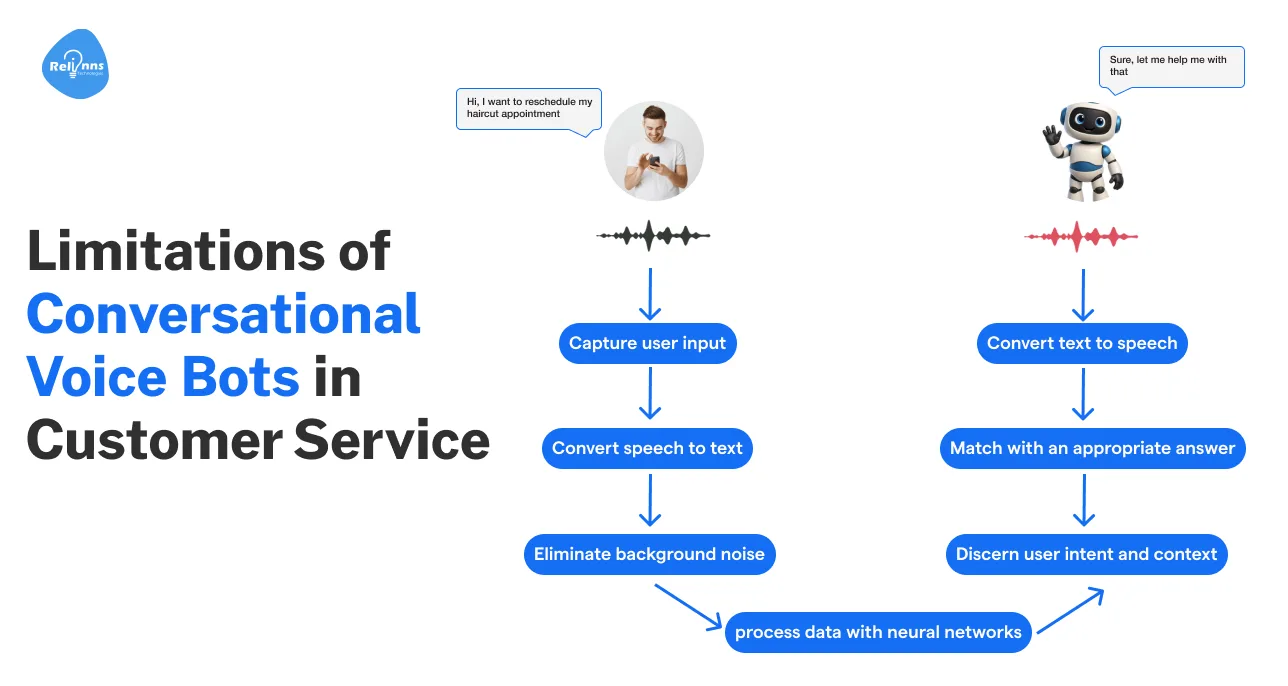
Ever tried talking to a voice bot… and wanted to scream?
You’re not alone. Many customers hang up frustrated when AI fails to understand them. Businesses think these bots can handle everything, but reality is harsher.
Conversational voice bots are impressive, yet they stumble over accents, context, and complex questions. They can mishear, misinterpret, or respond in ways that feel robotic or even wrong.
Knowing these limitations is absolutely critical.
In this guide, we’ll explore the technical, operational, and customer experience limitations of conversational voice bots in customer service. We’ll also show practical ways businesses can deploy them effectively, without frustrating customers or risking trust.
How Conversational Voice Bots Handle Customer Service
Before we delve into how these bots manage customer conversations, it’s worth understanding the basics of what a conversational voice bot is.
What is a Conversational Voice Bot?
Conversational voice bots are AI-powered systems that interact with customers using natural speech.
They listen, understand, and respond to customers’ questions, helping businesses handle queries over the phone or voice channels.
The Voice Bot Process in Customer Service
Here’s how a conversational voice bot handles a customer call from start to finish.
- Speech Recognition (ASR): Listens to the customer and converts their words into text that the bot can understand
- Natural Language Understanding (NLU): Figures out what the customer wants. Extracts key details and intent to respond accurately
- Dialogue Management: Decides what to do next in the conversation. Keeps the flow logical for a smooth interaction
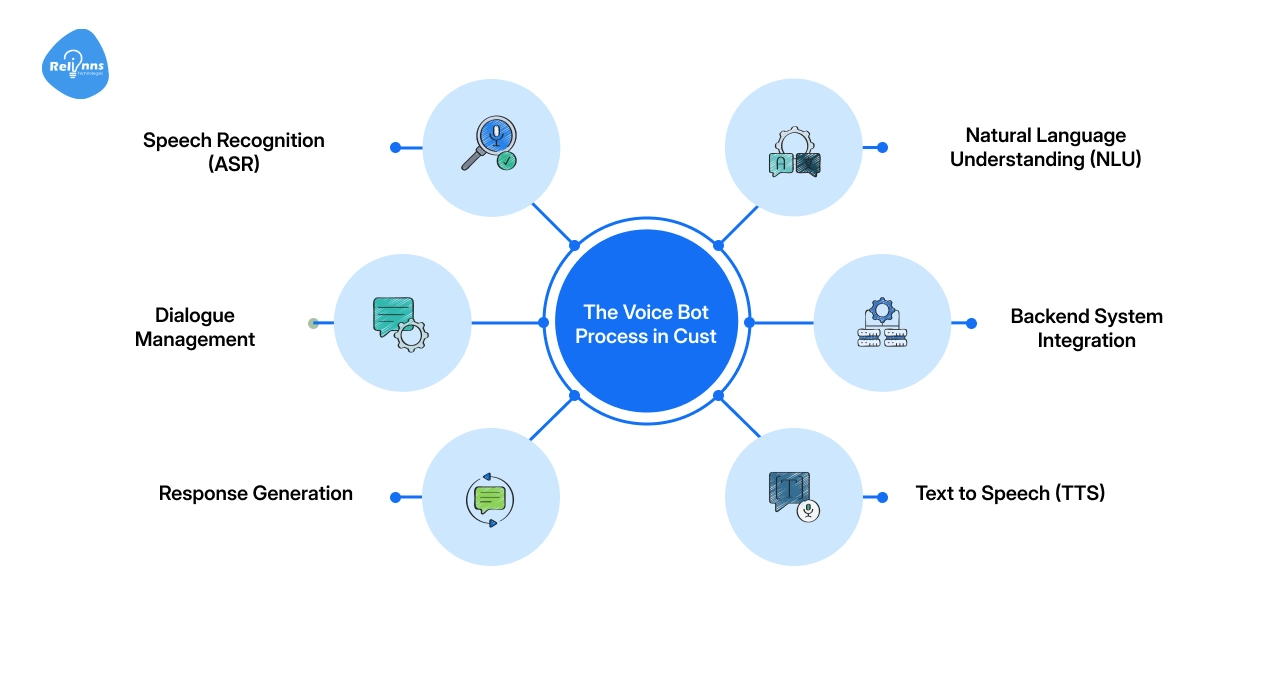
- Backend System Integration: Checks systems like CRM or order databases to get real info
- Response Generation: Crafts a reply based on what the customer said and business rules. This helps answer the customer correctly and quickly.
- Text to Speech (TTS): Turns the reply into a natural-sounding voice for the customer to hear and understand clearly
Together, these components let voice bots in customer service provide fast, automated support while handling common tasks efficiently.
If you’re looking to build a voice bot that balances automation with real customer understanding, companies like Relinns Technologies specialize in designing and deploying tailored conversational voice solutions.
From natural speech recognition to seamless backend integration, they help businesses create bots that work efficiently and maintain a human touch where it matters most.
Why Businesses Must Understand Voice Bot Limitations
Understanding how a bot works is only half the story. Even advanced voice bots have limits. Ignoring them can hurt your business and your customers.
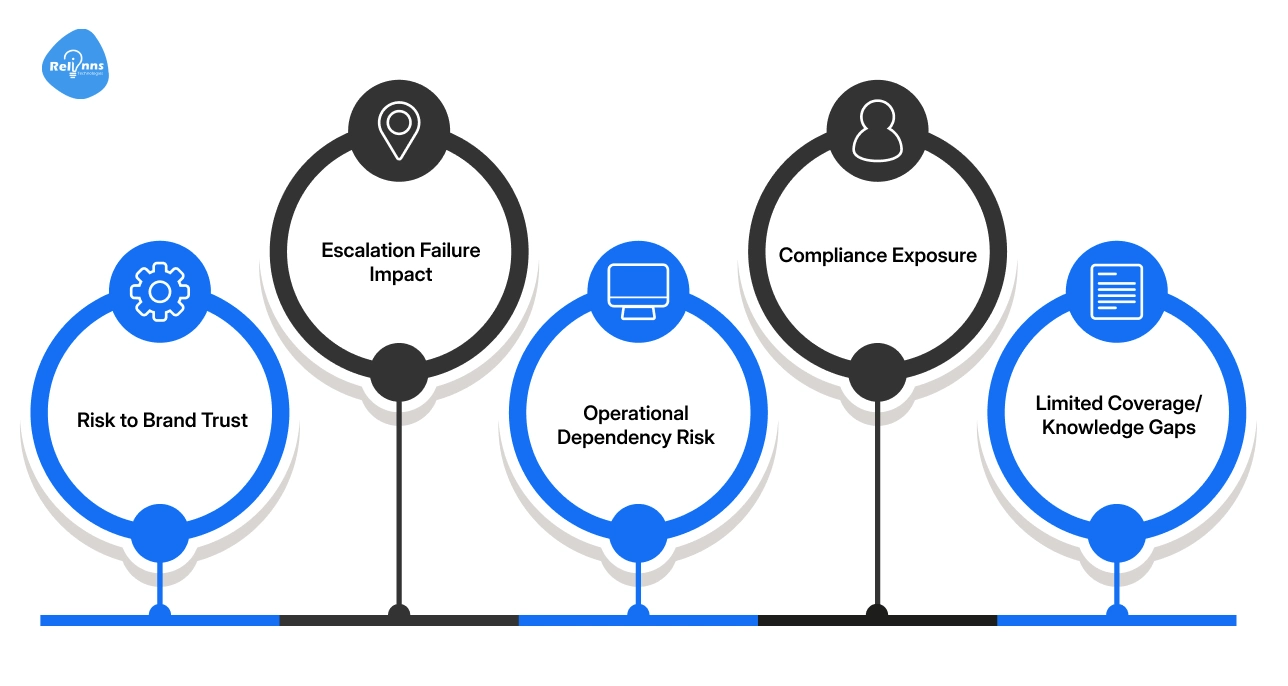
Here are the main risks businesses face when using a voice bot for customer support:
- Risk to Brand Trust: A bot that mishears or gives the wrong answer frustrates customers. Repeated mistakes can make your brand seem unreliable.
- Escalation Failure Impact: Bots can fail to route complex issues to humans on time. Delays frustrate customers and can lead to unresolved problems.
- Operational Dependency Risk: Relying too heavily on bots creates vulnerability. If the system struggles with unusual questions or goes down, customer support can stall. Human backup is essential.
- Compliance Exposure: Voice bots handle sensitive customer data. Mistakes in storing, processing, or sharing this information can cause legal trouble, fines, or reputational damage.
- Limited Coverage/Knowledge Gaps: Bots often only handle common questions. Without human support for complex queries, important issues may go unresolved.
Recognizing these limitations in voice bots for customer service helps businesses plan smarter. Proper monitoring, fallback systems, and continuous bot training reduce errors.
Companies that understand their bots’ limits can improve efficiency while keeping customers happy and protecting their brand reputation.
Core Technical Challenges of Conversational Voice Bots
Even the smartest voice bots have limits. These challenges affect accuracy, speed, and customer experience. Knowing them helps businesses plan better, set expectations, and create fallback systems to prevent frustration or errors.
Here are the prominent conversational voice bot technical challenges that businesses face:
| What Can Go Wrong | Why It Happens | Customer Impact |
| Speech Recognition Errors | Bot mishears spoken words. | Misunderstands accents, background noise, or industry-specific terms |
| Natural Language Understanding Gaps | Bot struggles to interpret meaning. | Fails with multi-intent questions, sarcasm, or complex requests |
| Latency & Real-Time Delays | Slow processing or response. | Cloud or API lag causes awkward pauses, breaking conversational flow |
| AI Hallucination & Fabricated Responses | Bot generates incorrect information. | Gives wrong policy answers or misleading guidance, creating liability risk |
| Limited Emotional Intelligence | Bot cannot read tone or emotion. | Fails to detect frustration, mis-times escalation, or responds with the wrong tone |
Below, we explore each technical challenge of voice bots in customer service in detail and outline ways to mitigate the risks.
Speech Recognition Errors in Real Environments
Background noise or heavy accents can make bots mishear words.
For example, a customer asking about a “return policy” may be interpreted as “refund policy”, causing confusion.
Solution: Use advanced noise filtering, regional accent training, and fallback prompts to clarify misunderstood speech.
Natural Language Understanding Gaps
Bots struggle with complex or multi-part questions.
A user asking, “Can I change my plan and update my payment method?” may receive a partial answer because the bot cannot always process multiple intents at once.
Solution: Implement intent confirmation, context tracking, and hybrid human handoff for complex queries.
Latency and Real-Time Processing Delays
Slow API calls or cloud processing can cause awkward pauses.
A delay in responding to “What’s my order status?” frustrates users.
Solution: Optimize cloud architecture, pre-fetch data, and set response thresholds to keep the conversation smooth.
AI Hallucination and Fabricated Responses
Bots may generate incorrect or misleading information.
For instance, stating a product is available when it’s out of stock is a false or fabricated response that can mislead customers.
Solution: Restrict bots to verified data sources and implement human review for sensitive queries.
Limited Emotional Intelligence
Bots can’t fully read tone or frustration.
Likewise, a customer using a harsh tone may not have their issue escalated appropriately.
Solution: Add sentiment detection, escalation rules, and human fallback for emotional interactions.
By understanding these technical limits and applying targeted solutions, businesses can improve the voice bot’s reliability while keeping customer interactions smooth and frustration-free.
Customer Experience Limitations of Conversational Voice Bots
Even when bots work technically, the customer experience can still fall short.
Frustration often arises when interactions feel rigid, slow, or impersonal. Addressing these challenges helps businesses design smoother, more satisfying experiences for their customers.
Some of the customer experience challenges of voice bots include:
Scripted Flow Breakdowns
Rigid conversation scripts can break when customers deviate from expected responses. This creates awkward pauses or repeated prompts.
The Fix: Include flexible flows and fallback prompts to guide unexpected paths.
Repetitive Interaction Loops
Bots can get stuck repeating questions or clarifications, especially when the intent isn’t clear. Customers feel trapped and impatient.
The Fix: Use intent confidence thresholds and escalation triggers to prevent loops.
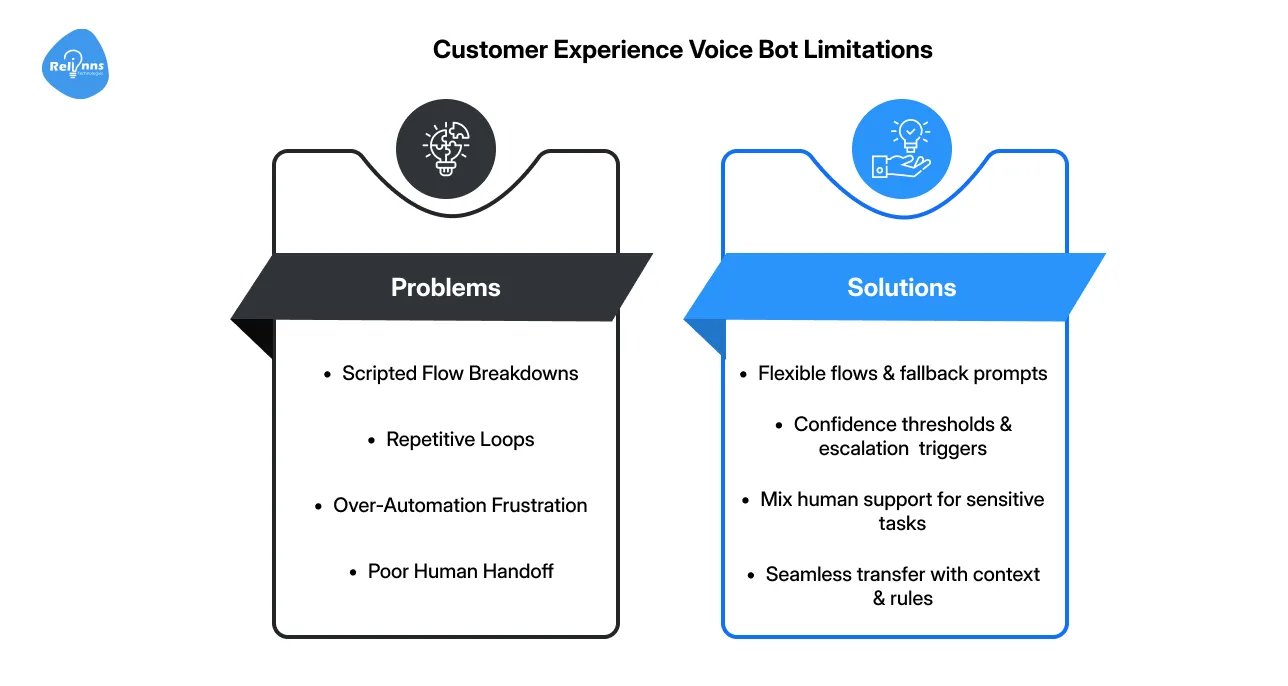
Over-Automation Frustration
Too much automation can make customers feel they’re talking to a machine with no empathy. Simple tasks may feel cold or tedious.
The Fix: Mix human support for sensitive or high-touch interactions.
Poor Handoff to Human Agents
Even when escalation is possible, handoffs are often slow or lack context. Customers repeat themselves, increasing frustration.
The Fix: Ensure seamless transfer with conversation history and clear escalation rules.
Focusing on these experiential gaps helps businesses balance automation with human touch, reducing frustration and keeping customer interactions smooth, efficient, and satisfying.
Operational and Business Voice Bot Limitations
Voice bots can handle many tasks, but they come with business and operational challenges.
Knowing these upfront helps teams plan budgets, resources, and long-term strategy more realistically.
The table below gives a quick overview of core operational and business conversational voice bot limitations.
| Operational Voice Bot Challenge | What It Really Means | Why It Matters |
| Expensive Setup & Maintenance | Setting up bots and keeping them running isn’t cheap. | Small teams may struggle to fund ongoing updates or integrations. |
| Heavy Data Dependence | Bots need large, high-quality datasets to perform well. | Missing or biased data leads to mistakes and frustrated customers. |
| Constant Optimization | Bots must be retrained to handle new queries or changes. | Without regular updates, performance drops and errors increase. |
| Scaling vs Accuracy | Handling more users or tasks can lower response quality. | Expanding too fast may slow performance or increase mistakes. |
| Vendor Lock-In | Proprietary platforms can limit flexibility. | Switching vendors is costly and complicated, restricting future options. |
What Helps Businesses Stay on Track: Proper budgeting, smart data practices, and careful vendor selection allow companies to deploy voice bots effectively while keeping control, accuracy, and reliability intact.
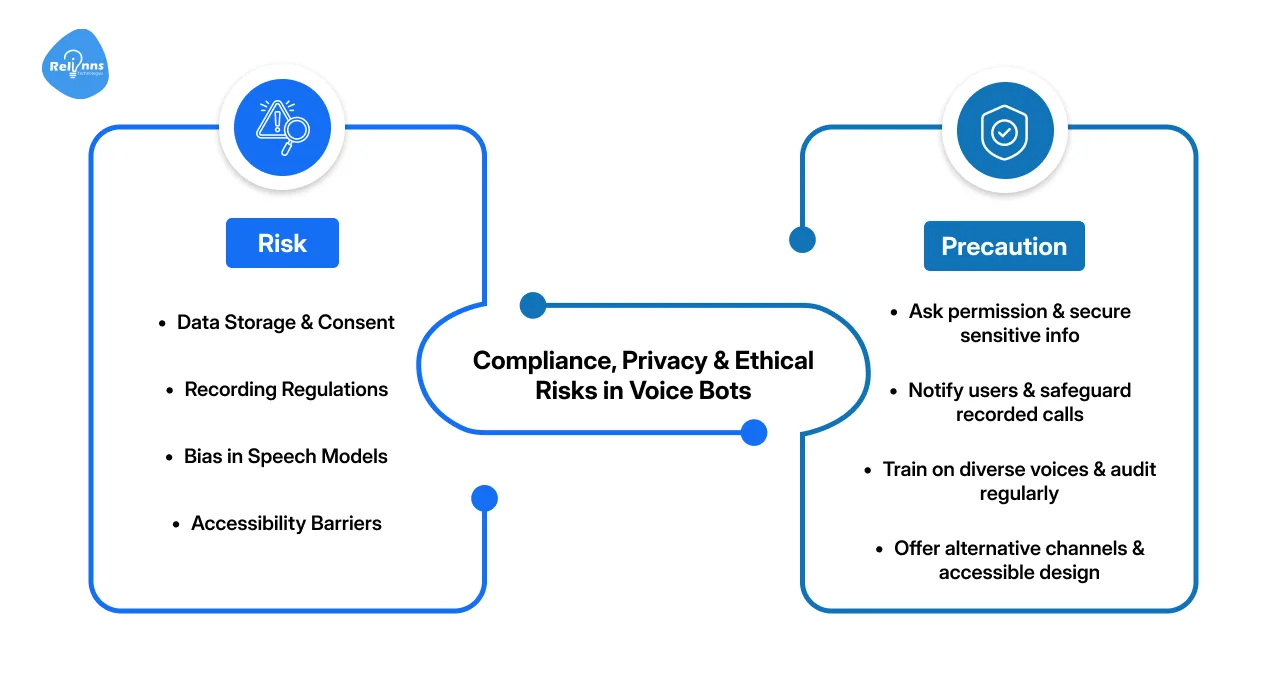
Compliance, Privacy, and Ethical Risks in Voice Bots
Voice bots make life easier, but they also handle sensitive information.
Missteps can hurt customers, break laws, or make your brand look careless. Overcoming these limits helps businesses keep interactions safe, fair, and inclusive.
Data Storage and Consent Issues
Bots collect personal info. If customers aren’t clearly asked for permission, privacy is compromised.
What to Do: Be upfront about data use and store it securely by encrypting sensitive information and limiting access to authorized staff only.
Recording and Disclosure Regulations
Some regions require call recording notices. Ignoring this can lead to fines or legal trouble.
What to Do: Add clear announcements and secure recording systems. This means customers know when calls are recorded and how the data will be used.
Bias in Speech Models
Bots can mishear or misinterpret certain accents, slang, or dialects, treating some users unfairly. It causes frustration, inequality, and customer dissatisfaction.
What to Do: Train models on diverse voices and monitor for bias. Have regular audits and performance checks in place to ensure all users are treated fairly.
Accessibility Barriers
Voice bots may be tricky for users with hearing or speech challenges. Ethically, everyone should have equal access to support.
What to Do: Provide alternative channels and a design for accessibility. Being inclusive is critical for building trust and serving all customers fairly.
By addressing these issues, businesses protect customers, stay compliant, and build trust with every interaction.
Voice Bot Customer Service vs Human Agents: Key Differences
Voice bots can handle many tasks, but they’re not humans.
Knowing the differences between human agents and voice bots helps businesses understand when to automate intelligently and when human intervention is critical for quality outcomes.
Here’s a comparative overview showcasing these core distinctions.
| Feature | Voice Bots | Human Agents |
| Decision-Making | Can follow complex rules consistently | Makes judgment calls in ambiguous or sensitive situations |
| Emotional Intelligence | Limited; struggles with subtle cues or frustration | Picks up tone, emotion, and urgency naturally |
| Adaptability | Handles unusual requests poorly | Adapts to unexpected problems and nuanced scenarios |
| Context Awareness | Can remember limited conversation context | Tracks history, cross-channel context, and customer preferences |
| Risk Management | Errors in judgment-heavy cases | Better at managing compliance, escalation, or high-stakes issues |
Key Takeaways:
- Voice bots excel at repetitive, predictable tasks or those that require context awareness and risk management.
- Humans step in when empathy, context, and critical thinking matter.
Using both strategically ensures efficiency without losing a human touch.
Where Voice Bots Perform Well Despite Limitations
Voice bots are not built for complex or emotional situations. But they work extremely well in repetitive, structured conversations. Used the right way, they save time, reduce load, and improve response speed without hurting customer experience.
| Use Case | Why Voice Bots Work Well | Business Impact |
| Simple FAQs | They tackle the easy, predictable questions instantly. | Reduces support queue volume |
| Status Updates | They grab real-time tracking or ticket data automatically. | Faster responses. Fewer agent interruptions. |
| Appointment Reminders | They handle outbound calls at scale, without delays. | Fewer missed appointments and “no-shows” |
| Lead Qualification | They ask predefined questions and capture structured responses. | Only passes the truly interested prospects to your team |
These tasks do not require deep emotional intelligence or complex judgment. They follow clear scripts and defined flows.
When used for structured interactions, voice bots improve efficiency without replacing human agents. The key is knowing where automation adds value, and where it does not.
When Should Businesses Avoid Using Voice Bots for Customer Support
Voice bots are useful. But they are not right for every situation.
Some conversations need judgment, empathy, or careful handling. In these cases, automation can frustrate customers or create risk.
Here’s when businesses should think twice:
High-Complexity Industries
Healthcare, finance, and technical services deal with layered problems. Customers often do not know the exact question to ask. They need guidance.
On the other hand, voice bots follow predefined flows. They struggle with ambiguity, follow-up questions, and exceptions.
A wrong response here can lead to financial loss or safety issues. Human judgment matters.
Legal-Sensitive Sectors
Legal and compliance-heavy industries require precise language. Small wording errors can create liability.
Bots cannot interpret gray areas or shifting regulations. They respond based on programmed rules.
In sensitive cases, that rigidity increases risk.
Premium Brand Experience
Luxury and premium brands sell experience, not just service. Customers expect attention and empathy.
A robotic interaction can feel impersonal. It weakens trust.
In high-value relationships, human interaction protects brand perception and loyalty.
The key is not to avoid voice bots entirely, but to use them wisely. With the right setup and safeguards, many of these limitations can be minimized.
Businesses navigating complex or sensitive interactions often team up with expert voice bot developers like Relinns Technologies, which design voice bots that know when to automate and when to hand off to humans, keeping customers satisfied and risks low.
Best Practices to Minimize Conversational Voice Bots Limitations
Voice bots are not perfect. But many limitations can be reduced with smart design. The goal is not full automation. The goal is controlled automation with safety checks.
These best practices help reduce risk and improve user experience.
- Human Fallback Design: Always give users a clear option to speak to a human. Quick handoff prevents frustration and builds trust during complex or sensitive interactions.
- Intent Confidence Thresholds: Set a minimum confidence score for each response. If the bot is unsure, escalate rather than guess, preventing incorrect or confusing answers.
- Clear Escalation Triggers: Define rules for transfer based on errors, repeated failures, or emotional language. Proper triggers ensure timely human intervention when needed.
- Continuous Retraining: Regularly review conversations and update intents, scripts, and responses. This helps the bot learn from real interactions and improve performance over time.
- Transparency with Users: Clearly tell users they are interacting with a bot. Being upfront sets expectations, reduces frustration, and improves acceptance of automated support.
By following these practices, businesses can make voice bots more reliable, efficient, and user-friendly. Smart design ensures automation supports (and does not frustrate) customers, creating a balance between agility, precision, and the human touch.
Wrap Up
Conversational voice bots can handle routine tasks fast and at scale. But they are not perfect.
They can mishear, misinterpret, or frustrate customers if used blindly.
The secret is knowing their limits, picking the right tasks, and providing a safety net for humans. With smart design, clear escalation, and regular updates, bots can handle repetitive work while humans handle nuance, empathy, and judgment.
The key is balance: automation that helps people, not replaces them, keeping customers happy, interactions smooth, and your brand trustworthy.
Frequently Asked Questions (FAQs)
What are the Main Limitations of Conversational Voice Bots in Customer Service?
Voice bots struggle with mishearing, misinterpretation, slow responses, poor emotional understanding, rigid scripts, compliance risks, and handling complex or ambiguous customer queries.
Are Voice Bots Reliable for Customer Support?
They are reliable for repetitive, structured tasks but can falter in complex, high-stakes, or emotionally sensitive interactions. Human backup is recommended.
Why do Voice Bots Fail in Complex Conversations?
Complex conversations involve multiple intents, ambiguous questions, and context shifts, which bots cannot always interpret accurately, leading to incorrect or incomplete responses.
Can AI Voice Bots Replace Human Agents?
No. Bots excel at structured, repetitive tasks. Humans remain essential for empathy, judgment, escalation, and nuanced problem-solving in customer service.
What Industries Should Avoid Voice Bot Automation?
Healthcare, finance, legal, and premium services should limit automation, as mistakes can cause financial loss, legal issues, or harm brand reputation.
When Should Businesses Avoid Using Voice Bots for Customer Support?
Avoid bots in complex, legal-sensitive, or premium brand contexts. Human judgment, empathy, and precise communication are essential for high-risk or high-value interactions.
Which Tasks are Ideal for Voice Bots Despite Their Limitations?
Voice bots excel at FAQs, status updates, appointment reminders, and lead qualification: tasks that are repetitive, structured, and don’t require emotional intelligence.
How Can Businesses Ensure Compliance and Fairness in Voice Bot Interactions?
Secure data, explicit consent, call recording transparency, bias monitoring, and accessible alternatives help meet legal, ethical, and customer trust requirements.
How Can Businesses Improve Voice Bot Performance and User Experience?
Use human fallback, intent confidence thresholds, clear escalation triggers, continuous retraining, and transparency to reduce errors and maintain customer satisfaction.