Faculty Activity Reporting Workflow Automation: A Complete Guide
Date
Jan 28, 26
Reading Time
8 Minutes
Category
Custom development
Share


In higher education today, reporting on faculty performance is a major source of faculty burden, due to the multitude of time-intensive duties related to accreditation reporting, annual faculty evaluations, faculty promotion, research project audits, grant applications, and compliance reviews.
These duties demand accuracy, consistency, and timely submission; however, most institutions continue to use paper forms and spreadsheets daily.
Currently, there is increasing complexity in reporting of faculty activity; with new accreditation models and increased reliance on data-driven decision-making, faculty spend hours populating the same information onto many different forms or spreadsheets.
Administrators must reconcile data from different departments, systems, and sources, which creates bottlenecks and inconsistencies.
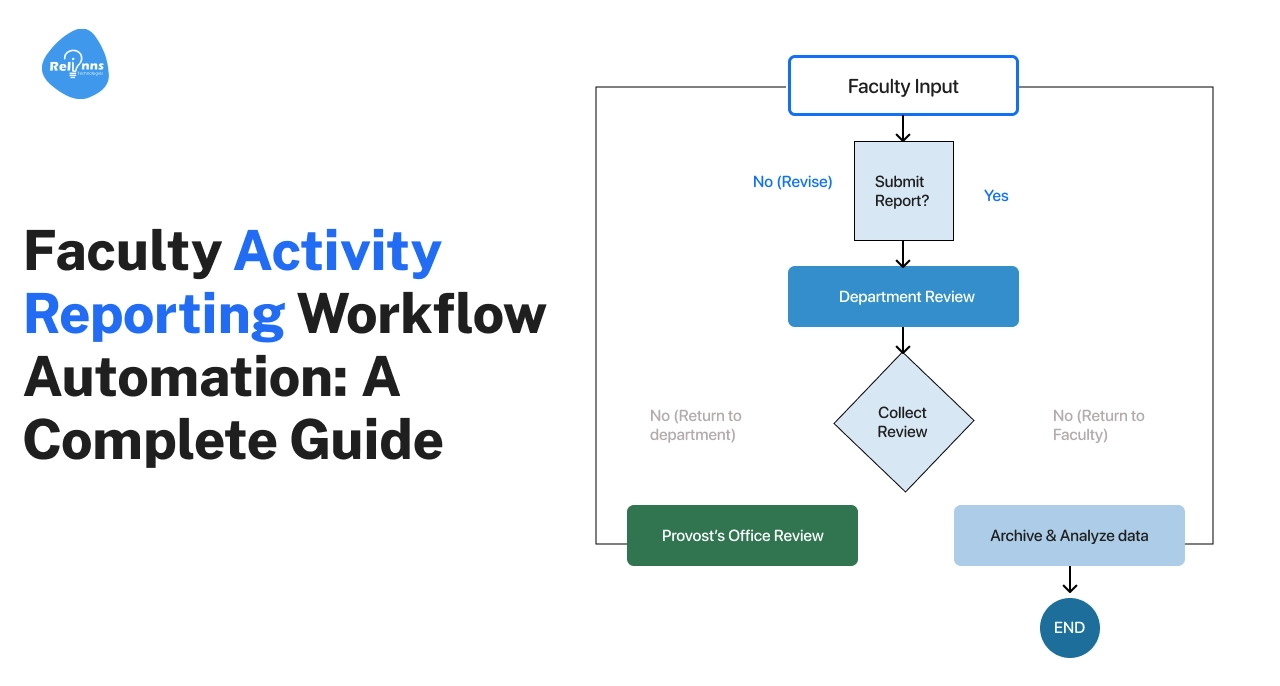
As universities move toward digital transformation, custom workflow automation provides a structured way to streamline faculty reporting. Automated workflows help collect, validate, route, approve, and store faculty data with minimal manual effort.
This article explores how workflow automation transforms faculty activity reporting, why universities are adopting custom solutions, and how platforms like Relinns help institutions modernize efficiently.
What is Faculty Reporting and Why is Workflow Automation Key to Its Streamlining?
The term "Faculty Reporting" refers to the method used to gather and handle data about teaching/research/publications/service activities/grants/credentials and contributions to an institution (i.e., things that add value to the institution as a whole).
Data gathered in Faculty Reports is used to support the accreditation cycle reports; department review processes; Promotion and Tenure (P&T); Faculty ranking submissions; and compliance audits of the institution.
Custom workflow automation replaces repetitive steps with streamlined, rule-based processes.
Automated systems ensure that faculty activity reporting software captures required inputs, validates data, routes submissions for approvals, and stores information systematically.
Which Common Challenges Do Institutions Face in Faculty Reporting Processes?

Creating a successful faculty activity reporting software has remained a persistent challenge across institutions of all sizes.
Manual methods introduce inefficiencies that affect both faculty and administrators. Common issues include fragmented systems, inconsistent data models, and a lack of centralized access to activity records.
Duplicate reporting across multiple platforms
- Faculty re-enter identical data into several disconnected institutional systems.
- Repeated submissions increase workload and reduce overall reporting accuracy.
- Fragmented tools create unnecessary duplication for faculty and administrators.
Inconsistent department-level data practices
- Independent spreadsheets cause mismatched records across academic units
- Manual corrections slow accreditation preparation significantly every cycle
- Departments struggle to maintain uniform reporting formats reliably
High manual verification workload
- Administrators must review thousands of faculty entries manually
- Review delays affect evaluation timelines and reporting consistency
- Human checks introduce avoidable errors in accreditation submissions
Complex multi-year accreditation requirements
- Bodies demand structured multi-year faculty activity documentation
- Manual tracking increases mistakes in instructional and research records
- Missing details risk accreditation outcomes and institutional readiness
Sensitive data security concerns
- Email submissions expose confidential faculty information unnecessarily
- Lack of access controls increases institutional compliance risks
- Audit trails are missing in manual reporting processes
What Features Should Custom Workflow Automation Software Include for Effective Faculty Reporting?
Effective faculty reporting requires a system that simplifies data entry, centralizes records, and supports accreditation and compliance workflows.
Custom workflow automation ensures that the software aligns with departmental structures and institutional policies.
A vigorous faculty activity reporting system software includes configurable forms for teaching, research, publications, grants, service, and clinical activities.
A. Configurable Forms for Diverse Faculty Activity Data
Modern systems must support varied academic inputs and multi-year histories needed for reporting.
These configurable forms enhance the functionality of faculty activity reporting software and improve the accuracy of institutional data.
- Forms capture publications, grants, teaching loads, service, and activity records
- Multi-year histories strengthen accreditation through consistent faculty activity reporting solutions
- Attachments and custom fields improve the completeness of academic submissions
- Automated validation reduces errors across faculty activity reporting system software workflows
B. Seamless Integration Across Institutional Databases
Effective reporting depends on unified data pulled automatically from institutional and external systems.
Integration removes duplication and strengthens faculty activity reporting solutions across departments.
- Connects with HR, SIS, LMS, and research indexing databases
- External imports reduce manual work using faculty activity reporting software tools
- Automated synchronization keeps research and teaching records continuously accurate
- Integration improves reliability for accreditation through the faculty activity reporting system software
C. Automated Workflow Routing and Approvals
Workflows support multi-level approval structures across departments and schools.
Automated routing enhances consistency and enables faster, institution-wide reporting of faculty activities.
- Routes submissions to chairs, deans, and institutional reviewers automatically
- Tracks status and reminders through faculty activity reporting software workflows
- Consolidated reporting improves departmental coordination and review accuracy
- Dashboards increase visibility across the faculty activity reporting system software processes
D. Accreditation-Ready Reporting and Templates
Automation reduces preparation time for accreditation bodies by generating formatted reports instantly.
Multi-year storage and templates support robust faculty activity reporting solutions.
- Templates match NAAC, ABET, AACSB, and NBA documentation formats
- Saves weeks through automated consolidation of faculty activity reporting software data
- Maintains historical records across cycles for accreditation readiness
- Centralized repositories ensure a consistent faculty activity reporting system, software outputs
E. Robust Security and Compliance Controls
Academic institutions must protect sensitive information related to teaching, research, and evaluations.
Secure workflows strengthen trust in faculty activity reporting solutions and institutional governance.
- Role-based control safeguards faculty activity reporting software submissions.
- Encrypted storage protects evaluations, publications, and confidential research details.
- Audit logs maintain accountability across the faculty activity reporting system software.
- Compliance ensures alignment with FERPA and institutional security standards.
How Can Automation Improve Accuracy, Compliance, and Timeliness in Faculty Reporting?

Automation improves accuracy by enforcing standard formats, requiring fields, and validating data.
This eliminates the common errors seen in manual reporting.
Duplicate entries and inconsistent formats are minimized by consolidating all activities in a single environment.
1. Improved Compliance Through Structured Reporting
Automation strengthens compliance by capturing accreditation requirements accurately and ensuring complete, consistent faculty activity reporting across departments.
- Automated templates align with accreditation reporting needs effectively
- Required-field checks reduce missing data in submissions
- Consistent formats improve audit readiness across all units
- Validation steps enhance accuracy in faculty activity reporting software
2. Faster Timelines for Review and Submission
Automation shortens reporting cycles by eliminating delays and enabling timely, accurate faculty activity reporting across institutional workflows.
- Deadline alerts improve speed across reporting workflows
- Real-time tracking simplifies administrative oversight instantly
- Automated routing reduces manual follow-up work significantly
- Instant submissions accelerate multi-level faculty activity reviews
3. Accurate Version Control and Centralized Dashboards
Automation prevents outdated files, ensures data consistency, and supports reliable faculty activity reporting for audits and accreditation.
- Centralized access removes outdated reporting versions.
- Dashboards strengthen accreditation preparation accuracy
- Historical records stay consistent across reporting cycles
- Unified data supports fast audit responses
4. Higher Faculty and Administrator Productivity
Automated workflows reduce repetitive tasks, improve focus, and streamline faculty activity reporting for both faculty and administrators.
- Automation lowers manual work across reporting tasks
- Faculty avoid repeated data entry efforts
- Administrators spend more time analyzing insights
- Overall productivity improves across institutional reporting workflows
What Are the Best Practices for Implementing Custom Workflow Automation in Faculty Reporting?

Successful automation requires thoughtful planning. Institutions should begin by mapping their current faculty reporting processes across departments.
Understanding variations helps build standardized workflows.
A. Pilot Implementation and Controlled Rollout
Institutions benefit from starting with a focused pilot.
Working with one or two departments helps teams refine forms, validate integrations, and test workflow accuracy before expanding.
Feedback gathered during this phase improves the quality and stability of the full rollout.
B. Need for Configurable and Flexible Workflows
Academic units often follow different evaluation models, so configurability is essential.
Flexible workflows allow each school or department to meet its own reporting needs while maintaining a consistent data structure across the institution.
This balance supports both autonomy and standardization.
C. Training, Communication, and Smooth Adoption
To successfully implement a project, it is essential to develop systems of communication that will outline training and the process of executing the project.
Faculty and administration require both direction and defined expectations (documented timelines) for understanding new program components and migrating to a new system.
In addition, building trust in new processes and workflow would not be possible without secure and accurate migration of data from historical systems such as spreadsheets, etc.
D. Continuous Improvement and Long-Term Adaptability
Reporting needs may change in response to the evolution of accreditation guidelines, the emergence of new research indices, or the changing structure of an institution.
Through the use of customized workflow automation, updates to the system can occur without interrupting existing data.
By continuously refining the system, it will continue to align with ongoing changes in academic requirements.
By implementing these best practices, universities will establish a scalable, precise, and dependable faculty reporting environment.
Real-World Use Cases of Streamlining Faculty Reporting With Custom Workflow Automation
Custom workflow automation is helping universities modernize their processes for collecting, validating, and managing academic activity data.
By using Faculty Activity Reporting (FAR) software and systems, colleges and universities can streamline reporting by reducing the workload of documenting faculty activities, eliminating duplicate records across departments, and improving data-entry accuracy.
Through these case studies, you will see how implementing these types of FAR solutions create organized and consistent data reporting environments that help institutions meet the accreditation requirements of various accrediting agencies.
A. Case Study: Florida State University ORCID Integrated Faculty Activity Reporting FEAS
Problem: FSU sought to reduce repetitive manual entry and improve the accuracy of faculty reporting of publications, presentations, teaching, and other activities for promotion and tenure workflows. Their team also needed better visibility into research outputs from major facilities such as the National High Magnetic Field Laboratory.
Solution: FSU integrated ORCID with its homegrown faculty activity reporting system (FEAS+) to enable faculty to link identifiers and reduce duplicate publication entries. They then surfaced ORCID linking inside the myFSU portal to drive adoption at scale.
Results: ORCID accounts linked to FSU-affiliated email addresses grew from 1,858 (June 2018) to 5,032 (September 2020), a 271% increase, with a notable lift after the myFSU portal integration.
Use Case Reference: Issues in Science and Technology Librarianship case study
B. Case Study: Osnabrück University and TIB ORCID-Based Semi-Automated Reporting Readiness
Problem: Both institutions needed a more scalable way to support standardized research reporting, where activity and output data is often collected manually from many sources, creating heavy administrative effort and inconsistent records.
Solution: They tested a PID-driven approach using ORCID and open data sources to partially automate researcher identification and feed institutional reporting systems, and measured how well external data sources matched internal researcher lists.
Results: Internal-verified ORCID coverage was 89% at TIB and 41% at Osnabrück University. External matching showed measurable but incomplete coverage, for example Osnabrück’s verified ORCID matches in one open source increased from 45% (49 researchers) to 48% (52 researchers) over time, showing progress toward reusable, automation-friendly reporting inputs.
Use Case Reference: Frontiers in Research Metrics and Analytics study
How Does Relinns Support Educational Institutions in Building Custom Workflow Automation Solutions for Faculty Reporting?
Relinns helps universities modernize reporting processes using low-code automation.
Their approach supports scalable, secure, and flexible faculty activity reporting systems that reduce manual work, improve accuracy, and strengthen accreditation readiness.
1. Rapid Development and Full Customization
Relinns delivers tailored applications quickly through low-code development, enabling institutions to shape workflows, forms, and data structures without lengthy engineering cycles.
- Customizable forms align with varied department reporting needs
- Flexible design supports evolving faculty activity reporting solutions
- Low-code development reduces dependency on large IT teams
- Faster deployment improves rollout of faculty activity reporting software
2. Flexible Workflow Automation Across Departments
Relinns automates routing, approvals, notifications, and task scheduling to streamline multi-level reporting across colleges and academic units.
- Automated routing accelerates faculty activity reporting processes
- Approval hierarchies support consistent review structures institution-wide
- Scheduled reminders reduce delays in faculty activity reporting software
- Configurable workflows adapt to departmental requirements easily
3. Seamless Integration With Academic Systems
Relinns supports integration with SIS, HR systems, LMS platforms, and research databases to reduce redundant entry and ensure accurate centralized records.
- Integrated systems reduce duplicate work across faculty activity reporting
- External data imports improve the accuracy of publications and research entries
- Unified data flow strengthens faculty activity reporting solutions
- Consistent synchronization supports accreditation and audit readiness
4. Security, Access Control, and Institutional Compliance
Relinns ensures secure management of faculty evaluations, research data, and accreditation information through strong access controls and audit logs.
- Role-based access safeguards the faculty activity reporting system software.
- Audit logs support compliance across academic reporting workflows
- Encrypted storage protects sensitive faculty records reliably
- Secure design aligns with institutional data governance policies
5. Scalable and Future-Proof Reporting Architecture
Relinns provides a flexible architecture that adapts as reporting models or accreditation requirements evolve, ensuring long-term sustainability.
- Scalable modules support long-term faculty activity reporting workflows
- System updates require minimal technical intervention at scale
- Flexibility ensures the longevity of faculty activity reporting software
- Adaptability promotes continuous improvement across academic units
6. Cost-Effective Implementation and Maintenance
Relinns minimizes development time and maintenance overhead through low-code configuration, making automation cost-efficient for institutions.
- Lower development effort reduces institutional implementation costs
- Faster updates keep faculty activity reporting solutions current
- Reduced maintenance load supports long-term sustainability
- Low-code workflows minimize reliance on custom engineering
Conclusion: Enhancing Faculty Activity Reporting Through Custom Workflow Automation
Custom workflow automation provides universities with a structured, scalable way to manage the rising demands of faculty activity reporting.
Automated systems improve accuracy, reduce manual workload, and support reliable accreditation preparation across departments.
By centralizing data, standardizing workflows, and strengthening security, institutions gain a more efficient and transparent academic reporting environment. Faculty and administrators benefit from streamlined processes that free time for teaching, research, and strategic decision-making.
Institutions that adopt flexible faculty activity reporting software and faculty activity reporting solutions position themselves for long-term success with systems that adapt to evolving academic requirements.
Why Choose Relinns for Faculty Reporting Automation?
Relinns delivers customizable workflow automation solutions that align with academic structures and accreditation needs.
Their systems integrate easily with institutional platforms and reduce reporting workload for faculty and administrators.
- Reporting errors are reduced by 41% in automated deployments
- Workflow automation accelerates submission and approval cycles by 32%
- Integration with academic databases reduces manual entry time by 58%
- Dashboards improve reporting transparency and institutional insights by 47%
- Customizable templates cut accreditation preparation time across cycles by 36%
Frequently Asked Questions (FAQ's)
What tools Are Available for Automating Faculty Workflow?
Centralized School Management Software can streamline workflows within higher education Institutions through automated approval workflows, Notifications, Reporting Tools, and Electronic Document Management Systems. Collectively, these tools will help increase operational efficiency, improve the accuracy of staff and faculty activity reporting, and Centralize Faculty Development and Academic Operations Data.
What is the Automated Reporting Process?
The Automated Reporting Process is a combination of collecting information from the number of integrated systems, validating that information as accurately as it relates to the Faculty Activity Reporting System (FARS), organizing Data as Structured Reports, and Sending the Report to Reviewers. This Process Improves Data Reliability and Relieves the Faculty Activity Reporting Software of Workload by Improving Workflow Process Controls.
How does AI Simplify Faculty Workflow Process?
Artificial Intelligence (AI) technology Can Simplify Faculty Workflows by Eliminating the Need to Manually Identify all missing data entries, making Helpful Recommendations for the Correction of Data, and Performing the Repetitive Tasks of Collecting, Entering, and Reporting Faculty Activity/Data (FA). Collectively, these Features Enhance the Accuracy of Faculty Activity Reporting Software and Speed Up the Decision-Making Process for Academic Teams.
What are everyday faculty tasks that can be automated?
Attendance tracking, workload submissions, publication updates, activity logs, and approval cycles can be automated. This reduces manual effort and improves consistency in faculty activity reporting solutions and departmental processes.