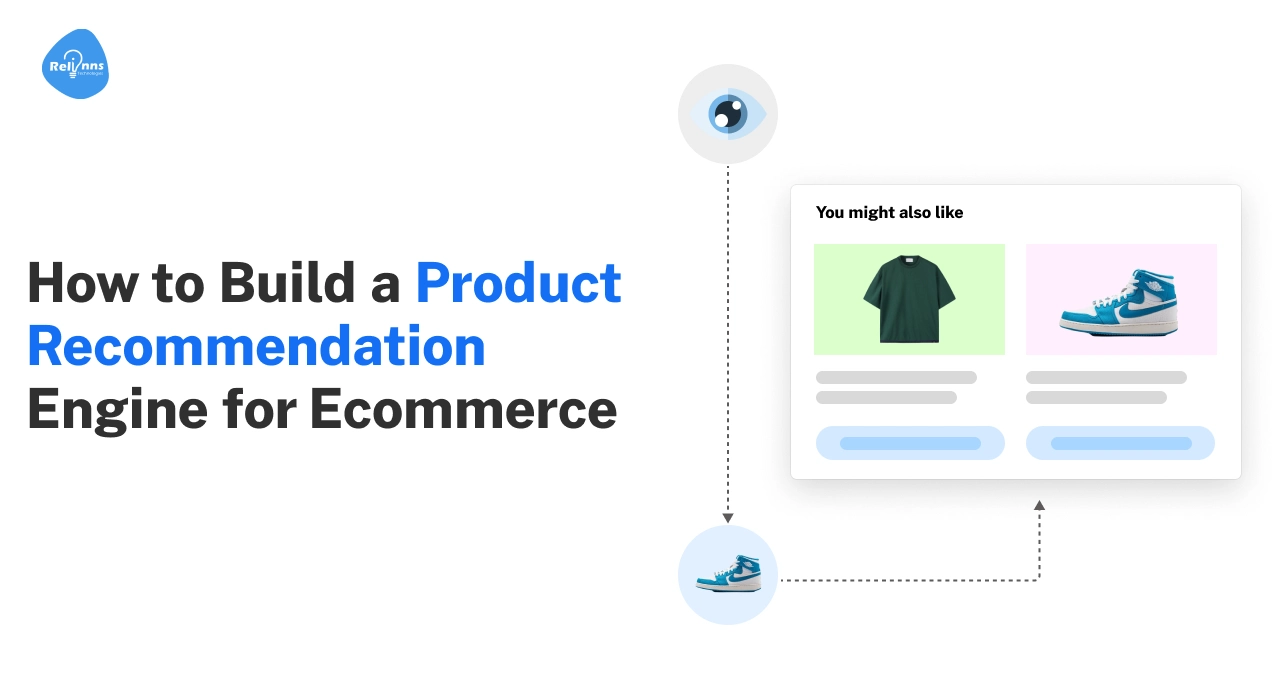
How to Build a Product Recommendation Engine for Ecommerce
Date
Mar 02, 26
Reading Time
12 Minutes
Category
Generative AI
Share


Your best customers are hiding in plain sight.
They visit your store. They browse a few products. Some even add items to their cart. And then they leave. Not because your prices are too high or your ads failed, but because you didn’t show them what they were most likely to buy.
That’s not a traffic problem or a discount problem, but a relevance problem.
This guide is for ecommerce founders, product managers, and engineers who want to systematically improve product discovery and conversion by building a real product recommendation engine for ecommerce, not just adding a basic “similar products” widget.
By the end, you’ll know how to design, build, and optimize a scalable engine that improves conversion rates, increases average order value, and drives measurable revenue growth.
What a Product Recommendation Engine for Ecommerce Actually Does
A product recommendation engine is a decision system that chooses what each shopper should see next. Its goal is simple: help customers find the right product faster and increase revenue without increasing traffic.
However, it is more than a “you may also like” box.
To understand the role of an AI recommendation engine for ecommerce, it’s worthwhile to break it down into what it actually does.
The Three Core Functions of a Recommendation Engine
Every strong recommendation engine performs three essential jobs.
1. Discover Relevant Products
It connects shoppers to products they might not find on their own. Through this function, it:
- Surfaces similar items based on attributes
- Highlights complementary products
- Brings visibility to long-tail inventory
It reduces the effort needed to explore your catalog.
For example, if a customer is viewing running shoes, the engine may recommend moisture-wicking socks, performance insoles, or similar shoes from another brand.
2. Personalize for Each Shopper
Not every visitor wants the same thing. The engine adapts in real time. It changes what it shows depending on the:
- Browsing history
- Past purchases
- Cart behavior
- Current session activity
Two users on the same page can see completely different suggestions.
Think of one shopper who prefers premium brands and another who filters by discounts. The engine adjusts recommendations to match each shopper’s behavior and intent.
3. Optimize for Conversion and Revenue
Relevance alone is not enough. The engine ranks products to drive results. Optimization means:
- Higher likelihood to convert
- Increased average order value
- Stronger revenue per session
Recommendations should support business goals, not just similarity.
For instance, the engine may prioritize in-stock, higher-margin products that are more likely to convert instead of simply showing the most viewed items.
For companies that want to turn data into smarter, revenue-driving recommendations, technology and AI experts like Relinns Technologies can help design and deploy AI-powered ecommerce engines that deliver personalized experiences, higher conversions, and measurable business impact.
Where Recommendations Appear in Ecommerce Journeys
Recommendations work best when placed across the full shopping journey. The most effective placement points are summarized in the table below:
| Placement Area | What Recommendations Do | Why It Matters |
| Homepage | Personalized discovery from the first visit | Engages users immediately and reduces bounce |
| Category Pages | Dynamic product ordering based on intent | Improves product visibility and conversion probability |
| Product Detail Pages | Similar products or frequently bought together | Increases exploration and basket size |
| Cart and Checkout | Cross-sell and upsell suggestions | Lifts average order value at high-intent stage |
| Post Purchase | Re-engagement, replenishment, or complementary suggestions | Drives repeat purchases and customer lifetime value |
When placed thoughtfully, these placements guide shoppers step by step toward purchase.
Data Signals That Power Recommendations
Behind every strong recommendation engine is data. Without the right signals, even the best model will fail.
Likewise, recommendations improve as your data improves. The most important signals include:
- Browsing Behavior: Pages viewed, time spent, scroll depth, and product clicks
- Search Queries: What users type reveals intent more clearly than browsing alone
- Cart Additions: Strong buying signals, even if the purchase does not happen
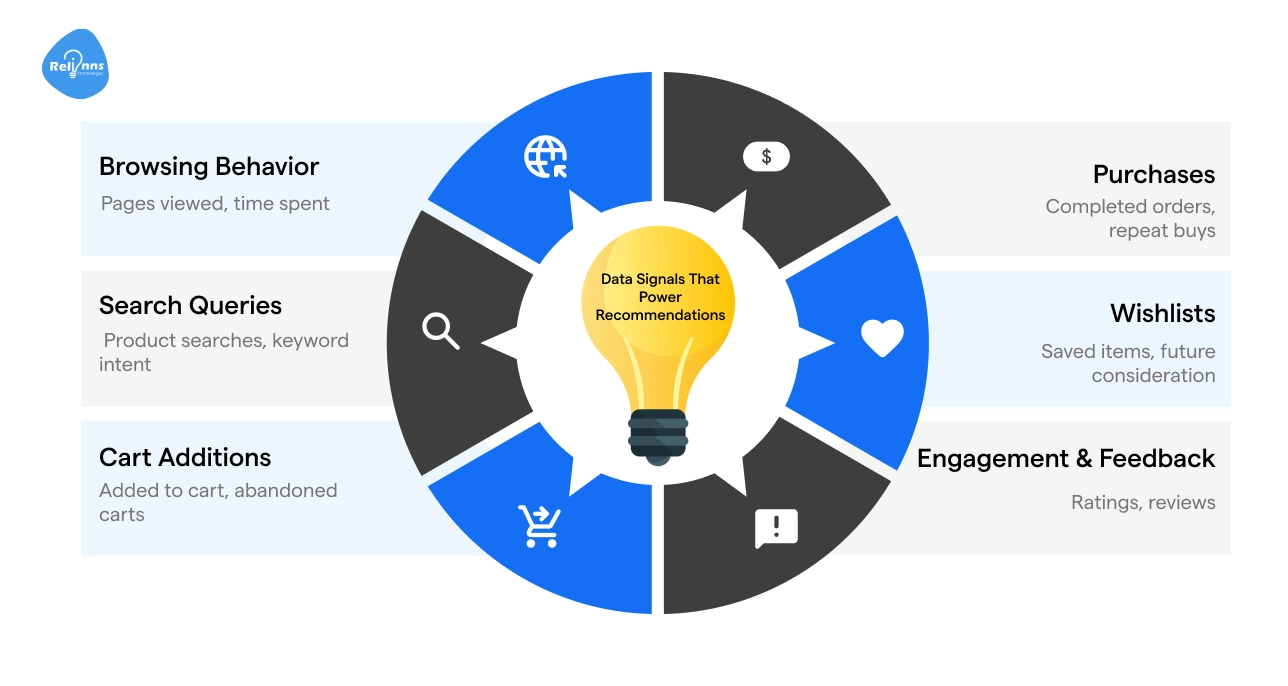
- Purchases: The highest-confidence signal of preference
- Wishlists: Products users are considering for later.
- Engagement and Feedback: Ratings, reviews, returns, and product interactions
Each signal carries a different weight. Purchases may matter more than clicks, and cart additions may matter more than impressions. A recommendation engine combines these signals to predict what a shopper is most likely to engage with next.
With this foundation in place, we can now move to the step-by-step process of building a product recommendation engine for ecommerce.
Step-by-Step Guide to Building a Product Recommendation Engine
Building a product recommendation engine for ecommerce is not a one-step task.
It is a layered system. You start simple. Then you improve with better data, better models, and constant testing.
Here’s an easy overview of the high-level roadmap for creating a digital recommendation engine for ecommerce:
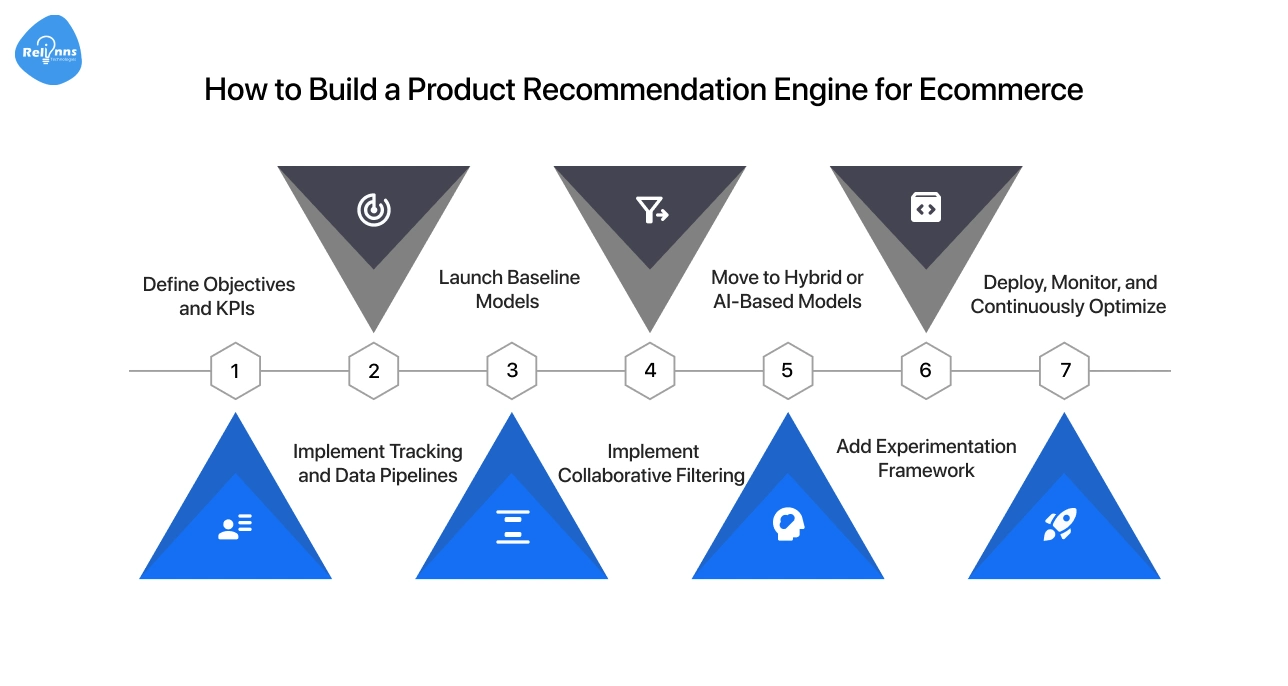
| Step | Focus | Outcome | Practical Illustration |
| 1. Define KPIs | Choosing between revenue, CTR, or inventory clearance | Clear business direction | A fashion brand decides to prioritize Cross-selling to increase Average Order Value (AOV). |
| 2. Implement Tracking and Data Pipeline | Tracking user events (clicks, views, "add to cart") | Reliable behavioral data | Setting up a “Pixel” to log every time a user hovers over a product image for >3 seconds. |
| 3. Launch Baseline Models | Logic-based rules like “Trending” or "New Arrivals” | Quick ROI | A “Best Sellers in Electronics” carousel on the homepage that requires zero user history. |
| 4. Add Collaborative Filtering | Matching users with similar taste profiles | Deeper personalization | “Customers who bought this coffee machine also bought these specific espresso pods.” |
| 5. Move to Hybrid or AI Models | Mixing user behavior with product attributes (color, size) | Solving the “Cold Start” (smarter predictions) | Recommending a brand-new dress to a user because they’ve previously liked similar floral patterns |
| 6. Add Experimentation | Running A/B tests on UI and algorithms | Data-backed proof | Showing 50% of users “Recommended for You” at the top vs. the bottom of the page to see which converts. |
| 7. Deploy and Optimize | Automating model updates and monitoring performance | Long-term scale | An AI that automatically stops recommending winter coats the moment it detects a spike in “swimwear” searches |
Now let’s break this down step by step so you can move from basic rules to a fully functional, revenue-driving system.
Step 1: Define Objectives and KPIs
Start with business goals. Are you optimizing for conversion rate, average order value, or revenue per visitor?
A recommendation engine for ecommerce without clear KPIs becomes a vanity project.
Next, define the exact recommendation modules you need. Not every module serves the same goal.
- Trending products → discovery
- Similar products → comparison
- Frequently bought together → higher AOV
- Recently viewed → friction reduction
Each module should tie directly to a measurable outcome.
Step 2: Implement Tracking and Data Pipelines
You need clean data. Track browsing behavior, search queries, cart additions, and purchases.
Without structured data pipelines, even the best AI recommendation engine for ecommerce can fail.
Step 3: Launch Baseline Models
Start simple. Think of the baseline model that you’ll want your future AI models to outperform. These include:
- Popularity-based recommendations to surface trending products
- Attribute similarity models using categories, tags, or product metadata
These give fast results with low complexity.
Step 4: Implement Collaborative Filtering
Use user-item interaction data. This identifies patterns like “users who bought X also bought Y”.
This is where personalization becomes meaningful for repeat visitors and high-intent shoppers.
Step 5: Move to Hybrid or AI-Based Models
Combine collaborative and content signals. Add embeddings or sequence-aware models.
This is your shift toward a modern AI recommendation engine for ecommerce.
Step 6: Add Experimentation Framework
Run A/B tests to validate performance and compare algorithm impact. Measure lift in conversion and revenue.
No testing means no proof of impact.
Step 7: Deploy, Monitor, and Continuously Optimize
Monitor model drift, inventory changes, and performance drops.
A digital recommendation engine for ecommerce is never “done”. It improves as your data grows.
With the process clear, the next step is understanding the different types of recommendation engines you can use, and when each makes sense.
Types of Recommendation Engines for Ecommerce
Different recommendation engines solve different problems. Some are simple and rule-based. Others use machine learning or AI.
Choosing the right type depends on your data maturity, traffic volume, and business goals.
Comparison Table of Recommendation Engine Types
The table below compares the core types of recommendation engines for ecommerce so you can understand how they differ in complexity, use case, and business impact.
| Type | How It Works | Best For | Limitation |
| Collaborative Filtering | Uses user-item interaction patterns | Stores with repeat users | Struggles with new users/products |
| Content-Based Filtering | Uses product attributes and metadata | Smaller catalogs or niche stores | Limited diversity |
| Hybrid Models | Combines collaborative + content signals | Growing ecommerce brands | Higher complexity |
| Other Modern AI Recommendation Engines for Ecommerce | Use session data, embeddings, and sequence models | High-scale personalization | Require strong data infrastructure |
Key Takeaways
- Start with content or collaborative models.
- Move to hybrid as data grows.
- Modern AI models improve real-time personalization. This is suited when you have high traffic, rich behavioral data, and need session-level predictions.
The more data you have, the more advanced your recommendation engine for ecommerce can become. The key is to match model complexity with your current data maturity and business goals, not jump to AI too early.
Data Architecture for a Digital Recommendation Engine for Ecommerce
At this point, it’s worth understanding the data foundation behind your recommendation engine.
A strong recommendation engine does not start with algorithms. It starts with clean, reliable data. If your inputs are messy, your outputs will be irrelevant. Before improving models, make sure your foundation is solid.
Core data layers to focus on include:
Event Tracking and Behavioral Data Collection
First, track what users actually do. Every click tells a story.
Here are a few things that you can capture:
- Product views
- Search queries
- Add-to-cart actions
- Purchases
- Time spent on products
This behavioral data helps your recommendation engine understand intent. If tracking is incomplete or inconsistent, personalization will feel random.
Building a Clean Product Catalog Layer
Your product catalog should be structured and easy to interpret.
Make sure you clearly define:
- Attributes: color, size, brand, price
- Categories: logical taxonomy
- Variants: size or color options
- Bundles: grouped products
- Margin and Inventory Data: to support smarter ranking
Even the most advanced AI recommendation engine for ecommerce cannot fix a messy catalog.
Identity Resolution for Logged-in and Guest Users
Many users browse without logging in.
You still need to connect sessions when possible. Use cookies or device IDs to build a more complete picture of behavior.
Handling Cold Start Problems
New users and new products have no history.
Start with popularity trends, product attributes, or contextual signals. As data grows, recommendations become more precise.
For instance, a new shopper visiting your store for the first time might see trending products in their region, while a newly launched product can be recommended based on similar attributes like category, price range, or style.
Having cleared the data architecture, let’s explore the reference architecture and system design that power digital product recommendation engines for ecommerce.
Reference Architecture of a Product Recommendation Engine
Once your data foundation is ready, the next step is system design.
An AI product recommendation engine needs a clear architecture. Without structure, performance slows, and personalization breaks at scale.
The Two-Stage Recommendation Pipeline
Most modern systems use a two-stage pipeline:
1. Candidate Generation
This stage narrows thousands of products down to a smaller, relevant set. It uses rules, embeddings, or similarity search to filter options quickly.
2. Ranking and Re-ranking
This stage scores and orders candidates based on user behavior, context, and business goals. This is where optimization happens.
Real-Time Personalization Loop
User behavior changes every second. The engine must update recommendations based on recent clicks, searches, and cart actions.
Real-time signals improve session-level personalization and prevent stale results.
For example, if a shopper suddenly starts browsing trail running shoes and applying “waterproof” filters, the engine should instantly pivot from generic sneakers to relevant trail gear and complementary products, reflecting what they want right now, not what they looked at yesterday.
Core Infrastructure Components
A scalable digital recommendation engine for ecommerce typically includes:
- Event Pipeline: streams user behavior data
- Feature Store: stores processed user and product features
- Vector Database or Similarity Index: retrieves related items fast
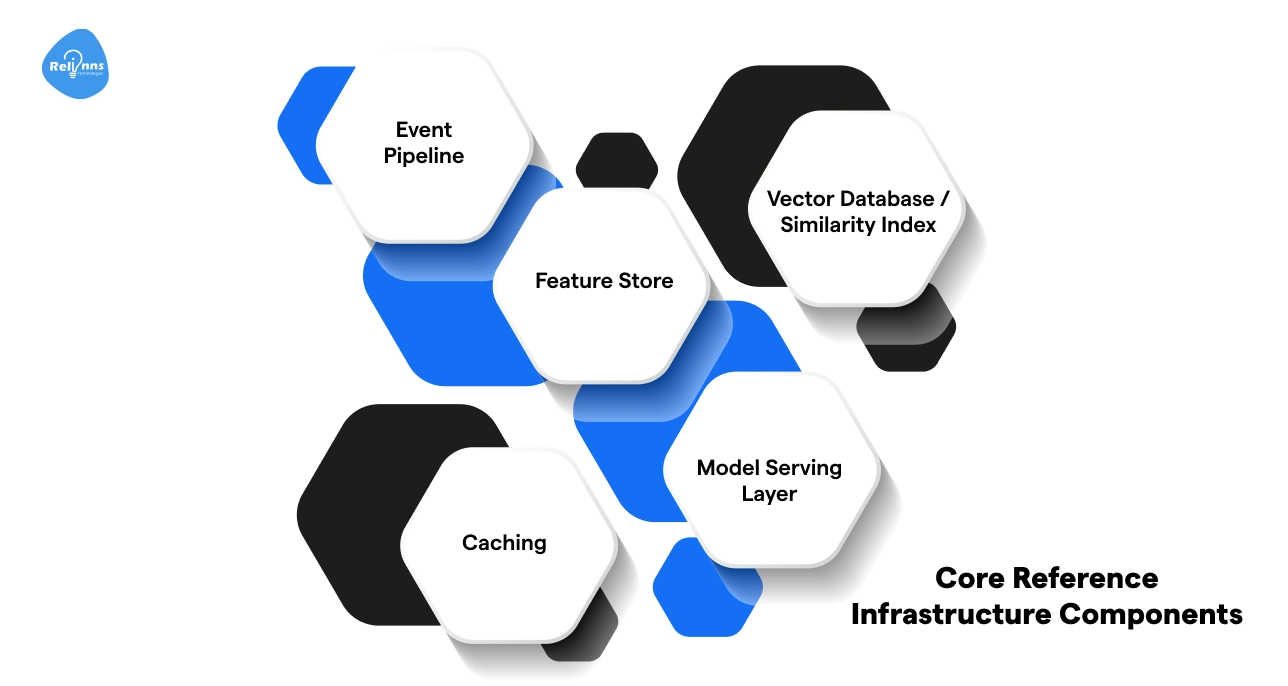
- Model Serving Layer: delivers predictions in real time
- Caching: reduces latency and improves speed
Business Rule and Merchandising Layer
Algorithms should not run unchecked. This layer ensures recommendations stay aligned with business priorities, including:
- Inventory Controls: Avoid promoting out-of-stock or low-stock products
- Pricing Logic: Prioritize high-margin or discounted items strategically
- Brand Rules: Boost preferred brands or suppress restricted ones
- Campaign Priorities: Surface products tied to ongoing promotions or seasonal pushes
A well-designed reference architecture turns recommendation logic into a scalable, real-time revenue engine rather than just another feature on your ecommerce site.
Must-Have Features for Ecommerce Recommendation Engines
A strong product recommendation engine for ecommerce needs more than good models. It needs control, speed, and accountability.
The top features that every production-ready recommendation engine should have include:
- Real-Time Personalization: Reacts instantly to clicks, searches, and cart changes. Static recommendations get ignored
- Explainability and Transparency: Shows why a product is recommended. Clear logic builds trust and helps with debugging.
- Merchandising Controls: Boosts high-margin items. Suppresses low inventory. Supports campaigns and brand rules.
- Cold Start Handling: Handles new users and new products using popularity, category trends, or contextual signals
- Experimentation and A/B Testing: Test models, placements, and strategies. Measures what actually drives revenue.
- Monitoring and Drift Detection: Tracks CTR, conversion rate, and revenue impact. Catches performance drops early.
- Omnichannel Delivery: Powers web, app, email, and ads from the same engine
- Privacy and Compliance Controls: Respects user data. Follows GDPR, CCPA, and internal data policies.
On the whole, these features allow businesses to deliver relevant recommendations at scale while staying aligned with revenue goals, operational constraints, and user trust.
How to Measure Performance of Recommendation Engines
A recommendation engine is only useful if it moves the right numbers.
You need to measure performance at three levels: how good the model is, how users react to it, and how it affects revenue.
If a recommendation block does not improve a clear KPI, it should be questioned.
Offline Metrics
These are tested before the model goes live. They use past data to estimate quality.
- Precision (0.3-0.5): When the engine recommends products, how often are they actually relevant?
- Recall (0.2-0.4): Out of all relevant products, how many did the model manage to show?
- NDCG (Normalized Discounted Cumulative Gain) (0.5-0.7): Are the most relevant products ranked at the top, where users actually see them?
Offline metrics help you compare models. But they do not guarantee business results.
Online Metrics (Typical Ranges in Brackets)
These reflect real user behavior after launch.
- Click-through Rate (CTR) (2-5%): Are users clicking the recommendations?
- Conversion Rate (5-10% of clicks): Are those clicks turning into purchases?
- Revenue Per Visitor ($0.5-$2 per visitor): Is each session generating more revenue?
This is where theory meets reality.
Business Impact Metrics
This is the bigger picture. It shows whether recommendations are driving sustainable growth.
- Average Order Value (10-30% uplift): Are baskets getting larger?
- Customer Retention (5-10% increase): Are users coming back more often?
- Return Rate (<5-8% of recommended products): Are recommended products being returned too frequently?
These metrics show whether personalization creates lasting value.
When Metrics Conflict and How to Decide
Not all metrics move together. You might see higher CTR but lower revenue.
When this happens, focus on the metric closest to revenue and long-term growth. Optimization should serve the business, not just the model.
Many companies looking to boost conversion and personalization often team up with technology and AI experts like Relinns Technologies that help ecommerce teams measure, analyze, and optimize recommendation engines so every suggestion drives revenue and long-term growth.
Build vs Buy a Recommendation Engine for Ecommerce
This is a critical strategic decision that every leader must evaluate carefully.
Depending on the stage of your business and technical maturity, some teams need deep customization. Others need fast deployment.
The right choice depends on data maturity, engineering strength, and growth goals.
Quick Decision Table for CTOs and Product Leaders
| Factor | Build In-House | Buy Vendor |
| Control | Full control over models | Limited customization |
| Speed | Slower to launch | Faster deployment |
| Engineering Effort | High | Low to moderate |
| Infrastructure Cost | Ongoing infra cost | Subscription pricing |
| Experimentation Velocity | Flexible but resource-heavy | Built-in testing tools |
When Building In-House Makes Sense
You have strong ML engineers, a large data volume, and complex personalization needs.
This approach gives full control over models, logic, and experimentation, letting you tailor recommendations to your unique business goals.
When to Choose a Vendor Solution
You want faster time-to-market and proven infrastructure.
The right solution will deliver scalable recommendations quickly, with built-in tools for testing, monitoring, and integration.
Cost Considerations
Account for infrastructure, engineering time, maintenance, and testing speed.
While buying reduces upfront engineering effort, subscription or usage costs should be weighed against long-term flexibility and control.
Ecommerce Stack Integration Checklist
Here’s a quick way to ensure seamless integration:
- API Access: Easy connection to your tech stack
- Event Tracking: Capture clicks, searches, and carts
- Catalog Sync: Keep products and inventory updated
- Analytics: Works with BI tools
- CRM / Marketing: Connects with campaigns and email
The Bottom Line: Build for control and customization; buy for speed and proven infrastructure.
Common Pitfalls in Ecommerce Recommendation Systems
Even the best recommendation engines can go wrong if the following pitfalls are ignored. Here’s what to watch for and how to fix it:
Popularity Bias
Problem: The engine keeps showing only best-sellers, ignoring niche products.
Solution: Balance recommendations with long-tail items and personalized signals.
Over-Personalization
Problem: Users see too narrow a set of products, missing new or unexpected options.
Solution: Mix in trending or complementary items to keep discovery alive.
Repetition Fatigue
Problem: Same products appear repeatedly, frustrating users.
Solution: Track session history and avoid repeating items too often.
Inventory Blind Recommendations
Problem: Out-of-stock products get recommended.
Solution: Integrate real-time inventory checks before showing items.
Data Leakage and Feedback Loops
Problem: Training on future or biased data inflates metrics but hurts real performance.
Solution: Carefully separate training and test data and monitor feedback loops.
Avoiding these common pitfalls ensures your recommendation engine stays relevant, trustworthy, and truly drives engagement and revenue.
Conclusion
A good product recommendation engine connects shoppers to the right products, personalizes every session, and drives measurable revenue.
Success comes from clean data, the right models, thoughtful architecture, and continuous testing. Likewise, it’s important to avoid common pitfalls, measure the right KPIs, and align recommendations with business goals.
Whether you build in-house or choose a vendor, focus on relevance, speed, and scalability.
For ecommerce teams ready to turn data into smarter, revenue-driving recommendations, expert guidance can help ensure every suggestion counts and every customer finds what they’re most likely to buy.
Frequently Asked Questions (FAQs)
What is a product recommendation engine for ecommerce?
A product recommendation engine suggests products based on shopper behavior and preferences, boosting relevance, conversions, and revenue without increasing traffic.
How do ecommerce recommendation engines work?
They analyze browsing, search, cart, and purchase data to personalize product suggestions, ranking items by relevance and business impact.
Should I build or buy a recommendation engine?
Build in-house for full customization if you have strong engineering; buy for faster deployment and proven infrastructure with testing tools.
How do you measure recommendation engine performance?
Track offline metrics (precision, recall, NDCG), online metrics (CTR, conversion, revenue per visitor), and business metrics (AOV, retention, return rate).
What are common pitfalls in recommendation engines?
Watch for popularity bias, over-personalization, repetition fatigue, inventory blind spots, and feedback loops that reduce relevance and conversions.
How do modern AI engines differ from traditional ones?
They use session-based personalization, embeddings, and sequence-aware models for real-time, high-scale, individualized recommendations beyond basic rules.