How Custom Software Can Digitize Citizen Services in the Public Sector
Date
Jan 28, 26
Reading Time
7 Minutes
Category
Custom development
Share


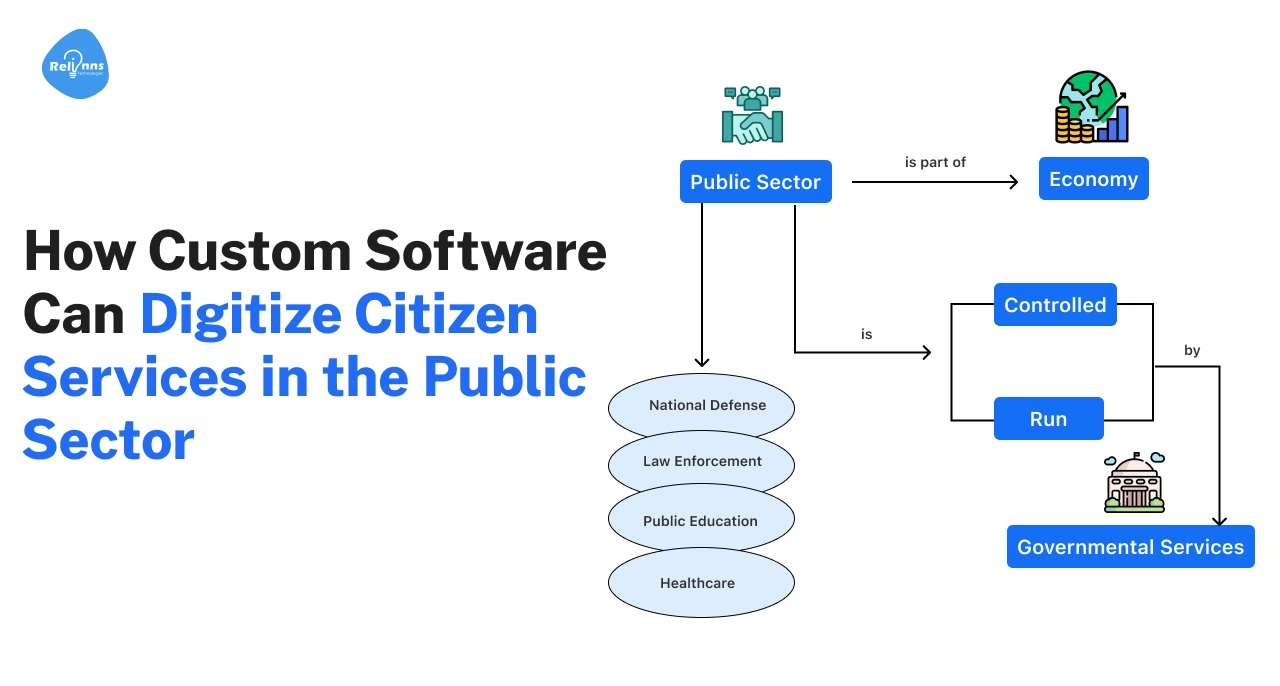
Digitizing Citizen Services has become a core priority for governments that want to improve public trust and deliver faster responses. Citizens expect public services to work with the same simplicity and reliability as the digital products they use daily.
They want clarity, speed, and access from any device, without long wait times or outdated manual steps.
Custom software enables governments to deliver on these expectations with precision. It removes legacy inefficiencies, centralizes service workflows, and supports real-time decision-making across departments.
As adoption increases, administrations are using technology to design digital citizen services that feel modern, consistent, and accessible.
This article explains how governments can use custom software to scale Digitizing Citizen Services and improve delivery outcomes. It highlights the importance of modern digital foundations and shows how public agencies can build accessible, citizen-centric digital services that support long-term growth.
What Makes Custom Software Essential for Digitizing Citizen Services

Government functions operate under unusual rules and require systems that address their policy, service, and compliance frameworks.
Because a generic application is usually insufficient for any given government agency, which won't support regional workflows, multilingual requirements, or complex approval chains, custom platforms can provide a solution.
Custom platforms deliver a tailored experience at every step of the service lifecycle: identity integration, automated forms, real-time application tracking, and secure communication between citizens and government officials.
Custom platforms improve the user experience for citizens while decreasing the operational burden on agency staff.
Custom platforms enable agencies to scale or build features over time without replacing their core platform. Custom platforms are essential to the digitisation of Citizen Services.
They improve service clarity, reduce errors, and provide reliable support during high-demand periods. Most importantly, they help governments maintain long-term stability while upgrading their digital infrastructure.
Blueprint of a High-Impact Digital Citizen Service Platform

A robust digital citizen service platform integrates workflows, data, and user interactions. The goal is to build a complete framework that supports accessible, citizen centric digital services used by millions of people and delivers predictable outcomes.
Below are the core components that define this blueprint.
1. Digital Identity and Secure Access
Digital identity is the foundation of any modern public system.
It verifies each user, protects sensitive information, and makes interactions safer for both citizens and institutions.
This layer supports multi-factor authentication, adaptive security checks, and secure access across all service channels.
- Enhances efficiency for Digitizing Citizen Services through verified user onboarding
- Strengthens operational trust inside a digital citizen service platform
- Builds reliable access pathways that support citizen-centric digital services
2. Data Integration Across Departments
Government systems often operate in isolation, which slows service delivery.
A unified data layer connects healthcare records, municipal systems, tax databases, and welfare registries.
It ensures that consistent information is available in a single view, enabling faster, more accurate decisions.
- Improves cross-departmental visibility for Digitizing Citizen Services
- Removes duplication within a digital citizen service platform
- Increases service accuracy across citizen centric digital services
3. Workflow Automation and Smart Approvals
Automated workflows replace slow manual file movement with streamlined digital steps.
Applications move through the correct approval path instantly.
Officers receive timely updates, and citizens see real-time progress without repeated visits or phone calls.
- Reduces bottlenecks associated with Digitizing Citizen Services
- Creates predictable outcomes inside a digital citizen service platform
- Supports faster resolution within citizen centric digital services
4. Omnichannel Experience and Multilingual Support
A modern system must serve people across devices and communication channels.
Citizens expect services to be accessible through mobile apps, websites, kiosks, and automated chat support.
Multilingual interfaces ensure inclusivity for large and diverse populations.
- Expands accessibility for Digitizing Citizen Services
- Delivers consistent experiences inside any digital citizen service platform
- Encourages participation in citizen centric digital services
5. Cybersecurity and Privacy Protection
A public system must be built with strong security practices.
Encryption, secure APIs, and audit trails protect sensitive data throughout every interaction. This increases trust and ensures compliance with national data standards.
- Protects information during Digitizing Citizen Services rollouts
- Ensures safer data flows inside a digital citizen service platform
- Creates a secure base for citizen centric digital services
6. Real-Time Analytics and Evidence-Based Policy Support
Analytics help agencies understand service patterns, citizen behavior, workload peaks, and operational risks.
Real-time dashboards support informed decisions, better planning, and transparent reporting.
- Provides insight for improving Digitizing Citizen Services
- Supports data-driven decisions within a digital citizen service platform
- Strengthens long-term outcomes for citizen centric digital services
Transforming Citizen Services with a Step-by-Step Digital Roadmap

Digitizing Citizen Services requires a clear, structured roadmap that aligns with policy requirements and meets citizen needs.
A systematic transformation plan ensures that core services, approvals, and public workflows shift smoothly from manual handling to automated digital processes. This roadmap helps agencies upgrade technology without disrupting ongoing operations.
Each step strengthens the ability to design digital citizen services that are accessible, transparent, and consistent.
With the proper foundation, governments can deploy a comprehensive digital citizen service platform and ensure long-term continuity across multiple departments.
Step 1: Assessment of Current Services and Readiness
Transformation begins with a realistic assessment of how services currently operate. Agencies review manual processes, identify delays, and understand gaps in citizen communication.
This mapping reveals which workflows are slow, repetitive, or prone to errors and helps define clear modernization priorities.
Step 2: Infrastructure Modernization and Secure Technology Setup
The next step is building a stable digital environment. Agencies update legacy tools, adopt secure cloud hosting, and establish a unified data foundation.
This ensures that all services perform reliably and remain protected under national data standards.
Step 3: Application Development and Core Feature Implementation
Custom modules are developed to replace manual service components.
These include digital forms, automated approvals, tracking dashboards, multilingual interfaces, and verification systems. Each feature supports streamlined citizen journeys and ensures predictable outcomes.
Step 4: Rollout, Training, and Public Adoption
Digital systems work best when both staff and citizens understand how to use them. Agencies train officials, release simple guides, and introduce mobile-friendly interfaces.
A gradual rollout across service categories ensures a smooth adoption without overwhelming users.
Step 5: Continuous Optimization and Evidence-Based Improvements
Governments monitor incoming data to refine service performance, identify issues, and upgrade communication flows.
Optimization keeps services responsive to population growth, policy changes, and new technology.
Global Use Cases of Digitizing Citizen Services
Below are real-world government examples that follow your exact structure and stat-based results.
A. Estonia National e-Government System

Problem: Estonia was experiencing long wait times and lines for people to obtain state documents because they had to go through multiple steps in the Document Management process. The state was using a paper-based system and had to handle all requests manually. To streamline Identity Management for the citizen base and efficiently process routine government transactions, the state needed a comprehensive Citizen Service Platform with a single database for each citizen's records.
Solution: To address this problem, Estonia created a Connected Digital System. The Connected Digital System utilizes Secure Identity Verification and an Integrated database structure. Within the Connected Digital System, citizens can submit online and allow the agency to provide real-time access to the status of their requests by sharing information with agency partners. As a result of the Connected Digital System, the ability to access public services 24/7 has improved significantly, and citizens can complete all government transactions online and via mobile devices.
Results
- Reduced processing time by 70 percent through Digitizing Citizen Services improvements
- Achieved 99 percent online availability across the digital citizen service platform
- Saved citizens an average of 5 working days yearly through citizen centric digital services
- Lowered administrative workload by 40 percent within six months of full rollout
Use case reference: See more here: Government of Estonia
B. India’s DIGIT Platform for Urban Services
Problem: India faces the challenge of establishing a framework to support the digital growth areas. As a result of using manual systems, municipalities had difficulty tracking applications, collecting taxes, and managing municipal data from multiple locations at scale.
Therefore, citizens of many municipalities faced long wait times when processing their applications and observed inconsistent service experiences across areas. As a result, a digital citizen service platform was required to integrate workflows across different municipal departments.
Solution: The DIGIT Platform provides urban municipalities with a suite of digital forms, automated workflows, multilingual interfaces, and mobile access to support their operations. Municipal Departments can now collaborate to synchronise records, tracking approvals, and deliver transparent updates across multiple Departments. Furthermore, the platform enables each state and city to tailor its features to suit the needs of its jurisdiction's needs without rebuilding core platform components.
Results
- Improved citizen satisfaction by 45 percent through the Digitizing Citizen Services reform
- Increased municipal revenue by 20 percent using digital citizen service platform tools
- Reduced field visits by 60 percent across citizen-centric digital services
- Cut document handling time by 55 percent after automation rollout
Digital Government Success Metrics
Measuring progress is essential for long-term modernization. When agencies invest in Digitizing Citizen Services, the impact should be visible across performance indicators such as service speed, citizen satisfaction, operational savings, and system reliability.
A well-structured digital citizen service platform helps agencies collect this data in real time.
Success metrics guide future improvements and confirm that digital citizen service efforts are delivering meaningful value. They also promote accountability and help governments refine citizen centric digital services to meet public needs.
Below are key metrics commonly used to evaluate digital transformation within the public sector.
- Faster Processing: Shorter service cycles across Digitizing Citizen Services
- Lower Costs: Significant savings on digital citizen service platform operations
- Higher Satisfaction: Improved usability in citizen centric digital services
- Stronger Transparency: Clear insights from unified analytics and reporting
- Better Decisions: Data-guided improvements for digital service planning
Conclusion for Digitizing Citizen Services
Digitizing Government Citizen Services: Digitization enables modernization of the public sector by emphasizing efficiency, clarity, and transparency.
Custom-built digital services enable citizens to access more secure transaction processes through Digital Workflow Technology (DWT), while providing the federal government with up-to-date, universal records for every citizen in the U.S.
While the agency designs a citizen-focused digital service based on a structured framework, it will develop a service that serves as the basis for creating similar services in the future, regardless of the circumstances surrounding government policy or the behaviors of the citizens being served.
Enhanced experiences, fewer delays, and greater reliability of citizen services are characteristics of digitally delivering services to the general public.
A well-built digital citizen service platform supports long-term modernization while providing citizens with a reliable path to essential services. With thoughtful planning and continuous improvement, governments can transform how citizens interact with public institutions.
Why Choose Relinns for Digitizing Citizen Services?
Relinns Technologies builds secure and adaptable systems. Their platforms support automation, multilingual access, analytics, and rapid workflow customization.
Relinns combines strong engineering with a clear focus on citizen centric digital services and long-term government scalability.
- 90% faster approvals within redesigned digital citizen service platform workflows
- 45% lower processing costs across major public service categories
- 95% accuracy improvement through automated data verification and validation
- 50% reduction in the manual department workload after modernization
- 80% citizen adoption rate of mobile-friendly public service features
Frequently Asked Questions (FAQ's)
What is Digitizing Citizen Services, and how does it help governments?
Digitizing Citizen Services replaces manual procedures with secure digital workflows that reduce wait times, improve accuracy, increase transparency, and create a smoother experience for every citizen who interacts with government services.
How does a digital citizen service platform support modernization?
A digital citizen service platform unifies identity and access management, data flows, automation, and analytics, enabling governments to operate services efficiently while achieving more predictable, citizen-friendly outcomes.
Why are custom tools needed to design digital citizen services?
Custom tools are required because governments manage unique policies, compliance rules, multilingual needs, and approval chains that generic solutions cannot consistently or reliably handle.
How do citizen-centric digital services improve accessibility?
Citizen-centric digital services offer mobile interfaces, multilingual content, simplified forms, and responsive tracking, helping more people access essential services without confusion or repeated office visits.
What performance indicators show Digitizing Citizen Services is working?
Key indicators include shorter approval cycles, higher online completion rates, reduced operating costs, improved citizen satisfaction, and greater data visibility to support informed government decision-making.