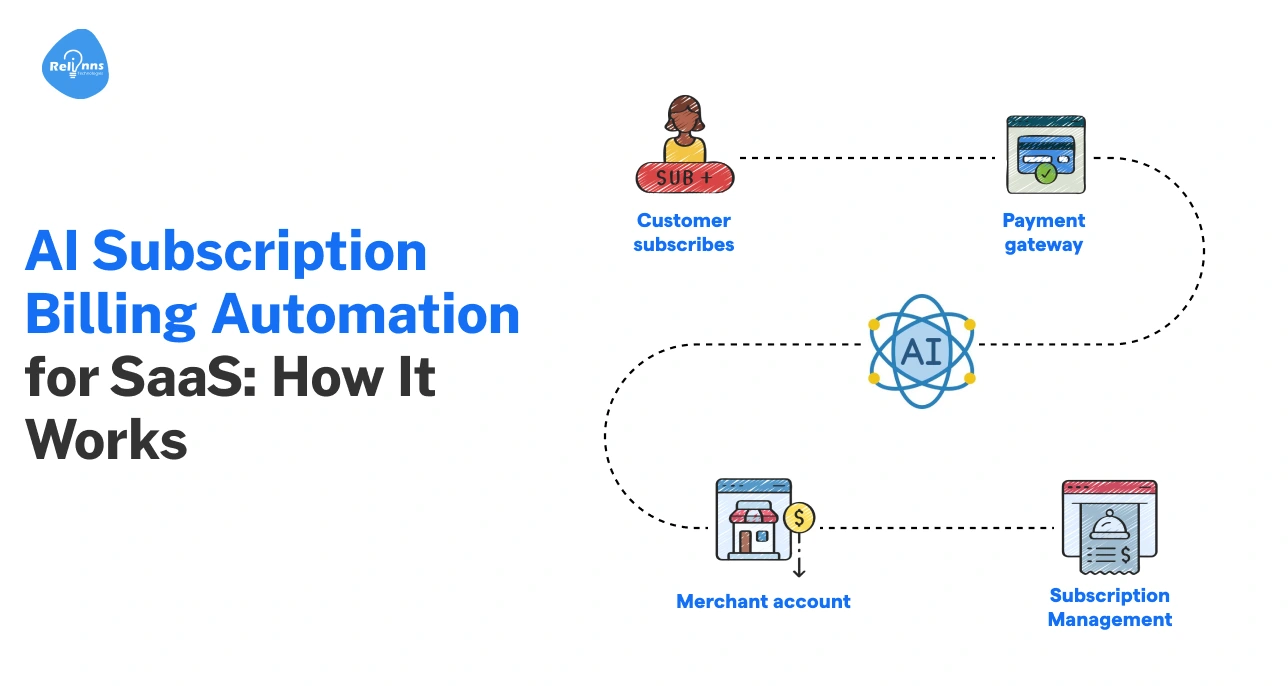
AI Subscription Billing Automation for SaaS: How It Works
Date
Mar 27, 26
Reading Time
10 Minutes
Category
Generative AI
Share


Most SaaS billing systems are one pricing change away from breaking.
Introduce an annual discount. Let customers upgrade mid-cycle. Suddenly, your invoices are wrong, your revenue numbers don’t reconcile, and your finance team is buried in spreadsheet fixes.
Billing fails because the process was never built for this level of complexity.
That’s exactly where AI changes things. AI subscription billing automation doesn’t just speed up your billing; it makes smarter decisions across the entire subscription lifecycle, from charge calculation to failed payment recovery.
In this guide, you’ll learn what AI billing automation for SaaS companies really is, how it works, and what it takes to implement it at scale.
What AI Subscription Billing Automation Means for SaaS
AI subscription billing automation uses machine learning to improve how billing decisions are made across the SaaS lifecycle. It doesn’t just execute rules. It adapts to changes in pricing, usage, and customer behavior.
For example, when a customer upgrades mid-cycle, AI calculates the correct proration, applies any active discount, and generates an accurate invoice.
In the sections ahead, we'll see how this differs from traditional billing automation and why that distinction matters.
Traditional Billing Automation vs AI Billing Automation
Traditional billing systems follow fixed logic. That means, if your pricing changes or customers upgrade mid-cycle, you often need manual fixes.
On the other hand, AI automation learns and adapts to your billing complexity without requiring manual reconfiguration. Here's a clear distinction between the two approaches:
| Aspect | Traditional Billing Automation | AI Billing Automation |
| Logic | Fixed rules (e.g., charge $X on the 1st of every month) | Learns and adapts (e.g.,adjusts charge when a customer upgrades mid-cycle) |
| Flexibility | Breaks with pricing changes | Handles dynamic pricing |
| Error Handling | Manual fixes required | Detects and corrects issues |
| Failed Payments | Basic retry rules | Smart retry and recovery |
| Insights | Limited reporting | Predictive insights |
Where AI Fits into the SaaS Billing Process
AI works across the full billing flow. It improves:
- Invoice accuracy and charge calculation
- Usage-based and hybrid pricing logic
- Failed payment recovery and retry timing
- Proration during upgrades and downgrades
- Revenue tracking and forecasting
For SaaS companies, AI introduces a layer of intelligence that reduces errors and improves recovery.
How SaaS Pricing Has Evolved Beyond Fixed Subscriptions
Modern SaaS pricing is no longer limited to simple monthly or annual plans. It now includes:
- Usage-based and hybrid models are common.
- Customers switch plans frequently.
- Billing cycles are no longer fixed.
- Global payments increase failure risk.
AI helps systems handle this complexity without breaking. It keeps billing accurate, even as your pricing evolves. Now, we'll explore why automating subscription billing isn't optional for growing SaaS companies; it's an operational necessity.
If your business is looking to automate subscription billing, teams like Relinns Technologies can design custom AI solutions that handle complex pricing, usage-based plans, and failed payment recovery, so your billing scales reliably as you grow.
Why SaaS Companies Need to Automate Subscription Billing
Billing feels manageable early on. A few hundred customers, a flat monthly plan, and one payment gateway. Your team handles it fine.
Then you grow. Pricing gets more complex. Customer behavior becomes harder to predict. And suddenly, billing becomes a bottleneck without automation.
Manual Billing Breaks at Scale
Manual billing works until it doesn't. As your customer base grows, so does the volume of invoices, plan changes, prorations, and failed payments. Every one of those requires attention.
For instance, a finance team that handles 200 customers manually cannot handle 2,000 the same way. Errors pile up. Delays increase. And the team spends more time fixing billing than analyzing it.
Billing Errors Create Churn and Revenue Leakage
An overcharge frustrates customers, while an undercharge quietly eats your revenue.
Billing errors are one of the most underrated causes of churn in SaaS. Customers don't always complain; they just cancel. And revenue leakage from missed usage charges or incorrect pro-rations rarely shows up until a financial audit.
Finance and Ops Teams Lose Time on Repetitive Work
Tasks like reconciliation and manual retries aren't strategic, but they consume hours every week.
That time has a real cost. Every hour your finance team spends fixing billing is an hour not spent on forecasting, pricing strategy, or growth planning.
Therefore, automation becomes necessary to maintain accuracy, efficiency, and control as you scale.
Breaking Down the SaaS Billing Process Before AI Automation
Before AI, SaaS billing followed a fixed, step-by-step flow.
Each step works, but it depends heavily on rules, manual checks, and reactive fixes. As complexity grows, these steps start to break or require constant intervention.
The table below showcases each step in the traditional SaaS billing process, and where AI can improve accuracy, speed, and decision-making.
| Step | What It Implies | AI Opportunity |
| Subscription Signup and Plan Selection | Customers choose plans, pricing rules are applied. | Predicts best plan; reduces misconfiguration |
| Usage Capture or Recurring Charge Setup | Track usage or apply fixed billing cycles. | Improves usage accuracy and real-time validation |
| Invoice Generation and Payment Collection | Generate invoices and charge customers. | Detects billing errors before invoices go out |
| Failed Payment Handling and Dunning | Retry failed payments using fixed schedules. | Optimizes retry timing and recovers more revenue |
| Proration, Upgrades, Downgrades, Renewals | Adjust charges during plan changes. | Automates proration with higher accuracy |
| Revenue Recognition and Reporting | Reconcile billing with financial reports. | Improves forecasting and detects revenue gaps |
This process works in simple setups. But as pricing becomes dynamic, edge cases increase. Teams end up fixing invoices, chasing failed payments, and reconciling mismatches manually.
This is where AI in subscription management starts to matter. In the next section, we’ll break down how AI automates each step and what that means for accuracy, recovery, and revenue.
How AI Automates Subscription Billing: A Practical Overview
AI makes billing smarter, catching errors, adapting to complexity, and recovering revenue that traditional systems quietly miss.
Invoice Creation and Billing Accuracy
Invoices are no longer just generated from fixed rules. The system checks pricing logic, validates charges, and flags inconsistencies before invoices are sent.
This reduces overbilling, underbilling, and last-minute corrections.
AI-powered tools like Maxio and Chargebee can help SaaS companies automatically validate invoice line items against contract terms, flagging discrepancies before they reach the customer.
Usage-based and Hybrid Billing Calculations
Dynamic pricing models need precise tracking. The system processes usage data in near real time and applies the correct pricing tiers or combinations.
This keeps charges aligned with actual consumption, even as patterns shift.
Smart Retry Logic and Failed Payment Recovery
Instead of retrying payments on fixed schedules, the system adjusts timing based on customer behavior and payment history.
It can also trigger alternate actions like updating payment methods or sending timely reminders to improve recovery rates.
A common example is seen in Stripe's Smart Retries, which uses machine learning across millions of transactions to predict the optimal moment to retry a failed charge, consistently recovering more revenue than fixed retry schedules.
Proration, Plan Changes, and Renewal Workflows
Mid-cycle upgrades and downgrades are calculated automatically with fewer errors. The system ensures that charges reflect the exact duration and plan differences, without manual adjustments or confusion.
Anomaly Detection, Fraud Flags, and Revenue Leakage
Unusual billing patterns are identified early. The system highlights duplicate charges, missing usage, or suspicious activity so teams can act before it impacts revenue or trust.
For example, if a usage-based customer’s billable events suddenly drop to zero mid-cycle, the system flags it as a potential metering gap, rather than silently generating an undercharged invoice.
Reconciliation, Forecasting, and Finance Reporting
Billing data is continuously aligned with financial records. This improves visibility into revenue trends and makes forecasting more reliable without heavy manual effort.
Especially for high-volume SaaS companies managing multiple plans, currencies, or entities, this removes the month-end reconciliation bottleneck that finance teams dread.
Key Takeaways:
- AI shifts billing from reactive fixes to proactive accuracy, catching errors before they reach customers.
- Smart retry logic and adaptive dunning recover significantly more revenue than fixed schedules ever could.
- From usage tracking to finance reporting, AI reduces manual intervention at every stage of the billing lifecycle.
AI in Subscription Management: A Look Beyond Recurring Charges
Subscription management goes beyond billing cycles. It includes how you segment users, communicate with them, and prevent churn.
Here's a breakdown of what AI makes possible across subscription management:
| Management Area | What Changes with AI | Real-world Examples |
| Smarter Customer Segmentation and Billing Rules | Customers are grouped based on behavior, usage, and payment patterns instead of static plans. | High-usage customers are identified early and prompted to upgrade to better-fit pricing tiers. |
| Personalized Payment Reminders and Renewal Nudges | Messages are timed and tailored based on user behavior. | A customer who usually pays late receives a reminder earlier, improving payment success rates. |
| Predictive Churn and Involuntary Churn Prevention | Risk signals are detected early from usage drops or failed payments. | A user who logged in daily but hasn’t in two weeks gets a targeted check-in before their next renewal - not after they cancel |
| Better Subscription Lifecycle Visibility for Finance Teams | Data is continuously updated across the customer journey. | Finance teams track MRR changes and churn risk in real time instead of waiting for month-end reports. |
AI thus turns subscription management into a continuous process. It helps teams act earlier, reduce churn, and improve customer experience without manual effort.
How to Manage Failed Payments in Automated Billing Systems
Failed payments don’t just delay revenue. They directly lead to involuntary churn.
Likewise, many customers don’t update payment details in time, even if they intend to continue. Over time, this results in lost revenue that could have been recovered.
What AI Changes in Dunning Workflows
Traditional dunning relies on fixed retry schedules and generic reminders. This approach misses context.
Intelligent systems like Recurly adjust retries and communication based on user behavior, payment history, and likelihood to pay.
Consider: A customer whose card was declined due to a temporary bank hold. A fixed system retries in 3 days and fails again. An intelligent system detects the decline code, waits 18 hours, and recovers the payment on the next attempt.
Smart Retry Timing and Payment Method Recovery
Instead of retrying blindly, systems optimize when and how to retry:
- Retry at times when the success probability is higher (like right after salary credit dates or typical payment windows)
- Detect temporary vs permanent failures.
- Prompt users to update payment methods at the right moment
It’s crucial to balance persistence with timing to maximize recovery without frustrating users.
Reminder Flows that Reduce Churn Without Hurting CX
Poorly timed reminders frustrate users. Smarter systems improve this by:
- Sending reminders based on user activity
- Personalizing tone and timing
- Avoiding excessive follow-ups
Imagine a customer whose card expires next week. Instead of a generic “payment failed” email after the fact, they receive a friendly in-app nudge three days before renewal, and update their card without ever experiencing a failed charge.
Key Metrics to Track Failed Payment Recovery Performance
To measure the effectiveness of your failed payment recovery strategy, track:
- Payment Recovery Rate: Percentage of failed payments successfully recovered.
(Benchmark: 60-80% for optimized systems) - Involuntary Churn Rate: Customers lost due to payment failures, not intent. (Benchmark: <1-2% of total subscribers)
- Retry Success Rate: Percentage of failed payments successfully captured through retry attempts. (Benchmark: 30–50% depending on timing, payment method, and retry strategy)
- Time to Recover Failed Payments: Average time taken to recover a failed payment. (Benchmark: 3-7 days for most SaaS companies)
The best dunning strategy isn’t the most aggressive one; it’s the one that recovers revenue while making the customer feel respected, not chased.
SaaS Billing Models That Benefit Most from AI Automation
Different SaaS pricing models introduce different levels of billing complexity. Some require more flexibility, accuracy, and control than others.
Here are the most common SaaS billing models that gain the most from AI automation:
| Billing Model | What It Means | Key Benefit |
| Fixed Recurring Subscriptions | Customers pay a set amount on a regular cycle. | Ensures consistent billing and fewer renewal errors |
| Usage-based Billing | Charges depend on actual product usage. | Improves billing accuracy and captures all usage revenue |
| Hybrid Subscription + Usage Models | Combines fixed fees with variable usage charges | Handles multiple pricing components without confusion |
| Tiered and Multi-plan Pricing | Different plans with varying features and pricing levels | Simplifies plan changes and pricing transitions |
| Multi-entity or High-volume SaaS Operations | Large-scale billing across regions, currencies, or entities | Maintains accuracy and consistency at scale |
Regardless of the model, the pattern is consistent. The more variables in your pricing, the more AI has to offer.
What to Look for in Subscription Billing Automated Software
Choosing the right billing software is not just about handling invoices. It should support your pricing model, reduce manual effort, and stay reliable as you scale.
Here's a breakdown of what you should expect in a production-ready subscription billing automation solution:
Billing Engine Flexibility
Your billing system should adapt to changing pricing structures. Whether it’s plan changes, discounts, or custom contracts, flexibility ensures you don’t rebuild workflows every time pricing evolves.
Think: Handling mid-cycle upgrades, custom pricing, and proration without manual fixes
Usage Metering and Pricing Support
Accurate usage tracking is critical for modern SaaS. The system should capture data reliably and apply the correct pricing logic without delays or gaps.
Example: Tracking API calls or feature usage and billing customers accurately in real time
Failed Payment Recovery Tools
Look for built-in capabilities that improve payment recovery. This includes smart retries, payment method updates, and well-timed reminders to reduce churn.
Tools like Paddle offer built-in dunning management with configurable retry logic, automated card update requests, and behavioral reminder sequences.
Revenue Recognition and Reporting
Billing and finance should stay aligned. The system must support clear reporting, making it easier to track revenue and maintain accuracy in financial records.
CRM, ERP, and Payment Gateway Integrations
Your billing software should connect easily with existing systems. Seamless integration reduces data silos and improves overall workflow efficiency.
Consider whether the platform natively integrates with your existing CRM, ERP, and payment gateway platforms or whether those connections require custom development.
Security, Compliance, and Audit Readiness
Strong data protection and compliance support are essential. The system should maintain clear records and meet standards required for audits and regulations.
For example, a SaaS company operating in healthcare will need billing systems that comply with HIPAA, ensuring patient-related billing data is handled, stored, and transmitted with the required level of protection.
The right billing software doesn’t just process payments; it protects revenue, reduces operational load, and grows with your pricing strategy.
Many growing SaaS businesses choose AI development experts like Relinns Technologies to build AI billing solutions that fit their unique pricing models, integrate seamlessly with existing systems, and handle failed payments intelligently.
Build vs Buy: Subscription Billing Automation for SaaS
As SaaS pricing models evolve, teams need to decide whether to rely on existing tools or build custom systems. The right choice depends on pricing complexity, scale, and control requirements.
Here’s a comparison across common SaaS billing scenarios:
| Criteria | SaaS Billing Software | Legacy or Rule-Based Systems | Custom AI Billing |
| Pricing Support | Supports standard, tiered, and some usage-based plans | Limited flexibility | Handles complex, hybrid, and usage-based models |
| Setup Time | Days to weeks | Weeks | 6-12+ weeks depending on scope |
| Scalability | Scales well but limited with complex logic | Struggles at scale | Built for high-scale, complex workflows |
| Customization | Configurable within platform limits | Rigid | Fully tailored |
| Failed Payment Recovery | Smart retries and dunning workflows | Basic retries | Adaptive, behavior-driven recovery |
| Revenue Recognition | Built-in reporting and compliance support | Often manual | Automated, finance-aligned workflows |
| Best Fit For | Early to growth-stage SaaS | Basic or legacy setups | Growth-stage and enterprise SaaS with complex needs |
The decision ultimately comes down to whether your billing system can support your pricing complexity today and scale with it tomorrow without increasing operational overhead.
Common Mistakes to Avoid When Automating Subscription Billing
Automation doesn't fix bad billing decisions; it amplifies them. Here are the most common mistakes SaaS teams make when automating subscription billing, and how to avoid them.
Automating a Broken Billing Process
Challenge: If your billing logic is unclear, automation will only scale the problem.
Solution: Fix workflows first, then automate clean, well-defined processes. This means auditing your current billing logic, resolving edge cases around plan changes and prorations, and documenting clear rules before a single workflow gets automated.
Ignoring Proration and Plan-change Clarity
Challenge: Poor handling of upgrades or downgrades leads to incorrect charges. For example, mid-cycle upgrades often result in overbilling if not calculated properly.
Solution: Ensure proration rules are accurate and transparent to avoid confusion.
Treating Failed Payments as a Minor Issue
Challenge: Failed payments are a major source of hidden churn and lost revenue. A highly common reason is outdated card details - customers don’t notice their card has expired until a payment fails and they receive a cancellation notice.
Solution: Build strong recovery flows with retries, reminders, and payment updates.
Using Tools That Cannot Support Future Pricing Models
Challenge: Rigid tools may work early but struggle with usage-based or hybrid pricing.
Solution: Choose systems that can adapt as your pricing evolves. This would mean avoiding tools locked into flat-rate billing if usage-based or hybrid pricing is on your product roadmap, switching systems mid-scale is far more costly than choosing the right one early.
Missing Finance, Compliance, and Reporting Needs
Challenge: If billing and finance don’t align, reporting gaps and audit risks increase.
Solution: Ensure your system supports accurate reporting and compliance requirements from the start.
The companies that get billing automation right don’t just automate faster. They audit first, plan ahead, and treat billing as a core part of their product experience.
Final Thoughts
Billing in SaaS gets messy as you grow. Plans change, usage varies, and customers upgrade mid-cycle. Manual fixes and basic tools can’t keep up.
AI billing automation for SaaS companies doesn’t just speed up invoices. It makes smarter decisions, decreases inaccuracies, and recovers revenue before it’s lost. It also gives your finance team clear insights without extra work.
With faster billing, you also get predictability and accuracy that adapt as your business evolves.
If your current system struggles, adopting AI-driven automation can keep your revenue flowing and your customers happy.
Frequently Asked Questions
What is AI billing automation for SaaS companies?
AI billing automation uses machine learning to handle complex subscriptions, improve invoice accuracy, and optimize failed payment recovery without manual intervention.
How does AI improve subscription billing?
AI adapts to pricing changes, usage variations, and customer behavior, reducing errors, speeding up billing, and increasing revenue recovery.
Can AI automate failed payment recovery?
Yes, AI optimizes retry timing, updates payment methods automatically, and sends tailored reminders to recover more failed payments efficiently.
What’s the difference between billing automation and AI billing automation?
Traditional automation follows fixed rules. AI billing adapts dynamically, predicts errors, and improves revenue and reporting accuracy.
Is AI useful for usage-based or hybrid SaaS pricing?
Absolutely. AI accurately calculates complex usage-based or hybrid charges, proration, and mid-cycle plan changes without manual effort.
Should SaaS companies build or buy AI billing automation?
Early-stage SaaS may use off-the-shelf software. Growth-stage or complex pricing often benefits from custom AI billing built by experts.
How can AI reduce involuntary churn in SaaS?
AI detects failed payments early, sends personalized reminders, and recovers subscriptions before customers cancel, reducing involuntary churn significantly.