AI Predictive Maintenance: How It Works, Examples, Benefits
Date
Mar 27, 26
Reading Time
10 Minutes
Category
Generative AI
Share


Most machines don't just break; they warn you first, and most businesses miss it entirely.
By the time something breaks, the damage is already done, and the cost is far higher than it needed to be. This is the reality for thousands of businesses still relying on outdated maintenance approaches.
AI predictive maintenance changes all of that. It catches failure signals early, before breakdowns happen, and helps teams act at exactly the right time.
This guide breaks down how AI in predictive maintenance works, what it takes to implement it, and why it matters.
AI Predictive Maintenance: What It Is and Why It Matters
AI predictive maintenance uses artificial intelligence to monitor equipment in real time, detect early failure signals, and predict when something is likely to break.
For instance, a sensor on a motor can flag abnormal vibration patterns days before a bearing fails.
But how is this different from what most businesses already do, and why does it matter?
Traditional Maintenance vs AI Predictive Maintenance: What's the Difference?
Traditional predictive maintenance relies on fixed thresholds. On the other hand, AI learns from historical data, adapts to changing conditions, and spots patterns that rule-based systems simply can't catch.
Here's a clear difference between traditional vs AI predictive maintenance.
| Factor | Traditional Predictive Maintenance | AI Predictive Maintenance |
| Decision Basis | Fixed thresholds (e.g., triggering an alert only when temperature exceeds 90°C) | Learned patterns from data (e.g., detecting subtle vibration shifts that precede motor failure) |
| Adaptability | Static rules | Continuously improves |
| Failure Detection | Reactive to known signals | Detects unknown anomalies |
| Data Handling | Limited data inputs | Handles large, complex datasets |
| Accuracy | Moderate | Higher, with fewer false alerts |
Thus, AI doesn't just monitor equipment. It understands it and gets smarter over time.
Why AI Improves Maintenance Decisions
Instead of acting on schedules or “gut feel”, maintenance teams get data-backed predictions with risk scores and recommended actions.
Think of it as having a highly experienced engineer watching every machine, every hour - without fatigue, bias, or blind spots. That means fewer emergency repairs, smarter scheduling, and less wasted spend on parts that didn't need replacing yet.
The result is decisions that are driven by evidence, not assumptions.
For businesses looking to move in this direction, the real challenge is turning this potential into a working system. Many organisations partner with teams like Relinns Technologies that build practical AI solutions to connect with existing systems, work with real-world data, and deliver measurable outcomes.
What's Pushing Businesses Toward AI-Driven Predictive Maintenance
Unexpected failures can slow business operations, delay deliveries, and increase costs.
As businesses implement more and more complex systems, it becomes difficult for traditional systems to follow suit. That’s why more businesses are shifting toward AI-driven predictive maintenance.
In fact, the global predictive maintenance market is projected to reach $16.74 billion by 2031, growing at over 11.5% annually. This reflects the increasing urgency for businesses to act proactively.
Limitations of Reactive Maintenance
Reactive maintenance means fixing things after they break. This creates more problems than it solves:
- Unplanned downtime disrupts operations.
- Emergency repairs are costly.
- Equipment damage often gets worse.
- Safety risks increase during sudden failures.
Example: A manufacturing plant may run a critical pump without warning signs, until it fails mid-shift, halting the entire production line for 18 hours and costing tens of thousands in emergency repairs and lost output.
Why Preventive Maintenance Falls Short Too
Preventive maintenance follows fixed schedules. That means, a machine would get serviced every 90 days regardless of its actual condition. But machines don’t fail on a timetable:
- Parts get replaced too early or too late.
- Maintenance costs increase without a clear need.
- Unexpected failures still happen.
- It ignores real-time equipment conditions.
This approach wastes resources on healthy equipment while still leaving teams blind to real-time deterioration.
Where AI Adds Real Value for Predictive Maintenance
The gap between fixed schedules and real equipment behavior is exactly where AI-driven predictive maintenance creates value.
AI predictive maintenance software uses real data to predict failures before they happen. This changes how maintenance works:
- Detects early warning signs from sensor data
- Predicts failures based on patterns, not guesswork
- Reduces downtime with timely interventions
- Helps teams focus only on high-risk assets
Consider: A wind farm operator uses AI to monitor turbine vibration and temperature in real time. The system flags a developing fault two weeks early; the team schedules a repair during low-wind hours and avoids a $200,000 unplanned outage.
Therefore, instead of reacting to breakdowns or following rigid schedules, AI enables maintenance decisions based on real-time data and predictive insights.
AI Predictive Maintenance vs Other Strategies: A Comparative Overview
We've already covered why reactive and preventive maintenance fall short. But there are other strategies worth understanding, particularly condition-based and prescriptive maintenance, and how they each compare to AI predictive maintenance.
Here’s a simple breakdown of each approach and where it stands:
| Approach | What it means | Impact | Example |
| Reactive maintenance | Fix the equipment after it breaks. | High downtime, costly repairs | Repairing a machine only after it stops working |
| Preventive maintenance | Service equipment on a fixed schedule. | Reduces failures but wastes resources | Replacing parts every 6 months regardless of condition |
| Condition-based maintenance | Monitor real-time conditions and act on thresholds. | Better timing but limited prediction | Servicing a motor when vibration crosses a set limit |
| Predictive maintenance | Use data and models to predict failures in advance. | Lower downtime, optimized maintenance | Predicting bearing failure using sensor data |
| Prescriptive maintenance | AI suggests what action to take and when. | Faster decisions, higher efficiency | The system recommends replacing a part next week to avoid failure. |
Based on the given table, here are the key takeaways for choosing the right maintenance strategy:
- Reactive and preventive methods are simple but inefficient.
- Condition-based adds real-time awareness but lacks prediction.
- Predictive maintenance improves planning using data.
- Prescriptive maintenance goes further by recommending actions.
- AI-driven approaches work best for critical, high-cost assets.
Which Approach is Right for Your Assets
The right approach depends on asset value, failure risk, and data availability.
High-value or critical systems benefit most from AI-driven methods, while low-risk assets may still work with simpler strategies.
For example, a CNC machine running 24/7 in a manufacturing plant justifies AI predictive maintenance, but a low-use storage conveyor may only need scheduled servicing every few months.
How AI Predictive Maintenance Works (Step-by-Step Process)
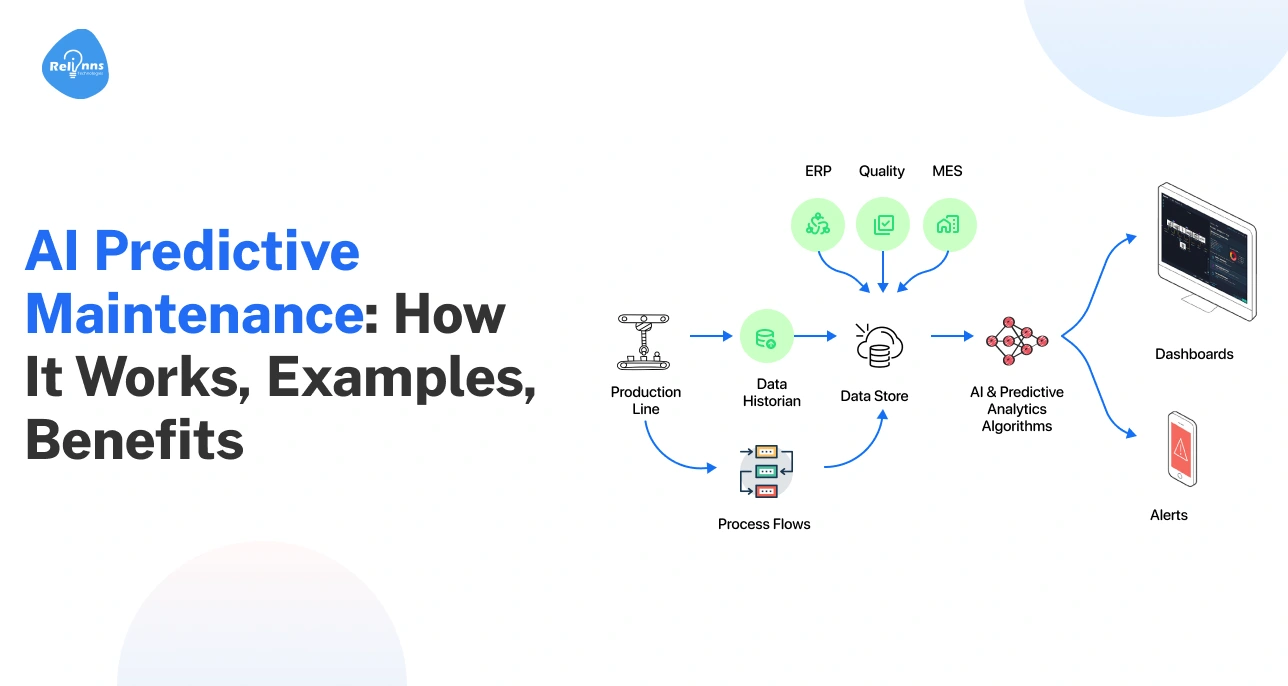
At its core, AI for predictive maintenance follows a simple idea: collect data → learn from it → act before something breaks.
But behind that simplicity is a step-by-step process that turns raw machine data into real decisions. Here’s how predictive maintenance using AI works in practice:
| Step | Implication |
| Data Collection from Machines and Systems | Sensors, IoT devices, and logs capture data like temperature, vibration, and usage. You get a continuous view of how equipment is actually behaving. |
| Data Processing and Preparation | Raw data is cleaned, organized, and aligned. This removes noise and makes the data usable for analysis. |
| Pattern Detection and Anomaly Identification | AI models learn what “normal” looks like and flag unusual patterns early. Small issues get noticed before they grow. |
| Failure Prediction and Risk Scoring | The system estimates when a failure might happen and how serious it could be. Teams can prioritize what needs attention first. |
| Alerts, Work Orders, and Maintenance Actions | Alerts are triggered automatically. Maintenance teams know what to fix, when, and why (without guesswork). |
| Continuous Learning and Model Improvement | The system keeps learning from new data and past outcomes. Predictions improve over time as more data flows in. |
The result is smarter maintenance. Teams fix issues at the right time, avoid unnecessary work, and keep systems running smoothly.
The Data That Powers AI Predictive Maintenance Software
AI models are only as good as the data they learn from. To predict failures accurately, systems need a mix of real-time signals, past records, and context around how equipment is used.
Here's what a well-rounded AI predictive maintenance system typically relies on:
- Sensor and IoT Data: Real-time signals like temperature, vibration, and pressure help track how machines behave and detect early warning signs.
- Historical Maintenance and Failure Logs: Past records of breakdowns and repairs help identify patterns and improve prediction accuracy over time.
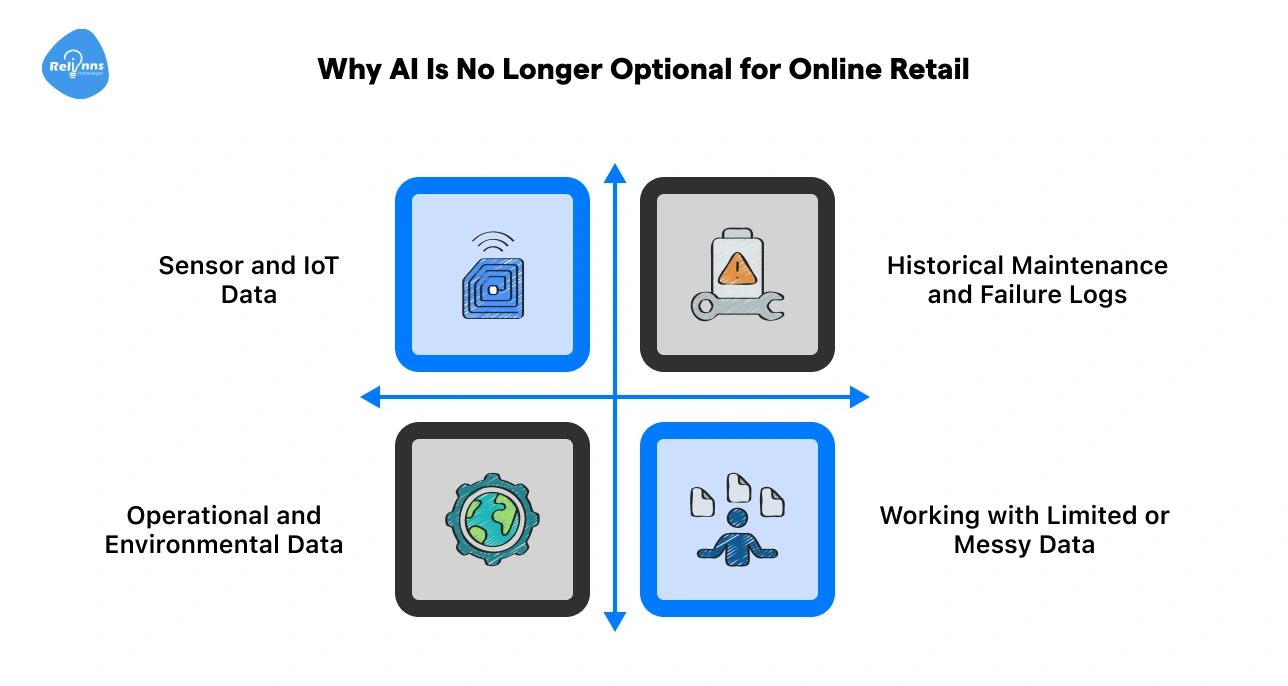
- Operational and Environmental Data: Usage patterns, load conditions, and external factors like humidity add important context to machine performance.
- Working with Limited or Messy Data: Data is often incomplete or inconsistent, but models can still work with smaller or imperfect datasets, though accuracy improves as more high-quality data becomes available.
Real-world Examples of Data in Action:
- A motor running at 85°C consistently (10°C above its normal baseline) triggers an AI alert flagging probable bearing wear, prompting a targeted inspection before failure occurs.
- Vibration readings on an industrial pump crossing a defined threshold (for example, around 5 mm/s depending on equipment standards) cause the system to automatically schedule a maintenance work order for the following week.
Better data and custom software for predictive maintenance don’t just improve predictions; they make the entire maintenance operation smarter.
Early Failure Signals AI Identifies Before Equipment Breaks
AI systems pick up small changes that are easy to miss. These signals often show up long before a breakdown. Here’s what artificial intelligence in predictive maintenance typically tracks:
| Signal | What it usually indicates |
| Vibration Anomalies | Imbalance, misalignment, or worn-out components in rotating equipment |
| Temperature Changes | Overheating due to friction, poor lubrication, or electrical issues |
| Pressure and Flow Irregularities | Blockages, leaks, or inefficient system performance |
| Acoustic Variations | Unusual sounds from friction, cracks, or internal damage |
| Electrical Signal Deviations | Voltage drops, current spikes, or failing electrical components |
When combined, these signals give a clearer picture of what’s actually going wrong inside the system.
At this stage, it’s worthwhile to look at what machine learning models turn the data into accurate predictions.
Machine Learning Models for Predictive Maintenance
For predictive maintenance using AI, different problems call for different models. Here's how machine learning for predictive maintenance works:
Anomaly Detection Models
These models learn what normal looks like and flag anything unusual. They work well when failure data is limited or unknown.
For example, an anomaly detection model monitoring a conveyor belt might flag an unusual spike in motor current, even if that exact pattern has never been seen before.
Classification Models for Fault Detection
These models identify specific fault types. They help teams understand what kind of issue is occurring in the system.
Let's think about a wind turbine. If the AI classifies a fault as “blade imbalance” rather than just “anomaly”, the maintenance team knows exactly what to fix, saving hours of diagnosis time.
Regression Models for Remaining Useful Life
These models estimate how long a component will last. This helps plan maintenance before failure happens.
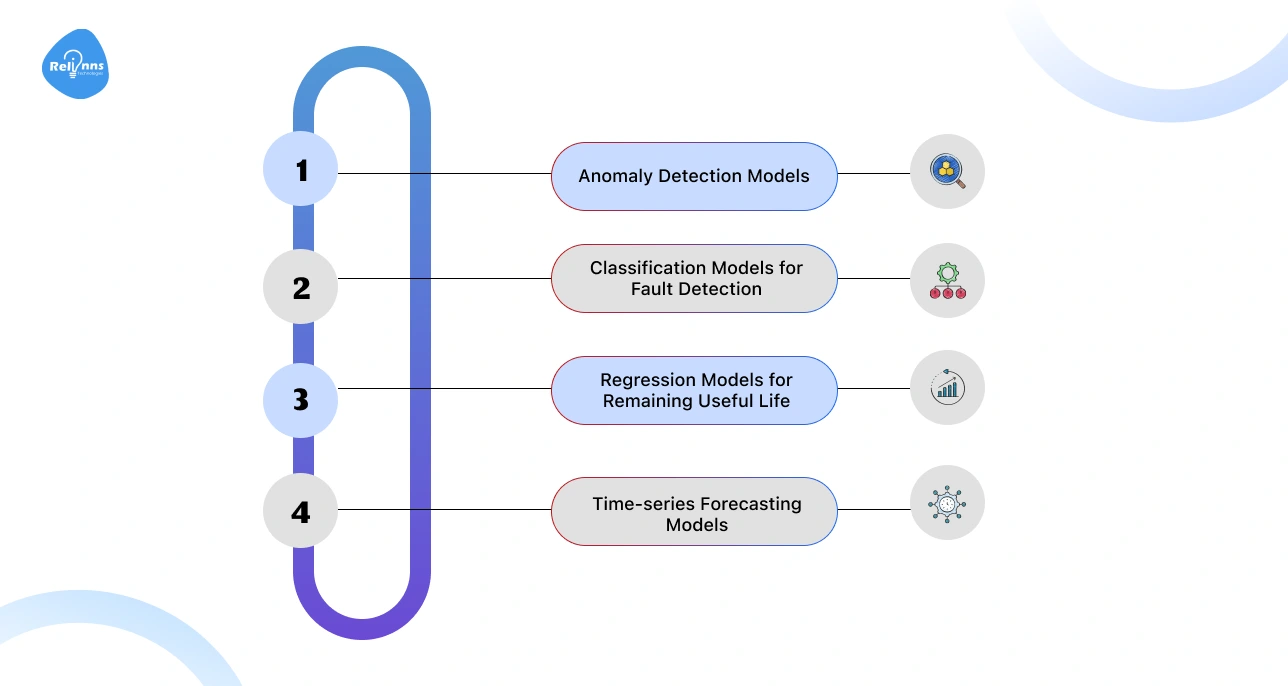
Time-series Forecasting Models
These models analyze patterns over time. They predict future behavior based on past trends in machine data.
Examples include LSTM (Long Short-Term Memory) networks and ARIMA models that analyze months of vibration or temperature data to forecast when a machine is likely to degrade beyond safe operating limits.
Yet, before you choose between advanced AI and simpler models, it's also important to understand the trade-offs that come with each approach.
When to Use Advanced AI vs Simpler Models
Simple models work well with smaller datasets and clear patterns. Advanced AI is useful when systems are complex and data is large. Here’s a quick way to think about it:
- Use simpler models(e.g., threshold rules, linear regression) when you have limited historical data, a small number of assets, or a tight implementation budget. They're faster to deploy and easier to explain to non-technical teams.
- Use advanced AI (e.g., deep learning, LSTM networks) when you’re dealing with high-value equipment, multiple interacting variables, or failure patterns that are too subtle for rule-based detection.
- Start simple, then scale. Many teams begin with basic anomaly detection and layer in more complex models as data volume and confidence grow.
The goal isn't the most sophisticated model; it's the most appropriate one for your assets and data maturity.
AI Predictive Maintenance Examples and Use Cases by Industry
Different industries use AI predictive maintenance in different ways, but the use cases depend on the type of equipment and risks involved.
| Industry | How It Is Used |
| Manufacturing | Predicts machine wear in production lines. Helps avoid sudden stoppages and keeps output stable. |
| Energy and Utilities | Monitors turbines, transformers, and grids. Detects issues early to prevent outages. |
| Transportation and Fleet Management | Tracks vehicle health using engine and usage data. Companies like Tesla use predictive insights to monitor performance and reduce unexpected breakdowns. |
| Oil and Gas | Watch pipelines, drilling equipment, and compressors. Flags risks like leaks or pressure issues early. |
| Healthcare | Monitors critical equipment like MRI and ventilators. Helps ensure devices are available when needed. |
| Facilities and Infrastructure | Tracks HVAC systems, elevators, and building assets. Keeps operations smooth in large buildings and campuses. |
Each industry applies the same idea in its own context, using data to catch issues early and keep operations running without disruption.
Key Benefits of AI in Predictive Maintenance
AI predictive maintenance helps teams move from guesswork to informed decisions.
Instead of reacting late or over-maintaining, businesses can act at the right time. This leads to better performance, lower costs, and more reliable operations.
Here are the top advantages of using AI in predictive maintenance:
- Reduced Unplanned Downtime: AI spots early warning signs and helps fix issues before failure. This keeps machines running and avoids sudden interruptions.
- Lower Maintenance Costs: Teams avoid unnecessary servicing and emergency repairs. Resources are used only where needed, reducing overall spend.
- Extended Equipment Lifespan: Fixing problems early prevents damage from getting worse. Machines stay in better condition for longer.
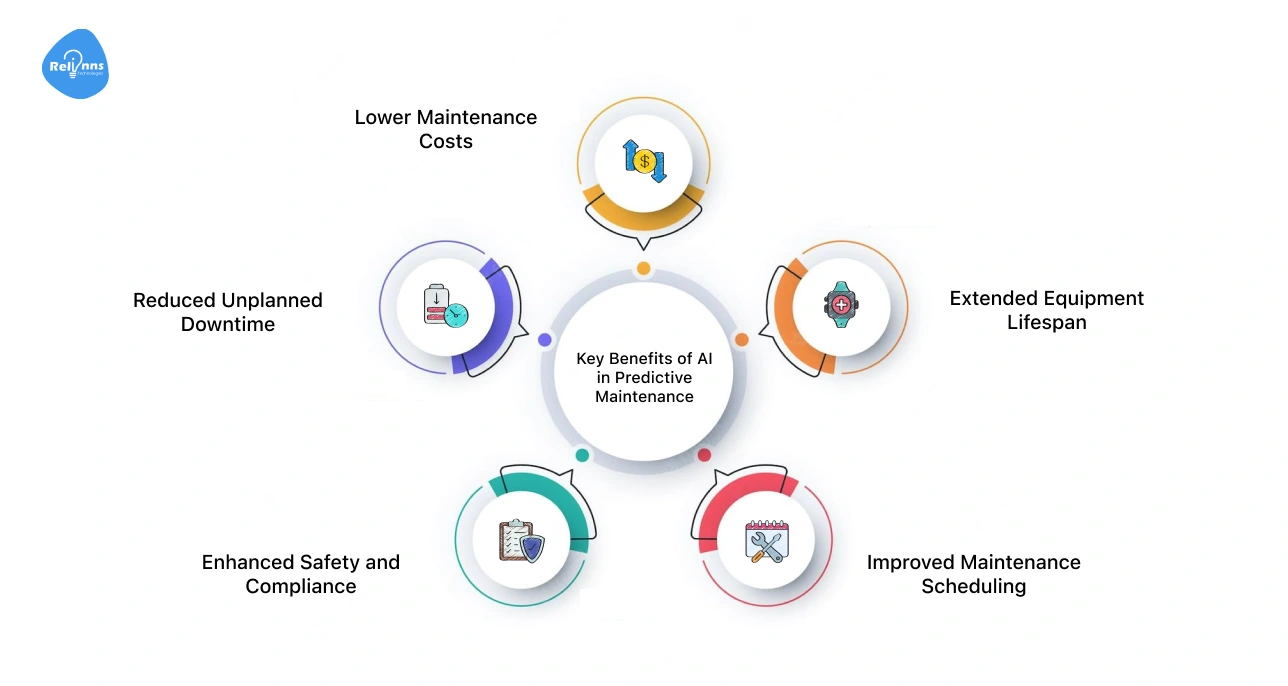
- Improved Maintenance Scheduling: Maintenance is planned based on actual need, not fixed timelines. This reduces disruption and improves team efficiency.
- Enhanced Safety and Compliance: Early detection lowers the risk of accidents. It also helps meet safety standards by keeping equipment in proper condition.
The shift from reactive to AI-driven maintenance isn't just an operational upgrade. It provides a competitive advantage to businesses seeking to eliminate unnecessary downtime and get more out of every asset they own.
The Real Challenges of AI Predictive Maintenance
AI predictive maintenance can deliver strong results, but the path isn’t always straightforward.
Most teams run into a few common hurdles early on. The good news is, each of these can be handled with the right approach.
Data Quality Issues
Challenge: The data you get from machines is often messy. It may have gaps, errors, or inconsistent formats, which makes it harder to trust the insights.
For example, a sensor that records temperature every 10 seconds may have hours of missing data during shift changes, making it difficult for the model to learn accurate patterns.
Solution: Don’t wait for perfect data. Start small, clean what you have, and improve data quality step by step as the system evolves.
Integration with Legacy Systems
Challenge: Many existing machines weren’t built to share data easily, which makes integration slow and frustrating. This is seen in older manufacturing plants where machines run on proprietary protocols that don't communicate with modern software out of the box.
Solution: Add external sensors or use simple connectors to pull data without replacing entire systems.
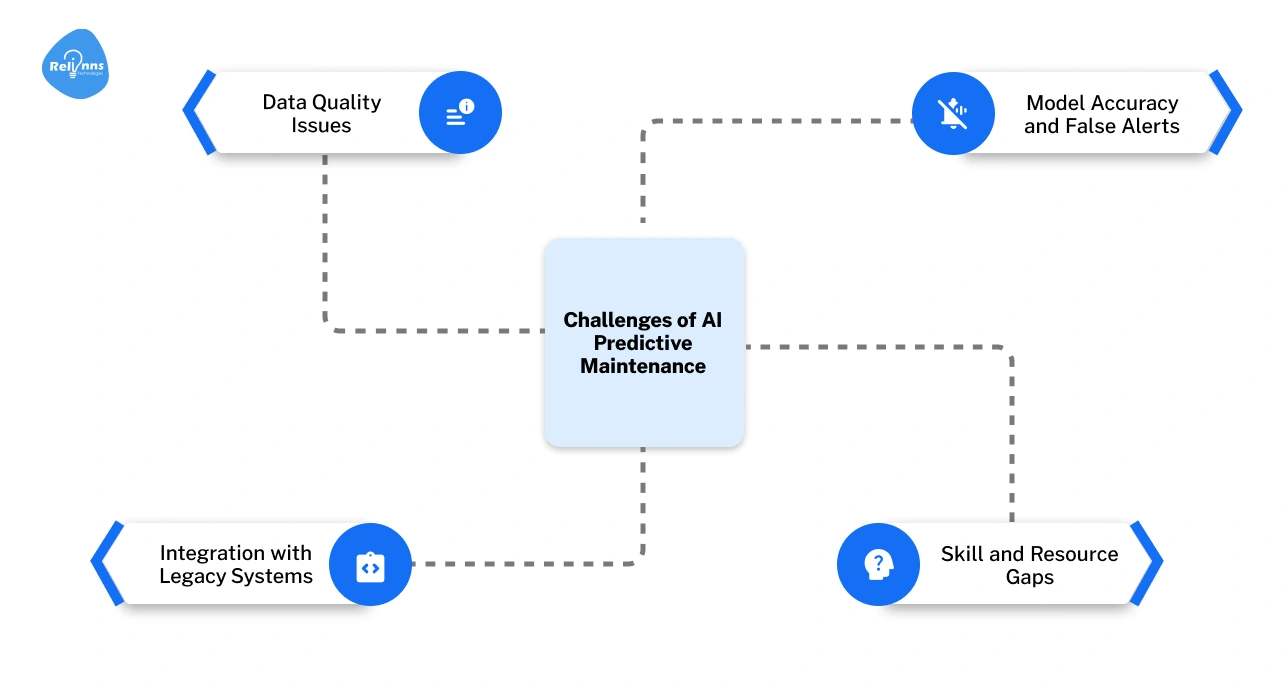
Model Accuracy and False Alerts
Challenge: Early models can overreact or miss real issues, which can reduce trust among teams.
Solution: Keep refining models with real feedback and adjust alert thresholds based on actual outcomes. It helps build team confidence gradually, so people stop dismissing alerts and start acting on them.
Skill and Resource Gaps
Challenge: Teams may not have the time or expertise to build and manage AI systems. This becomes a huge roadblock for mid-sized businesses that don't have dedicated data science teams or in-house AI expertise.
Solution: Begin with focused pilots and use ready tools or external support to ease the workload and build internal confidence before committing to a full-scale rollout.
The challenges are real, but none of them are dealbreakers. With the right strategy, the right tools, and the right partner, most businesses can work through them faster than they expect.
Partnering with experienced teams like Relinns Technologies can make a difference - helping businesses navigate messy data, connect legacy systems, and build practical AI solutions that actually work in real-world conditions.
How to Actually Implement AI Predictive Maintenance
Getting started with AI predictive maintenance doesn’t have to be complex. The key is to take it step by step, focus on impact, and build as you go.
Here’s a simple way for businesses to approach it:
| Step | What it Means in Practice |
| Identify Critical Assets | Focus on machines that are expensive to repair or cause major disruption when they fail. Start where impact is highest. |
| Define Failure Modes and Goals | Be clear on what can go wrong and what you want to prevent. This helps guide the entire setup. |
| Prepare and Integrate Data Sources | Bring together sensor data, logs, and system data. Make sure everything is accessible and usable. |
| Run Pilot Projects | Start small with one use case or asset group. Test, learn, and fix gaps before expanding. |
| Scale Across Operations | Once it works, roll it out to more systems. Standardize processes and improve as more data comes in. |
This step-by-step approach keeps things practical and reduces risk while building real results.
The ROI of AI Predictive Maintenance: What to Track and Why
Investing in AI predictive maintenance is one thing; proving its value to stakeholders is another. These four metrics give you a clear, measurable way to do exactly that.
- Downtime Reduction: Track the drop in unplanned outages. A 20-50% reduction is a strong benchmark for most operations.
- Cost Savings: Measure lower repair and maintenance spend. Many teams see 10-30% savings by avoiding emergency fixes and unnecessary servicing.
- Asset Performance Improvements: Look at uptime and output consistency. A 10-20% improvement in asset utilization is a solid indicator of impact.
- Operational Efficiency Gains: Evaluate team productivity and planning accuracy. A 15-25% boost in maintenance efficiency shows better use of time and resources.
These benchmarks give a clear way to track value and justify investment.
The Future of AI Predictive Maintenance
AI predictive maintenance is moving toward edge AI and real-time monitoring, where decisions happen instantly, closer to the machines.
Digital twins will create virtual models of equipment, helping teams simulate failures and plan better. Over time, autonomous maintenance systems will not just detect issues but also trigger the right actions with minimal input.
This shift will make maintenance more seamless and less disruptive. For businesses, it means fewer surprises, better planning, and smoother operations without constant manual oversight.
On the whole, maintenance is shifting from a cost center to a strategic advantage, and AI is what's making that possible.
Frequently Asked Questions (FAQs)
What is AI predictive maintenance?
AI predictive maintenance uses machine learning and data from equipment to predict failures in advance, helping teams fix issues before breakdowns occur.
How does AI predictive maintenance work?
It collects machine data, analyzes patterns, detects anomalies, and predicts failures, allowing maintenance teams to act before problems cause downtime.
What are the benefits of AI predictive maintenance?
It reduces downtime, lowers maintenance costs, improves equipment lifespan, and helps teams plan maintenance more efficiently using real-time data insights.
What data is needed for predictive maintenance?
It requires sensor data, historical maintenance records, and operational data to accurately detect patterns and predict equipment failures.
Which industries use AI predictive maintenance?
Manufacturing, energy, transportation, oil and gas, healthcare, and infrastructure use it to monitor equipment and prevent unexpected failures.
What is the difference between predictive and preventive maintenance?
Preventive maintenance follows fixed schedules, while predictive maintenance uses data and AI to perform maintenance only when needed.
What are the common challenges in AI predictive maintenance?
Common challenges include poor data quality, integration with legacy systems, model accuracy issues, and a lack of skilled resources to manage AI systems.
How do you implement AI predictive maintenance?
Start by identifying critical assets, defining failure goals, preparing data, running small pilots, and then scaling across operations based on results.
Is AI predictive maintenance expensive to implement?
Initial setup can cost more, but it reduces long-term expenses by preventing failures, lowering repair costs, and improving operational efficiency.
How do you measure ROI in AI predictive maintenance?
Measure ROI through reduced downtime, lower maintenance costs, improved asset performance, and increased operational efficiency over time.