AI MVP App Development for Startups: Speed, Cost, and Validation
Date
Feb 10, 26
Reading Time
10 Minutes
Category
Custom development
Share


A fast AI MVP can still be the wrong one.
In the same way, early traction doesn’t always mean business value. There are many factors to consider when determining AI MVP success.
Validation, real usage, and reliability can’t be judged by speed or early hype alone.
Many AI MVPs fail not due to weak technology, but because early testing focuses on the wrong things.
This guide helps early startups and founders decide what to validate first, how fast to move, and where money is actually worth spending during AI MVP app development.
What is AI MVP App Development (and Why It’s Not a Regular MVP)
.webp)
AI MVP app development focuses on learning, not just releasing features. Unlike standard MVPs, AI MVPs must prove that the system produces useful outcomes in real-world use.
The aim is to confirm decisions, data readiness, and business impact before scaling the product or the model.
How AI MVPs Differ from Traditional Software MVPs
A traditional MVP checks whether users can move through screens and complete basic actions.
An AI MVP is different. It tests uncertainty and whether users are comfortable trusting the system’s output. Success depends on data quality and user trust, not just functionality.
Example: A booking app MVP tests if users complete a form or confirm a time slot. An AI scheduling MVP tests whether users accept the suggested time or date and relies on the AI to make the decision for them.
This is why teams building AI MVPs often benefit from partners like Relinns Technologies that focus on validating both product workflows and AI-driven decisions simultaneously.
This ensures the solution creates real value before you commit to scale.
Debunking the ‘Working AI = a Validated Product’ Fallacy
An AI model can function perfectly, but still fail the business. It’s important to note that being accurate does not guarantee a valid product.
It all comes down to users’ belief in the output. They may ignore, override, or distrust the AI. Validity is established when users rely on the AI repeatedly.
Example: A chatbot answers correctly, but users still escalate to human support.
Role of Data, Models, Prompts, and Feedback Loops
Without feedback, AI MVPs break under real usage. Data defines outputs. Models generate predictions. Prompts guide responses. Feedback loops improve results over time.
These elements must evolve together for the AI to stay useful and reliable.
Example: A support AI improves only after tracking rejected outputs and retraining on actual customer questions.
Why Startups Are Prioritizing AI MVPs Today
Startups today opt for AI MVPs to reduce uncertainty around core assumptions early.
AI-heavy ideas are expensive to build and risky to scale without validation. An AI MVP helps founders test feasibility, value, risk, and adoption before making long-term bets.
Here are a few reasons why AI MVPs have become a preferred choice among startups:
Faster Experimentation Cycles
AI MVPs allow teams to test ideas quickly without committing to full-scale systems.
Founders can check whether the AI output is actually useful before investing in infrastructure, complex workflows, or custom models. This speeds up learning and limits wasted effort.
Lower Upfront Risk in AI-Heavy Products
AI products carry higher uncertainty because they depend on data quality and model behavior. An MVP helps uncover risks early. These include unreliable data, low user trust, or inconsistent results.
This helps founders avoid expensive problems later.
Investor and Market Signaling
A well-scoped AI MVP shows clear intent and direction.
It signals that the startup understands where AI creates value within the product, not just that AI is being used. At this stage, investors often look for proof of learning, not polished presentations.
AI MVPs make the most sense when the problem benefits from automation or prediction.
They add little value when AI is included without a defined purpose or when basic product validation is still missing.
Speed: Realistic Timelines for AI MVP Development
Speed matters in AI MVPs, but only when it helps learning.
Timelines set real expectations on what can be tested for validation, what gets skipped, and what risks are silently carried forward.
While some teams follow a fixed 6-8 week build plan to move from idea to launch, these timelines only work when validation goals are clearly outlined.
Here’s a quick overview of realistic AI MVP development timelines:
| Timeline | What You Can Build | What Gets Skipped/ Trade-offs | Best Used For |
| 48 hours | Demo or proof-of-concept (a visual prototype) | Validation, reliability, feedback loops (no real AI processing) | Idea demos, internal alignment (selling the vision to investors) |
| 2-4 weeks | Narrow AI MVP with basic workflows (single use case, limited automation) | Depth, edge cases, scale testing (minimum guardrails for AI errors) | Early validation, pilot users (validating the core problem) |
| 8-12 weeks | Usable AI MVP with feedback and guardrails (stable for public use) | Long-term optimization (not yet optimized for thousands of users) | Real user testing, stronger signals (getting real data and customers) |
Each timeline in the table optimizes for a different outcome. Here’s how to interpret them correctly.
Typical AI MVP Timeframes (2-4 Weeks vs 8-12 Weeks)
A 2 to 4 week AI MVP focuses on validating a single use case. It includes basic data integration and limited automation with simple prompts or pre-trained APIs.
An 8 to 12 week MVP allows deeper testing, stronger feedback loops, and better reliability. The trade-off is cost, but it also reduces the risk of false validation signals.
48-Hour AI MVPs: When They Work and When They Hurt
48-hour AI MVPs are effective for visualizing ideas, aligning teams, or pitching concepts. They demonstrate potential, not performance.
Problems arise when these quick builds are treated as real products. Without structure or validation, they often lead to rework, misplaced confidence, and patchy fixes.
Speed vs Technical Debt in AI MVP Development
Moving fast often means skipping guardrails, feedback loops, and edge cases. In AI MVPs, this creates technical debt early.
That debt shows up as unreliable outputs, brittle prompts, or data issues. The goal isn’t to move slowly, but to move with intent.
Key AI MVP Validation Metrics for Early-Stage Startups
Validation is the hardest yet the most important part of building an AI product.
Your goal isn’t just to prove the AI is accurate; you need to prove it creates real value for customers.
What Counts as Validation for an AI MVP?
Accuracy means nothing if users ignore the feature. And automation only matters if people adopt it.
Real validation, therefore, comes from observing how users behave when the AI is a part of their actual workflow. This includes tracking a set of key MVP validation metrics that show real usage, trust, and impact.
4 AI MVP Validation Metrics That Matter
For developers, it’s important to focus on these signals of real utility that reflect whether the AI is actually helping users, and not just functioning correctly.
- Task Success Rate: Does the AI actually get the intended task done?
- Human Override Rate: How often do users correct or bypass the AI’s work?
- Time or Cost Saved Per User: Is the AI measurably improving efficiency?
- Retention: Do users return for a second interaction?

Together, these metrics reveal whether the AI is becoming part of the user’s workflow or being silently ignored.
Decision Framework: When to Improve the Model vs Pivot the Idea
Validation metrics can directly inform product decisions, not just reporting. It includes the following situations:
- High Usage, Poor Results: Users want this, but AI results are weak. Improve the Model.
- Low Usage, Great Results: The tech works, but the workflow or positioning is wrong. Fix the UX.
- Low Usage, Poor Results: The value proposition is weak. Pivot the Idea.
Once validation is clear, the next question becomes cost: What does it actually take to build, run, and scale an AI MVP responsibly?
AI MVP App Development Costs: What to Expect
Many factors go into play when deciding AI MVP costs. What you build, how you build, and what you validate first all shape expenses related to AI MVP app development more than the timelines.
AI MVP Cost by Product Type
Different AI MVPs cost differently to build.
Products like chatbots and copilots are the simplest. These rely on pre-trained models, limited workflows, and structured prompts. Cost stays lower while the scope is narrow.
On the other hand, generative AI tools add complexity. Outputs are open-ended, and prompt tuning, evaluation, and safeguards matter more.
Predictive systems also depend heavily on data quality. When data is incomplete or messy, preparation becomes a major cost driver.
What Actually Drives AI MVP Costs
Cost is driven more by the choices around the AI than by the AI itself.
While custom models raise complexity and ongoing efforts, using APIs with prompt engineering keeps cost controlled in early stages.
Clean, ready data lowers risk, yet unstructured or siloed data increases cost quickly.
Likewise, an experienced MVP team reduces trial and error, while an inexperienced one often spends more fixing early mistakes.
Here’s how cost drivers usually play out in practice:
| Cost Factor | Costs Lower | Costs Higher |
| AI Approach | Pre-trained APIs (e.g., GPT-4) and simple prompts | Custom models or complex RAG pipelines |
| Data Readiness | Clean, structured data already exists | Data needs labeling, cleaning, and restructuring |
| Product Scope | Limited workflows, single use case | Multiple AI-driven decisions |
| Validation Setup | Basic feedback and logging | Audit trails, safeguards, and human reviews |
| Team Experience | High and proven AI MVP expertise (do it right the first time) | Trial-and-error learning (paying for the team’s learning curve) |
| Compliance Requirements | Low regulatory exposure (internal tools or low-risk domains | Privacy, auditability, and regulated use cases (healthcare, finance or GDPR-heavy) |
That is why two AI MVPs with similar features can have very different cost profiles.
Cost vs Validation ROI (What’s Worth Paying for Early)
Early costs should support learning, not refinement. It’s worth investing in error monitoring, real usage signals, and feedback logs because they decrease false validation.
On the other hand, over-investing in optimization, scale, or perfect accuracy before demand should be avoided.
The goal is simple. Spend on ‘learning faster’. Avoid premature scaling.
Common AI MVP Challenges Startups Must Avoid
Most AI MVPs don’t fail because the technology is too hard. They fail because of early decisions that prioritize building impressive tech over addressing validation, viability, or user trust.
Here are some common challenges startups face during AI MVP development.
Product and Decision-Level Challenges
Many teams suffer strategic pitfalls early in the product decision-making process.
- Overbuilding: Building complex models before proving demand
- The ‘Demo Trap’: Demos get mistaken for validation
- Zero ‘Human-in-the-Loop’: Assuming the AI is perfect from the beginning, rather than designing workflows where humans review the output
Model and System-Level Challenges
These are the technical and UX pitfalls that enlarge the trust gap between the AI output and user expectations.
- Hallucinations and Inconsistent Outputs: Users lose trust instantly if the AI confidently lies.
- Latency Friction: If the model is smart but takes 10-15 seconds to load, users will abandon the workflow.
- Hidden Dependencies: Relying 100% on a generic third-party API creates a product that’s easily copied or hard to defend, affecting cost, control, and reliability.
Operational and Compliance Challenges
Operational risks show up early in AI products. These include:
- Poor Data Management: Exposing sensitive user data to public models or failing to log why the AI made a decision makes debugging and audits difficult.
- Negative Unit Economics: Spending more cash on API tokens per query than what the user pays for the subscription creates unsustainable margins.
- Regulatory Issues: Ignoring GDPR or industry compliance can block pilots or force total rebuilds.
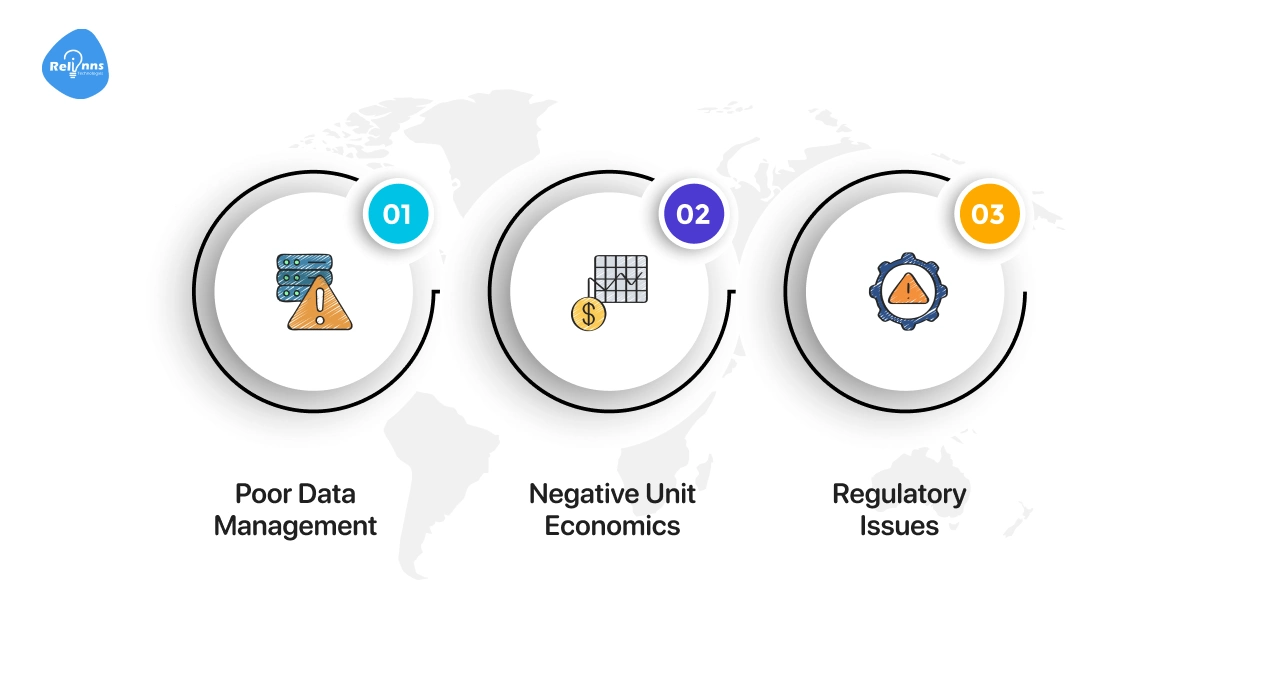
Overcoming these challenges early makes validation clearer and decisions easier later.
Generative AI MVP Development Considerations
Generative AI MVPs behave differently from the traditional ones. Outputs are unpredictable, user-facing, and heavily open-ended.
Early decisions for control, evaluation, and architecture determine whether validation is reliable or misleading. Best teams for generative AI MVP development design for behavior, not just generation.
Here are the key considerations to keep in mind:
Prompt-First vs Model-First Architecture
Prompt-first GenAI MVPs are faster, cheaper, and easier to iterate on. Thus, most of these MVPs should begin prompt-first.
On the other hand, model-first approaches increase complexity too early. These models only make sense after usage patterns are clear.
According to Gartner, around 80% of generative AI business applications are expected to be built on existing data platforms by 2028, rather than custom models, reinforcing the need to prioritize data quality and integration early.
Safeguards, Fallbacks, and Output Control
Generative systems need boundaries to work reliably. Guardrails reduce harmful or irrelevant outputs. Fallbacks handle cases where the model fails.
Output controls improve consistency. Without these, even capable models feel unreliable. Early MVPs don’t need perfection, but they must behave in ways users can rely on.
Evaluating GenAI MVP Outputs Without Overfitting
Evaluation should reflect real usage, not curated examples.
Avoid optimizing prompts only for ideal test cases. Observe how users respond in real workflows. Track edits, rejections, and follow-up actions. If outputs look good only in demos, validation is misleading.
Once these foundations are established, the next critical step is to decide whether to build AI capabilities in-house or rely on existing tools and platforms.
Build vs Buy: Critical Decisions in AI MVP App Development
Build vs buy decisions shape how fast you learn and how much risk you take in an AI MVP. The right call helps validation. The wrong one slows learning and adds complexity before it’s needed.
For early-stage startups, some critical decisions fall into three clear areas:
Pre-Trained APIs vs Custom Models
Pre-trained APIs are usually the right starting point. They are faster to ship and easier to replace. Custom models demand more data, time, and upkeep. They make sense only when APIs fail to meet accuracy, control, or cost needs discovered during real usage.
Fine-Tuning vs Prompt Engineering
It’s fairly established that pre-trained APIs are usually the safest place to start. They let teams move quickly and change direction if needed. Most MVPs should wait until prompts and workflows prove they actually work for users.
What to Defer Until After MVP Validation
Some investments don’t help early learning and can wait. These include:
- Custom models
- Large-scale infrastructure
- Edge-case optimization
- Performance optimization
Focus on decisions that improve validation clarity. Build the rest later.
With these choices in place, the next challenge is selecting the right people and partners to execute the AI MVP effectively.
How to Choose the Best AI MVP Development Services
Choosing the right development partner matters as much as the idea itself. A strong AI MVP team helps founders learn faster, avoid false signals, and make smarter product decisions early on.
Skills Your AI MVP Team Must Have
An effective AI MVP team needs more than just developers. They should understand how AI works, how data and prompts shape results, and how products are actually used.
The team must design for trust, uncertainty, and user decision-making, not just screens or features.
Red Flags When Evaluating AI MVP Development Partners
Be cautious of teams that promise guaranteed accuracy or extremely fast results without discussing validation.
If there’s little focus on data, feedback loops, or human oversight, that is a warning sign. Overemphasis on flashy demos instead of real usage signals often leads to weak real-world performance.
What Sets the Best MVP Development Teams Apart
Best MVP development services with AI capabilities put learning first. They help define what to test, design controlled experiments, and adjust quickly based on real feedback.
Their goal is clarity, not complexity, and progress is measured by insights gained, not how many features were shipped.
Partnering with experienced teams like Relinns Technologies can help you validate AI MVPs across both product and conversational layers.
With their in-house platform, AppsRhino (custom web and app development) and BotPenguin (AI-driven chatbots), they support early-stage MVPs to focus on usability, validation, and real-world adoption.
Working with Relinns for AI MVP App Development
Relinns Technologies works with startups to build AI MVPs that keep validation front and center. The focus is on testing real-world applicability, business impact, and trust, before committing to scale.
Through its platforms, AppsRhino for custom web and app development and BotPenguin for AI-powered chatbots, Relinns supports both product and conversational MVPs. This helps founders test workflows, AI outputs, and user adoption as a connected system rather than separate pieces.
Their emphasis on speeding up learning, reducing false positives, and making clearer product decisions with AI aligns well with how early-stage AI MVPs should be built.
Wrapping Up
Good AI MVP development is when learning is prioritized.
Here, founders focus on going beyond just getting a working model. Validation comes from real usage, user trust, and repeated decisions in real workflows.
The best AI MVPs focus on testing one assumption at a time and observing how users actually respond. They learn fast, invest early in feedback, and resist the urge to polish too soon.
Speed matters only when it improves clarity. Cost matters only when it lowers uncertainty. It’s important to build to learn first and validate before scaling.
When teams let real signals, not hype, guide what they build next, they make better decisions, limit wasted effort, and scale only what users adopt.
Frequently Asked Questions
What is AI MVP app development?
AI MVP development focuses on validating AI-driven decisions, user trust, and real outcomes before investing in scale or optimization.
How is an AI MVP different from a traditional MVP?
Traditional MVPs test functionality. AI MVPs test uncertainty, data quality, and user trust in AI outputs.
How long does it take to build an AI MVP?
Timelines vary by goal, from quick demos to multi-week builds focused on real validation and reliability.
What metrics matter most when validating an AI MVP?
Task success, human overrides, time saved, and repeat usage reflect whether AI creates real value.
When should startups build custom AI models?
Only after usage patterns, data quality, and API limitations are clearly proven through validation