The Role of AI Risk Management in Modern Finance
Date
Aug 10, 26
Reading Time
13 Minutes
Category
Generative AI
Share


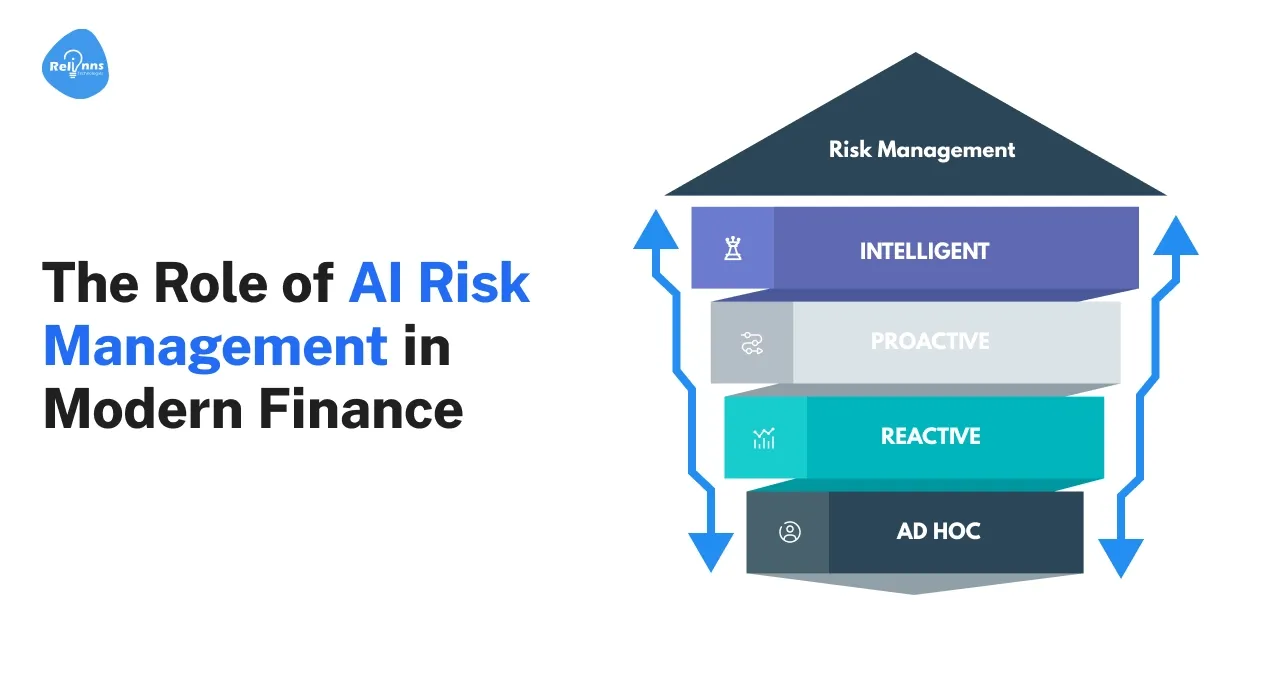
AI risk management in finance uses machine learning, predictive models, and generative AI to identify, assess, monitor, and respond to financial risk. It also covers the controls financial institutions need around the AI models themselves.
In the Bank of England and FCA's 2024 survey of 118 financial firms, 75% reported already using AI, while another 10% planned to adopt it within three years. Fraud detection, cybersecurity, data analysis, and process optimization were among the common applications.
The practical rule is materiality. As AI-supported decisions create greater financial, customer, or regulatory impact, institutions need stronger validation, oversight, auditability, and human control.
What Is AI Risk Management in Finance?
AI risk management in finance encompasses two interrelated responsibilities: using AI to manage financial risks and managing the risks posed by AI itself. Financial institutions can use AI for fraud detection, credit assessment, exposure monitoring, compliance work, and operational risk. They also need controls for model errors, poor data, bias, security, explainability, and third-party dependencies.
That distinction affects how institutions design AI systems.
A fraud model may identify suspicious transactions faster than a manual review queue. But the institution still needs to know which data shaped the score, how the model performs, and what happens when the model gets a case wrong.
The type of AI also changes the control requirements:
- Predictive machine learning estimates probabilities, classifications, scores, and future outcomes.
- Generative AI works well with documents, summaries, knowledge retrieval, analyst support, and draft content.
- Agentic AI can execute tasks across connected systems, which increases the need for permission limits and human oversight.
Canada's OSFI warned in July 2026 that generative and agentic AI can amplify operational and cyber risks because these systems can operate at greater speed, scale, and autonomy.
Once the distinction is clear, the next question is where AI produces useful risk signals.
Where Is AI Used in Financial Risk Management?
Financial institutions use AI where risk teams must process large amounts of transaction, customer, market, operational, or document data. The strongest applications involve pattern detection, prioritization, forecasting, and decision support rather than unrestricted automated decision-making.
The Bank of England and FCA's 2024 survey found that 37% of respondents used AI for cybersecurity and 33% for fraud detection. Firms also expected more AI use in regulatory compliance, reporting, and fraud prevention.
| Risk Area | What AI Can Analyze | Typical Output | Control Requirement |
|---|---|---|---|
| Fraud and financial crime | Transactions, account behavior, devices, historical cases | Anomaly scores, alerts, case prioritization | Analyst review for material cases |
| Credit and underwriting | Applications, repayment history, financial data, risk indicators | Risk scores, forecasts, decision support | Explainability, policy controls, validation |
| Market and liquidity risk | Positions, prices, exposures, market movements | Exposure forecasts, scenario alerts | Risk limits and independent monitoring |
| Operational risk | Process logs, incidents, system events | Exception detection, failure prediction | Escalation rules and audit records |
| Compliance | Policies, customer records, case files, regulatory documents | Classification, summaries, review queues | Approved sources and human sign-off |
AI works best when the institution defines the decision before choosing the model.
A model that ranks fraud cases has a different risk profile from one that blocks transactions. A system that drafts a compliance memo also requires different controls from one that decides whether a customer passes a regulatory check.
That separation between prediction and action shapes the architecture of an effective AI risk system.
How Does an AI Risk Management System Work?
An AI risk management system turns approved data into a risk signal, applies business controls, routes material decisions to the right people, and monitors what happens afterward. The model forms one part of that process. Data governance, workflow logic, human review, and monitoring determine whether the output can support a real financial decision.
A practical workflow follows five stages:
Define the risk decision and accountable owner.
Specify whether AI will detect, recommend, prioritize, approve, or act.
Connect approved data sources.
Feed the model relevant transaction, customer, market, policy, or operational data while enforcing access and privacy controls.
Generate the risk output.
The model may produce a probability, classification, anomaly score, forecast, summary, or recommendation.
Apply decision rules and oversight.
Business rules determine which outputs can trigger automated actions and which require review or escalation.
Monitor outcomes and model behavior.
Risk teams track model performance, overrides, exceptions, data changes, incidents, and signs of model drift.
The U.S. banking agencies' April 2026 model risk guidance follows the same risk-based principle: organizations should apply controls based on a model's purpose, exposure, and materiality rather than treating all models the same.
A risk score should inform a defined decision process. It should not become the decision process by default.
That principle becomes more important as financial institutions introduce generative AI.
Where Does Generative AI Fit in Financial Risk Management?
Generative AI fits best in document-heavy, knowledge-heavy, and analyst-support workflows. Financial institutions can use generative AI to summarize case files, search internal policies, draft risk reports, organize regulatory information, and prepare material for human review. High-impact financial decisions require stronger safeguards than document assistance.
Foundation models represented 17% of reported AI use cases in the Bank of England and FCA's 2024 survey, indicating that traditional predictive AI still accounted for most deployments at that point.
Useful generative AI applications include:
- Summarizing long fraud or investigation files
- Drafting risk and audit documentation
- Searching policy and procedure libraries
- Extracting information from contracts and regulatory documents
- Producing structured case summaries for analysts
- Assisting compliance and risk teams with internal knowledge retrieval
The limitation comes from how generative models produce answers.
OSFI's July 2026 technology risk bulletin specifically identifies hallucinations, data leakage, weak explainability, and auditability problems as risks institutions need to control when deploying generative and agentic AI.
That makes unrestricted use a poor fit for decisions such as denying credit, rejecting a claim, releasing funds, or closing a high-risk compliance case.
For those workflows, generative AI can prepare evidence or recommendations while deterministic rules, validated models, and authorized staff control the final action.
Generative AI therefore expands what risk teams can automate, while also expanding the risk surface they must govern.
What Risks Does AI Introduce to Financial Institutions?
AI introduces data, model, security, third-party, and automation risks alongside its operational benefits. Financial institutions need to evaluate these risks across the full AI lifecycle because a model can perform well in testing and still create problems after data, customer behavior, dependencies, or operating conditions change.
The Bank of England and the FCA found that four of the five highest-perceived current AI risks were data-related. Firms also expected third-party dependencies, model complexity, and embedded or hidden models to become more significant.
Data Risk
Incomplete, outdated, biased, or incorrectly labeled data can distort model outputs.
Financial institutions also need controls over confidential customer data, proprietary information, and data used by external AI providers.
Model Risk
Models can produce inaccurate predictions or behave differently as input patterns change.
Explainability becomes more important when an output affects credit, fraud intervention, customer access, or another high-impact decision.
Third-Party Risk
Financial institutions may depend on external model providers, cloud platforms, data vendors, and AI services they do not control.
The Bank of England and FCA reported that one-third of surveyed AI use cases involved third-party implementations, with risk and compliance showing particularly high third-party involvement.
Cybersecurity Risk
Attackers can target AI systems through malicious inputs, data manipulation, unauthorized access, or attacks against connected applications.
AI can also help fraudsters create more convincing social engineering and impersonation attempts.
Automation Risk
Greater autonomy increases the potential impact of a bad decision.
An incorrect analyst summary can be corrected before action. An autonomous agent with permission to modify accounts, initiate transactions, or change workflow states can propagate an error before a person intervenes.
Those risks make governance architecture as important as model selection.
What Controls Should Financial Institutions Put Around AI?
Financial institutions should use risk-tiered AI governance that defines ownership, validates models and data, limits autonomy, preserves human intervention, monitors performance, and records material actions. Controls should become stricter as the potential financial, customer, or regulatory consequence of an AI decision increases.
A practical control stack includes:
- Named accountability: Assign an owner for each material AI use case.
- AI inventory: Record models, use cases, data sources, vendors, permissions, and dependencies.
- Materiality classification: Separate low-impact assistance from decisions affecting customers, capital, payments, claims, or compliance.
- Data controls: Define approved sources, access rules, retention, quality checks, and sensitive-data handling.
- Validation and testing: Test accuracy, failure conditions, bias, security, and edge cases before deployment.
- Human oversight: Define review thresholds, escalation paths, override authority, and limits on autonomous actions.
- Ongoing monitoring: Track performance, drift, incidents, exceptions, and changes in upstream data.
- Third-party governance: Assess external models and vendors with the same seriousness as internally developed components.
- Auditability: Preserve model versions, important inputs, outputs, approvals, overrides, and actions.
Regulatory direction across Relinns' target markets supports this risk-based approach.
In the United States, the Treasury released its Financial Services AI Risk Management Framework in February 2026. The framework adapts NIST's AI Risk Management Framework to financial services and covers governance across the AI lifecycle.
Separate U.S. interagency model risk guidance issued in April 2026 applies a proportional approach to model risk. The guidance also states that generative and agentic AI models fall outside that specific model-risk guidance, making the distinction between traditional model governance and broader AI governance important.
In the United Kingdom, 84% of respondents to the Bank of England and FCA's 2024 survey reported having an accountable person for their AI use cases, while 72% placed accountability with executive leadership.
In the UAE, the DFSA's June 2025 survey of 661 authorized firms found that 52% were using AI. Yet 21% lacked clear accountability or oversight, showing why governance remains part of the adoption problem.
In Canada, OSFI published Guideline E-23 on model risk management in September 2025. The guideline takes effect on May 1, 2027 and applies a proportional approach based on an institution's size, complexity, strategy, and risk profile.
Regulatory requirements still vary by institution, activity, and jurisdiction, so each deployment needs a control map tied to the rules that apply to the organization.
How Should a Financial Institution Decide What to Automate?
Financial institutions should automate according to decision materiality, reversibility, explainability, and the institution's ability to detect and correct failures. Low-impact, reversible work can support greater automation. Decisions affecting customer rights, large financial exposures, or regulatory obligations need tighter limits and stronger oversight.
A useful decision framework is:
Low materiality and easy to reverse:
Document classification, information extraction, routine case routing, and internal summaries can support high automation with monitoring.
Moderate materiality:
Fraud prioritization, compliance triage, risk alerts, and underwriting support can use automated scoring while humans review exceptions and material cases.
High materiality or customer impact:
Credit decisions, claim denials, account restrictions, and regulatory determinations require stronger validation, explainability, escalation, and independent control.
Autonomous financial actions:
Agents that can move money, modify customer records, execute trades, or trigger external actions need narrow permissions, explicit limits, monitoring, and a reliable way to stop or reverse actions.
The Bank of England and FCA's 2024 findings show how firms are drawing this boundary. Among AI use cases involving automated decision-making, 24% were semi-autonomous with human oversight for critical or ambiguous decisions, while only 2% were fully autonomous.
That ratio reflects a useful operating principle: increase autonomy only when the institution can bound the action, observe the outcome, and recover from failure.
How Should Financial Institutions Approach AI Risk Management?
Financial institutions should start AI risk management with the decision and its consequences, then choose the model, workflow, and controls that fit that risk. Fraud detection, credit analysis, compliance review, operational monitoring, and generative AI support can all benefit from AI, but each requires a different level of governance.
The strongest implementation connects data quality, model validation, workflow controls, human accountability, monitoring, and auditability from the beginning.
For teams evaluating AI across financial or insurance operations, Relinns Technologies can help scope the use case, integrations, AI architecture, decision controls, and human-review workflow before development begins.
Explore Relinns' Custom AI Development services to design an AI system around the risk decision it needs to support.