How Project Tracking Automation Elevates Real Estate Development
Date
Sep 01, 26
Reading Time
15 Minutes
Category
Enterprise Solutions
Share


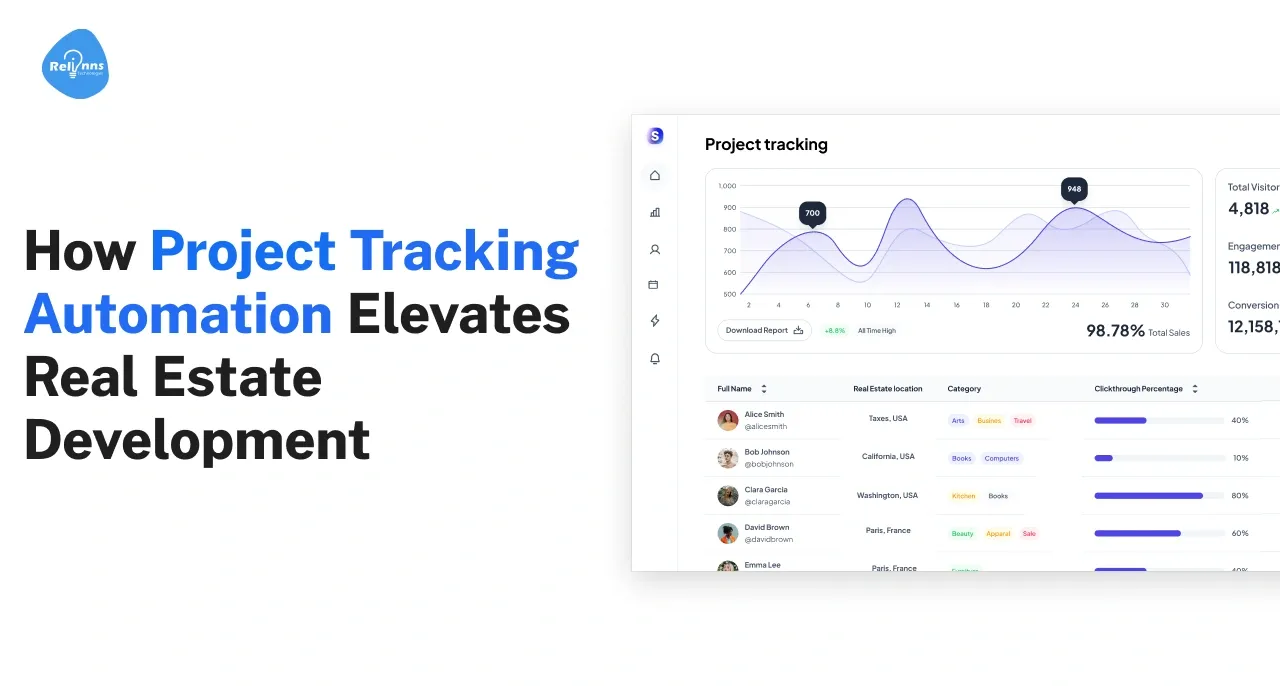
The growing complexity and scale of real estate projects have led real estate companies worldwide to struggle with project delays, budget overruns, multiple versions of project status reports, and disunity within project teams.
Due to their limitations in terms of speed, accuracy, and reliability, traditional project management tools can no longer provide project stakeholders with the level of insight needed to monitor timeline and financial performance.
Using spreadsheets to manage inventory and invoices, as well as various tracking applications, creates opportunities for errors, coordination delays, and a loss of accountability for project teams.
Using automated technology to track real estate project progress improves accuracy, expedites the generation of project status reports, and keeps both back-office and field teams aligned without requiring continual check-ins.
This article explains how custom real estate software delivers stronger control than generic tools by aligning technology with real construction workflows.
It explores the role of project management automation, the impact of automating budget tracking for construction projects, key advantages for developers and contractors, and real global use cases that demonstrate measurable improvements in cost, speed, and visibility.
What Is Project Tracking Automation in Real Estate?
Project tracking automation is the structured, technology-driven oversight of tasks, budgets, documents, risks, and communication across development lifecycles.
It replaces fragmented spreadsheets with integrated real estate software that updates information in real time. This ensures that every activity in a project management workflow follows accurate, predefined steps.
Each of these components contributes to the creation of an integrated, automated real estate software system.
Previously disparate spreadsheets were replaced with a single system that enables real-time information updates.
This allows each step in a project management process to align with a predefined path.
In addition, integrating scheduling, approvals, procurement, and financial tracking into a single automated control point reduces the number of manual updates required, eliminates the risk of missing information, and promotes greater collaboration across project teams, including engineering, design, construction, and finance.
The system automatically tracks activity within the integration, ensuring that all changes to the project, progress logs, and costs are incorporated.
- Automated updates improve decision-making speed by nearly 35% across multi-site portfolios.
- Integrated platforms reduce manual coordination effort by 40% in complex project management structures.
- Centralized dashboards enhance real-time visibility for all stakeholders by approximately 50%.
Challenges With Traditional Real Estate Project Tracking
Traditional tracking relies heavily on spreadsheets, manual approvals, emails, and offline documentation.
Such processes create delays, limit visibility, and reduce accuracy, especially when multiple contractors and internal departments are involved.
Teams operate in silos, causing misalignment across schedules, budgets, and compliance tasks.
Miscommunication becomes frequent when contractors, architects, subcontractors, and finance divisions use separate tools.
Without unified real estate software, data inconsistencies multiply, slowing corrective actions.
Reporting becomes reactive instead of strategic, reducing the effectiveness of project management oversight.
The absence of a central source of truth further escalates challenges. Critical documents, budgets, change orders, and inspection records remain scattered.
This leads to unclear accountability, weak audit trails, and slower regulatory compliance, especially for significant developments that require automating budget tracking for construction projects.
- Manual spreadsheets increase the probability of data errors by up to 60% in multi-stakeholder teams.
- Reporting delays postpone corrective action by 2–4 weeks in typical project management cycles.
- Lack of centralization causes 45% slower reconciliation across design, contracting, and finance units.
Why Real Estate Needs a Custom Project Tracking Solution?
Real estate development relies on processes that are far more intricate than standard project workflows.
Multiple stakeholders, regulatory conditions, complex financial structures, and evolving site realities make it difficult for generic tools to support consistent execution.
Custom real estate software provides a stronger foundation by aligning technology with real operational needs, enabling firms to scale confidently while improving visibility, accuracy, and control across the entire project lifecycle.
A. Unique Workflows in Real Estate Planning and Construction
Real estate development spans planning, procurement, execution, and handover, each with distinct requirements.
Generic tools cannot accurately model these phases, leading to gaps in reporting and delays in decision-making cycles.
A customized system adapts to the exact structure of your project management operations.
- Tailored workflows reduce task delays by 30% across complex project phases.
- Integrated planning improves multi-block scheduling accuracy by nearly 25%.
- Automated sequencing supports smoother handover readiness across large sites.
B. Deep ERP, CRM, and Accounting Integrations Required
The continuous coordination of Financial, Lead, Vendor, and Contract Data is essential to the Real Estate Industry’s day-to-day operations.
Customised software developed for the Real Estate Industry connects data across ERP, CRM, Accounting, and Procurement systems, providing a continuous flow of information between them.
By eliminating delays from reconciling data across systems, the software enhances automated budget tracking during construction projects.
- Connectivity reduces financial discrepancies by almost 40% across multi-team operations.
- Automated syncing accelerates approval cycles by up to 35%.
- Unified records improve audit-readiness and compliance accuracy by 45%.
C. Multi-Stakeholder Dependencies Too Complex for Off-the-Shelf Tools
In a construction environment, contractors, subcontractors, architects, consultants, and regulatory agencies all work together.
Standard software applications do not support these high levels of interdependency and can therefore create areas of miscommunication.
By creating a customised system that maps every individual's contributions to their designated workflow, a custom platform will enable repeatable, automated tracking of projects throughout the project lifecycle.
- Structured dependencies reduce coordination errors by nearly 32% across teams.
- Consistent data flow cuts reporting lag by up to 40%.
- Stakeholder alignment strengthens decision accuracy by more than 28%.
D. Custom Automation Aligns With Real Workflows
You may define your organisation's own process using custom software rather than forcing an existing process through a standard package.
Custom software has many advantages over this.
Custom systems enable the organisation to retain existing institutional knowledge, maintain a team's ability to continue its collaborative relationships with existing staff, and eliminate the disruption that rigid tools cause to processes.
- Adapted workflows boost user adoption rates by almost 60%.
- Process-aligned systems reduce transition friction by 40%.
- Custom triggers maintain operational consistency across all development stages.
E. Superior Security, Scalability, and Long-Term ROI
Real estate firms manage sensitive financials, contracts, and project records.
Custom real estate software provides stronger access controls, encryption, and alignment with compliance requirements.
It scales with growing portfolios and supports long-term ROI by reducing manual effort and improving planning accuracy.
- Data governance improvements lower security risk exposure by 50%.
- Scalable architectures support 3× portfolio expansion without performance loss.
- Automation yields up to 35% ROI by reducing administrative overhead.
Comparison Table: Custom vs Off-the-Shelf vs Manual Tracking
Real estate teams often consider several approaches when evaluating how to implement project tracking automation.
Each option, such as a custom-built platform, an off-the-shelf real estate software product, or a manual spreadsheet-driven method, brings a different level of automation, flexibility, and accuracy.
This comparison clarifies how each approach affects project management efficiency, integration capability, and long-term scalability.
Criteria | Custom Solution | Off-the-Shelf Software | Manual Tracking (Spreadsheets) |
| Workflow Fit | Fully aligned with planning, procurement, and project management workflows | Partial alignment; requires compromises | Poor alignment; inconsistent processes |
| Automation Level | High automation; supports automating budget tracking for construction projects | Limited, depends on vendor roadmap | None; high manual workload |
| Integration | Deep CRM, ERP, finance, and procurement integrations | Basic integrations, limited customization | No integrations; siloed data |
| Scalability | Designed for multi-site, multi-phase portfolios | Moderate scalability with subscription tiers | Low scalability; becomes unmanageable |
| Security & Compliance | Enterprise-grade security and audit trails | Standard security varies by vendor | Minimal security, high risk |
| ROI Potential | High long-term ROI due to efficiency and precision | Moderate ROI, vendor-dependent | Low or negative ROI due to errors and delays |
Core Features of Project Tracking Automation (Custom Solution)
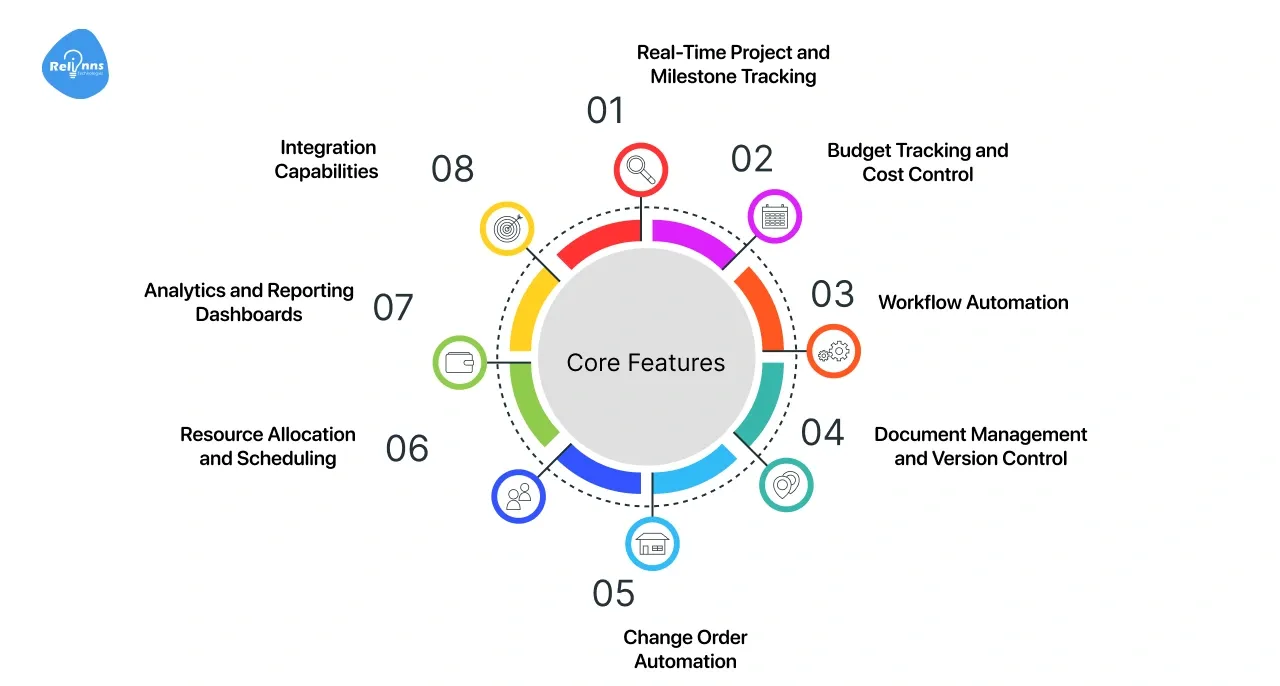
Real estate development requires coordinated management of schedules, budgets, documents, and resources. Standard tools often fail to capture the complexity of multi-phase construction or multi-stakeholder workflows.
A custom solution provides structured tracking, real-time visibility, and deeper integration across systems, enabling predictable delivery and more accurate project management outcomes.
1. Real-Time Project and Milestone Tracking
- Automated Gantt charts improve clarity across sequential construction tasks.
- Daily and weekly automated reporting reduces the need for manual updates.
- Real-time progress tracking accelerates decision-making in multi-site operations.
2. Budget Tracking and Cost Control
- Automated cost variance alerts reduce the likelihood of unexpected overruns.
- Consolidated expense logs enhance accuracy across procurement workflows.
- Forecasting tools improve budget alignment across long construction cycles.
3. Workflow Automation
- Automated approvals shorten processing cycles and reduce manual intervention.
- Escalation triggers help resolve bottlenecks before timelines are affected.
- Custom workflows support procurement, documentation, and compliance requirements.
4. Document Management and Version Control
- Version control reduces confusion across updated drawings and revisions.
- Centralized storage ensures that all project teams use the same documents.
- Digital signatures streamline approval and filing processes.
5. Change Order Automation
- Automated logging improves transparency across design and scope changes.
- Approval routing reduces delays during critical review cycles.
- Impact analysis improves decision accuracy for scheduling and budgeting.
6. Resource Allocation and Scheduling
- Automated assignment improves the distribution of labor across tasks.
- Availability tracking reduces scheduling conflicts across teams.
- Centralized planning enhances coordination in multi-contractor environments.
7. Analytics and Reporting Dashboards
- Real-time dashboards provide clear visibility into cost and progress.
- Performance analytics support long-term planning and risk management.
- Instant reports reduce the time required to prepare for project reviews.
8. Integration Capabilities
- ERP and CRM integration reduces inconsistencies across operations.
- Automated syncing improves reporting accuracy for finance and procurement.
- Connected systems facilitate more effective collaboration between field and office teams.
What are the benefits of project tracking automation for real estate developers?
Real estate developers manage multiple stakeholders, financial commitments, and regulatory conditions.
Automation strengthens these areas by improving visibility, coordination, and responsiveness.
It reduces manual workload, enhances financial accuracy, and helps maintain predictable delivery outcomes across all project locations.
A. Improved On-Time Delivery and Reduced Delays
Timely delivery is essential for maintaining project viability. Automated tracking provides a structured view of task dependencies and progress health.
This helps managers identify risks early and take corrective steps before delays accumulate.
- Automated tracking improves scheduling accuracy across stages.
- Stronger visibility helps prevent timeline slippage.
- Coordinated workflows reduce waiting time between tasks.
B. Enhanced Transparency Across Stakeholders
Real estate projects involve diverse contributors, including contractors, consultants, and internal teams.
Automated platforms offer a shared view of progress, reducing confusion and improving accountability. Transparency supports smoother coordination throughout the development cycle.
- Shared dashboards reduce miscommunication between teams.
- Real-time updates keep stakeholders aligned with field conditions.
- Centralized insights support consistent collaboration.
C. Lower Operational Costs Through Reduced Manual Effort
Manual data collection and repetitive follow-ups can consume significant administrative time.
Automation minimizes these tasks, allowing the team to focus on strategic activities. This reduces operating expenses and increases overall efficiency.
- Automated workflows reduce administrative hours significantly.
- Reduced errors and lower rework costs.
- Centralized processes improve efficiency across operations.
D. Stronger Budget Control and Reduced Cost Overruns
Budget stability is a recurring challenge in construction. Automated financial tools identify cost deviations early and ensure consistent expense logs across vendors.
These capabilities improve financial performance across all phases of development.
- Early deviation alerts support proactive budget control.
- Real-time summaries improve financial decision-making.
- Consolidated logging reduces billing inconsistencies.
E. Centralized Data for Better Decision-Making
Fragmented data leads to slow and often inaccurate decision-making.
Automation unifies information across departments, enabling faster responses and stronger planning. Centralized visibility ensures that decisions reflect current project conditions.
- Unified data improves decision-making speed.
- Consistent updates strengthen cross-team coordination.
- Centralized records support reliable planning.
F. Improved Compliance Readiness and Auditability
Regulatory obligations require accurate documentation and traceable review histories.
Automated systems maintain clean audit trails and consistent version control, helping teams reliably meet compliance requirements.
- Automated logs improve documentation quality.
- Version control reduces compliance gaps.
- Structured workflows support regulatory adherence.
G. Scalable for Multi-Project and Multi-Location Operations
Developers managing projects across multiple cities or regions need systems that scale effectively.
Automation allows standardized processes to be replicated, supporting portfolio expansion without compromising oversight.
- Scalable workflows support growth across several locations.
- Templates reduce setup time for new projects.
- Multi-site coordination improves accuracy across portfolios.
What are the top use cases of project tracking automation in real estate?
Every real estate project has moving parts that must align at the right moment.
A delayed permit, a missing material batch, a misread drawing, or a disconnected update can reshape an entire timeline.
Project tracking automation turns these fragile moments into controlled, predictable events. By converting field activity, budget movements, and stakeholder communication into real-time intelligence, developers gain an edge that manual tracking cannot match.
The following use cases illustrate how automation transforms complex development scenarios into streamlined, data-driven operations that deliver faster, smarter, and with far fewer surprises.
A. Automated Progress Monitoring for Enhanced Decision Making
Research Insight: A systematic review of automated progress-monitoring frameworks for construction projects shows that automated tracking significantly improves the accuracy and timeliness of project status information compared with manual methods. Automated monitoring allows stakeholders to detect deviations early and enables faster, evidence-based decisions to keep work on schedule. (Source: SpringerLink)
Key Findings
- Automating progress data collection reduces reporting delays and improves decision-making accuracy.
- Real-time insights from data integration help teams adjust workflows proactively.
- Enhanced monitoring correlates with reduced schedule overruns.
Relevance: This is a direct outcome of project-tracking automation and aligns with modern project management best practices that emphasize timeliness and data integrity.
B. Digital Twin and Integrated Cost–Schedule Control in Construction
Research Insight: Recent academic work on integrated digital twin frameworks for construction demonstrates how combining automated schedule tracking with dynamic cost estimation (sometimes referred to as 4D/5D modeling in research) enables continuous performance updates and predictive control. A case study simulation showed measurable efficiency gains, including improved cost and schedule alignment in a mid-rise building project. (Source: arXiv)
Key Outcomes
- Structured real-time cost and scheduling data into a unified analytics platform.
- Predictive forecasting enabled early detection of resource inefficiencies.
- Cost estimation became more responsive to evolving site conditions.
Relevance: This illustrates a real-world application of automating budget tracking for construction projects within research frameworks that unify tracking and cost control.
C. Vision-Based Progress Tracking for Real-Time Construction Insight
Research Insight: State-of-the-art academic research proposes using computer vision to automate progress monitoring on construction sites. Instead of relying on periodic manual reporting, automated visual data collection enables real-time detection of construction activities and discrepancies. (Source: arXiv)
Key Impacts
- Automated progress tracking significantly shortens the feedback loop between field activity and managerial review.
- Objective, sensor-based tracking reduces human error.
- Real-time visuals provide quantifiable project insights to support schedule adherence.
Relevance: Vision-based automation enhances project tracking by making monitoring more frequent, accurate, and less labor-intensive.
D. Real-Time Data Frameworks for Delay and Efficiency Analysis
Research Insight: Studies on real-time, data-driven project analysis frameworks show that integrating automated data collection, unified communication, and predictive analytics improves delay management and overall project responsiveness. This includes the automatic synthesis of data from multiple sources to provide centralized decision support. (Source: Tuwhera Open Repository)
Key Benefits
- Centralized data reduces information silos and increases traceability.
- Predictive analytics enables early intervention to mitigate schedule risk.
- Decision-making improves with continuous, real-time visibility.
Relevance: These outcomes support the use of project tracking automation as a foundational process in advanced construction project management.
E. Peer-Reviewed Trends on Monitoring and Predictive Analytics
Industry Review: A scientometric analysis of global research into automatic monitoring technologies shows that machine learning, BIM, and related automated approaches are increasingly central to construction oversight and performance analysis. Modern research consistently frames automation as key for timely detection of discrepancies and enhanced project controls. (Source: SpringerLink)
Key Insights
- Automated monitoring addresses limitations of manual progress tracking such as inaccuracy and delayed reporting.
- Evidence indicates that advanced monitoring correlates with better project outcomes and reduced project risk.
Relevance: These research trends confirm the importance of project tracking automation and inform how real estate software integrated with analytics can fundamentally improve performance.
These research insights demonstrate how project tracking automation, when integrated with real estate software and modern project management techniques, can sustainably enhance performance without relying on any specific product or service.
Integration Requirements for a Successful Custom Project Tracking System
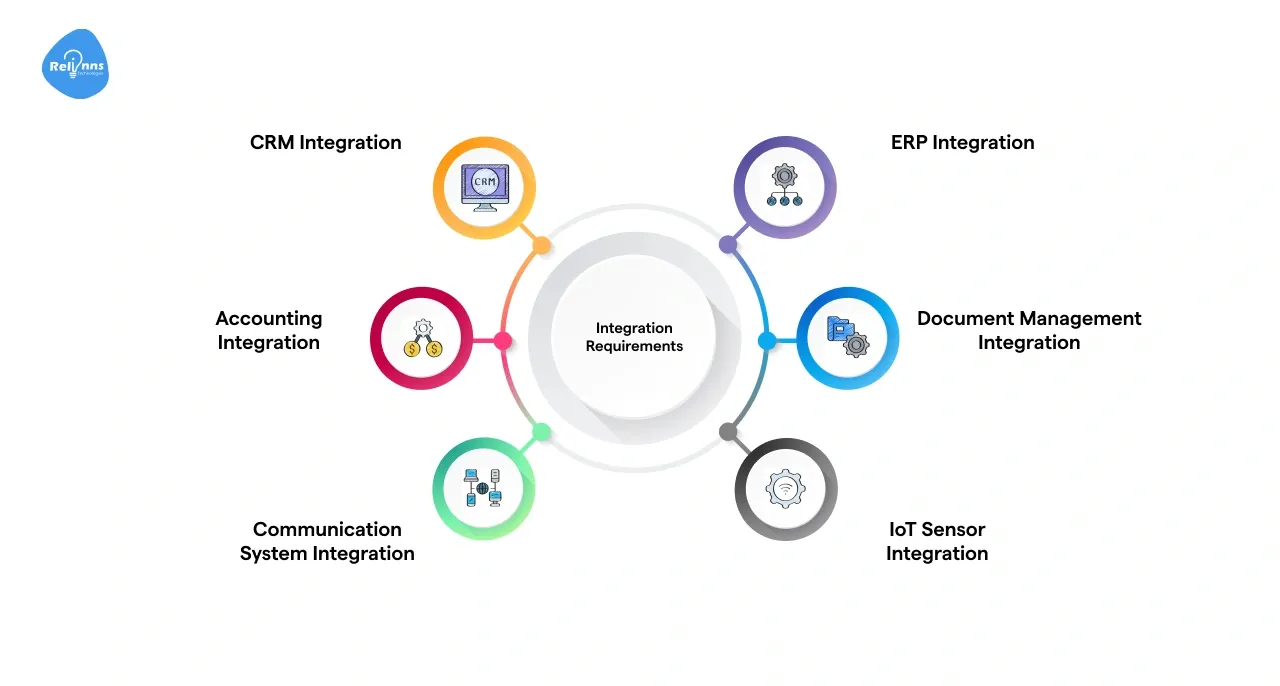
A robust project-tracking automation system relies on seamless integration across CRM, ERP, accounting, communication, and documentation platforms.
These connections ensure consistent data flow, improved operational accuracy, and unified visibility across all real estate software systems.
Effective integration reduces manual entry, minimizes errors, and supports efficient project management at every stage.
CRM Integration
- Synchronizes pipeline and active project information.
- Supports coordinated planning across teams.
- Provides clear continuity from sales to delivery.
ERP Integration
- Aligns procurement and budgeting data.
- Reduces reconciliation cycles.
- Enhances visibility across vendor activity
Accounting Integration
- Ensures real-time cost updates.
- Improves billing consistency.
- Strengthens financial forecasting.
Document Management Integration
- Maintains updated drawings and contracts.
- Reduces versioning errors.
- Supports compliance audits.
Communication System Integration
- Accelerates team coordination.
- Reduces approval delays.
- Improves field-to-office response times.
IoT Sensor Integration
- Tracks material and equipment movement.
- Supports safety monitoring.
- Provides predictive insights for planning.
Common Pitfalls When Automating Project Tracking
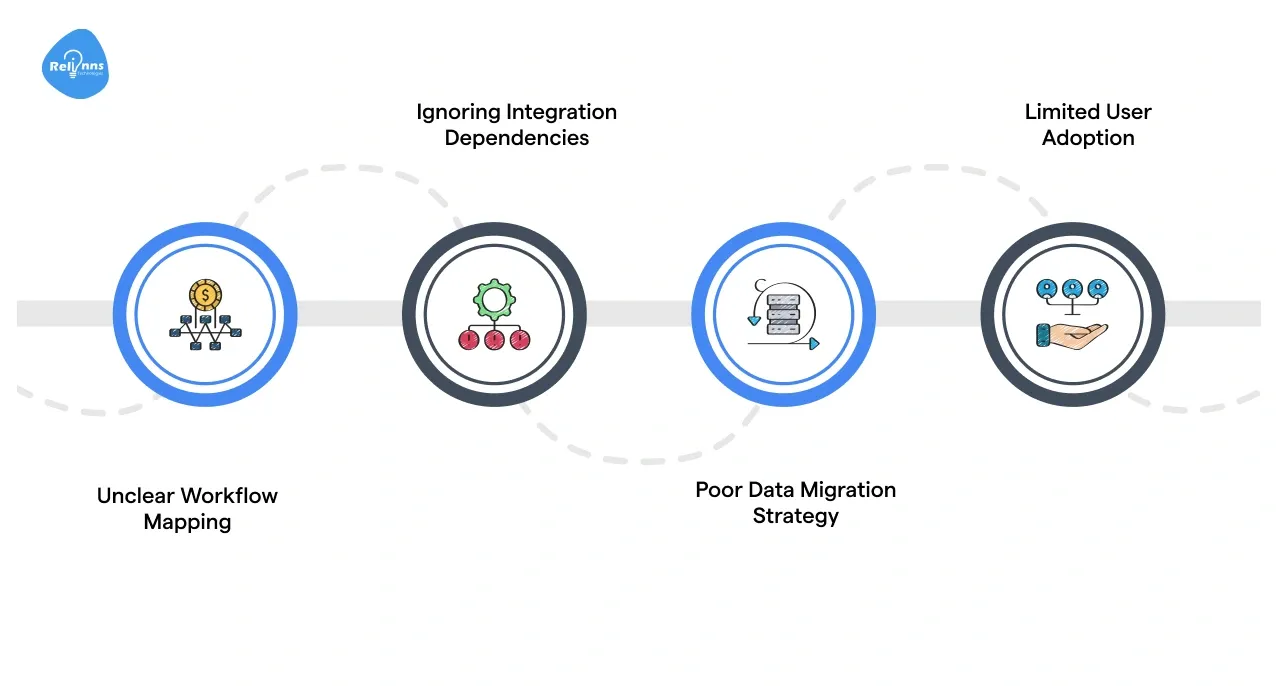
Real estate teams often face challenges when shifting from manual processes to automated project tracking.
Without precise planning and structured workflow mapping, automation can create confusion rather than improve efficiency.
Many issues arise from incomplete integrations, inconsistent data, and limited user adoption, all of which reduce the impact of real estate software and slow overall project management performance.
A. Unclear Workflow Mapping
Most failures occur because teams automate workflows they have never fully documented.
When steps, responsibilities, or dependencies are unclear, automation amplifies the chaos rather than resolving it.
Clear, structured mapping is crucial for project-tracking automation to operate reliably over extended development cycles.
B. Ignoring Integration Dependencies
Real estate projects depend on seamless data movement.
When integrations with ERP, CRM, or accounting platforms are overlooked, gaps appear in budgets, schedules, and reporting.
These blind spots disrupt coordination and weaken the value of real estate software that should serve as the unified operational source.
C. Poor Data Migration Strategy
Legacy spreadsheets often contain conflicting records and outdated values.
Migrating this directly into a new system without cleansing creates long-term issues.
Clean, accurate data is essential for strong project management, accurate forecasting, and consistent automated reporting.
D. Limited User Adoption
A system only succeeds when teams actually use it.
Without training and change management, users revert to old tools.
Poor adoption undermines automation, leading to duplicated work, missed updates, and lower ROI.
How to Implement a Custom Project Tracking Automation System?
A structured implementation process helps real estate teams adopt automation smoothly.
By mapping workflows, defining objectives, and planning integrations early, organizations reduce risks and establish a strong foundation for operational success.
This approach supports long-term stability and scalable project management performance.
Step 1: Assess Existing Workflows
- Identifies critical bottlenecks across collaborating teams.
- Highlights automation-ready tasks for smoother execution.
- Establishes clear baseline improvement metrics for planning.
Step 2: Define Goals and KPIs
- Sets clear performance expectations for all stakeholders.
- Supports measurable system evaluation through defined metrics
- Aligns teams on outcomes and shared priorities.
Step 3: Architect Integrations
- Ensures system-wide synchronization across connected platforms.
- Reduces manual dependencies in daily operations.
- Supports scalable data flow for growing portfolios.
Step 4: Develop Custom Modules
- Tailors automation to real operational processes.
- Supports compliance-driven workflows for approvals.
- Enhances user efficiency during everyday tasks.
Step 5: Data Migration and Cleanup
- Improves data accuracy across integrated systems.
- Eliminates outdated records from legacy sources.
- Strengthens reporting reliability for all stakeholders.
Step 6: Pilot Deployment
- Test functionality with minimal operational risk.
- Identifies adjustments for meaningful improvements.
- Builds user confidence before complete rollout.
Step 7: Organization-Wide Rollout
- Establishes consistent operations across all teams.
- Reduces manual tracking dependence significantly.
- Supports portfolio-wide execution with stability.
Step 8: Continuous Improvement
- Refines modules over time through iteration.
- Supports evolving project needs effectively.
- Improves performance and speed across workflows.
How to Choose the Right Technology Partner for Project Tracking Automation?
Selecting the right technology partner determines how effectively a real estate organization can scale its project tracking automation across teams and locations.
The partner you choose influences system stability, integration depth, and long-term adaptability.
A strong partner brings clarity to complex workflows, translates operational needs into reliable software, and supports your vision from design to deployment without adding unnecessary complexity.
1. Real Estate Software Expertise
Choosing a partner with real estate experience ensures the system reflects genuine field challenges rather than generic assumptions.
Teams familiar with construction cycles, regulatory workflows, and vendor ecosystems design automation that fits real operations and strengthens long-term delivery performance.
2. Ability to Build Automation Engines
A capable partner builds workflow engines that adapt to your processes instead of forcing rigid templates.
The appropriate engineering strength enables your automation to mirror how your teams actually work, enhancing precision and improving adoption across planning and execution.
3. Integration Strength
Strong integration capability is essential for unifying ERP, CRM, accounting systems, and communication tools.
A partner skilled in multi-system connectivity ensures data consistency, reduces delays, and improves the reliability of your entire project tracking automation ecosystem.
4. Commitment to Security and Scalability
A secure, scalable architecture ensures your solution grows with your portfolio.
Security-first engineering keeps financial and operational data protected, while scalable systems support expansion across cities, regions, and significant multi-site developments.
Why Custom Project Tracking Automation Offers Better ROI Than Off-the-Shelf Tools
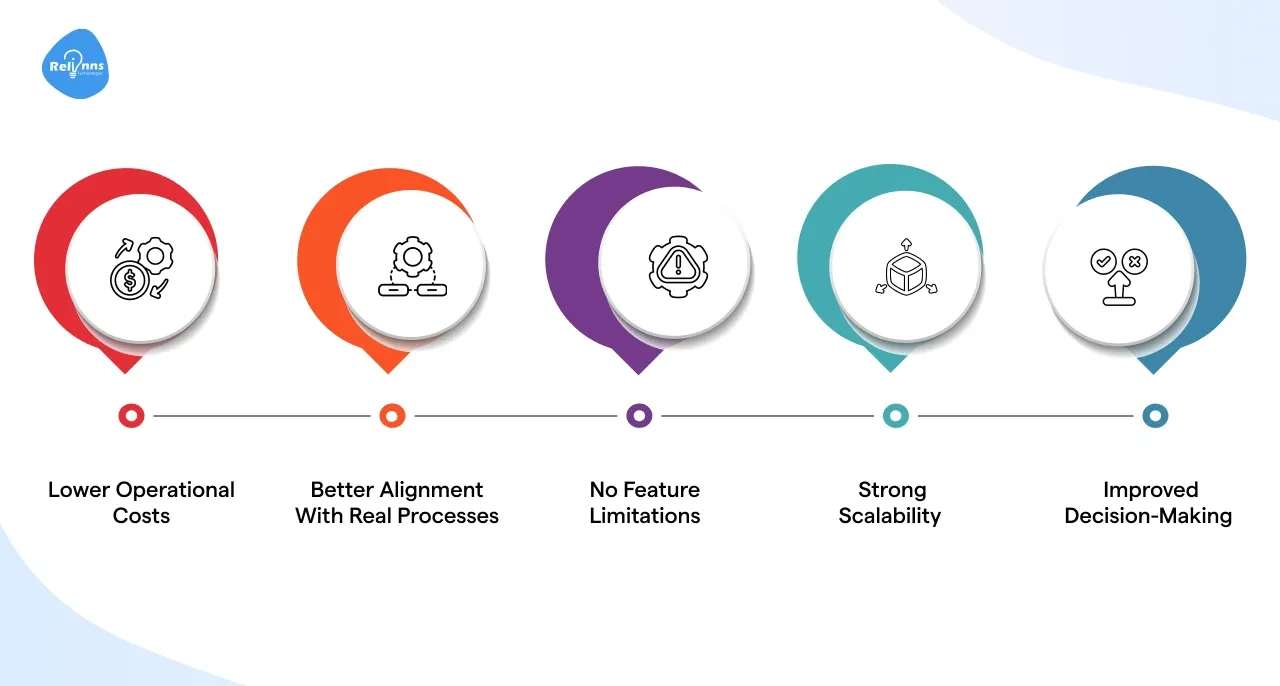
Custom project tracking systems offer long-term financial and operational benefits by aligning with real workflows and eliminating feature gaps.
Unlike generic tools, they scale with developer needs and support stronger budget control, faster coordination, and improved portfolio performance.
1. Lower Operational Costs
- Reduces administrative hours through automated routine tasks.
- Reduces rework from repeated manual errors.
- Improves efficiency across teams in daily operations.
2. Better Alignment With Real Processes
- Matches existing workflows used by project teams.
- Supports stakeholder coordination across multi-phase projects.
- Strengthens project consistency across all operational stages.
3. No Feature Limitations
- Avoids rigid prebuilt workflows, limiting customization.
- Supports advanced automation needs for developers.
- Ensures alignment with changing real estate requirements.
4. Strong Scalability
- Handles multi-site operations with high stability.
- Supports growth across expanding project portfolios.
- Maintains performance with increased activity volume.
5. Improved Decision-Making
- Provides unified data views for leadership teams.
- Enhances risk identification through real-time analysis.
- Strengthens long-term planning across developments.
Conclusion and Why Relinns Is a Smart Partner for Project Tracking Automation
When real estate teams shift from a scattered set of tools to a unified project-tracking automation system, the choice of technology partner becomes critical.
Relinns brings strong experience in delivering customizable, scalable automation solutions tailored to the complexity of real estate workflows.
Their background in low-code and no-code development, combined with deep integration capability, makes them a strong fit for developers managing large portfolios and multi-site operations.
Relinns Strengths and Key Benefits
- With more than 250 global projects delivered, Relinns shows a strong delivery record and enterprise readiness.
- Their low-code services include workflow automation, system integrations, and custom application development, helping teams accelerate builds without heavy engineering effort.
- The low-code approach enables rapid development while maintaining flexibility, which is valuable for real estate teams automating budget tracking for construction projects.
- Their integration capabilities span ERP, CRM, accounting platforms, and reporting systems, ensuring seamless data flow across budgeting, procurement, and project management.
Relinns builds solutions that adapt to the way real estate teams already work. Rather than imposing rigid workflows, their technology adapts to operational practices.
This is especially important for multi-site development environments with shifting timelines, subcontractor coordination, and evolving financial needs.
Typical ROI Gains With Relinns-Based Automation
Based on Relinns' efficiency metrics and industry benchmarks for low-code and no-code platforms.
- Up to 50% cost reduction in workflow setup and manual effort when moving away from traditional tools.
- Around 70% faster development time for custom modules, making real estate project tracking automation easier to deploy even under tight schedules.
- Noticeable reductions in human error and rework, improving the accuracy of budget tracking, progress reporting, and overall project management reliability.
How Relinns Supports Real Estate Project Needs
Real estate projects operate with strict dependencies across planning, design, procurement, field execution, and compliance.
- Flexible to match unique internal processes
- Integrated to connect contracts, budgets, procurement, and site updates
- Scalable for growth across regions and expanding portfolios
- Maintainable to allow modifications without large redevelopment cycles
Relinns aligns with these needs by providing deep integrations, custom workflows, and scalable architecture.
This provides real estate organizations with the stability and adaptability needed to manage complex development cycles with confidence.
Frequently Asked Questions (FAQ's)
What is project tracking automation in real estate?
Project tracking automation uses digital systems to monitor schedules, budgets, documents, and resources across real estate projects. It replaces disconnected spreadsheets with unified real estate software that improves accuracy, transparency, and coordination across project management activities.
How does automation reduce construction project delays?
Automation reduces delays by providing real-time visibility into tasks, dependencies, and risks. Teams receive timely alerts, faster approvals, and clearer responsibilities, helping prevent scheduling conflicts and speeding up decision-making during construction.
What features should a real estate project tracking system include?
A strong system includes milestone tracking, workflow automation, document control, budgeting tools, change order management, analytics dashboards, and integrations with ERP, CRM, and accounting platforms for coordinated project management across teams.
How does custom software compare to off-the-shelf real estate tools?
Custom software aligns fully with internal workflows, supports deeper integrations, and scales more effectively. Off-the-shelf tools often provide fixed templates that may not align with the complex requirements of real estate project management or evolving operational needs.
Can project tracking automation improve budget control?
Yes. Automation supports automating budget tracking for construction projects by delivering real-time cost updates, early variance alerts, and centralized expense logs. This reduces financial inconsistencies and improves forecasting accuracy across development stages.
What integrations matter most for real estate software?
Key integrations include ERP systems for procurement and budgeting, CRM for pipeline visibility, accounting systems for expense tracking, document repositories for version control, and communication tools for coordinated project management.
How long does it take to implement a custom system?
Implementation typically ranges from 8 to 16 weeks, depending on workflow complexity, integration needs, and migration requirements. Multi-site portfolios may require phased rollout to ensure stability and consistent adoption.
Is project tracking automation suitable for small developers?
Yes. Small developers benefit from better visibility, fewer manual tasks, improved documentation, and more accurate cost tracking. Custom systems can be tailored to smaller operations while still supporting long-term scalability.
How secure is a custom real estate project tracking platform?
Custom platforms can include role-based access, encrypted data storage, audit trails, and compliance-focused workflows. These controls protect sensitive operational, financial, and legal information across all project teams.
What is the cost range for developing a custom project-tracking solution?
Costs vary based on workflow complexity, integrations, and customization requirements. Most real estate organizations invest within mid-range to enterprise-level budgets aligned with their project management needs and long-term operational goals.