How to Use OEE Custom Manufacturing Software for Automated Warehousing
Date
Jan 08, 26
Reading Time
11 Minutes
Category
Custom development
Share


Warehouse operations have become a core driver of manufacturing performance, not just a support function.
Rising order volumes, growing SKU complexity, and tighter delivery schedules have increased pressure on warehouses to move faster with fewer errors.
Traditional manual workflows can no longer keep pace with the flexibility and accuracy required by today’s production lines.
As a result, organizations are turning to automation paired with OEE custom manufacturing software to streamline material flow, reduce delays, and maintain consistent visibility across systems. Automation also provides the stability needed to scale operations without increasing labor costs in proportion.
This guide explores the most effective best practices for warehouse automation, supported by real-world use cases and data-driven insights. You’ll learn how modern tools, integrated workflows, and OEE tracking software for manufacturing can transform warehouse performance from end to end.
9 Best Practices for Automating Warehouse Management Workflows
Warehouse automation has become a central driver of modern manufacturing performance. As production cycles shorten and order volumes grow, warehouses must operate with higher accuracy, faster response times, and clearer visibility across every workflow.
These nine best practices highlight the most impactful areas where automation creates measurable improvements.
By integrating data-driven tools and OEE custom manufacturing software, manufacturers can streamline material movement, reduce bottlenecks, and maintain consistent operational flow from receiving to dispatch.
Overview of the 9 Best Practices for Warehouse Automation
Best Practice | What It Improves | Quick Insight |
| 1. Automate Inventory Replenishment | Material availability | Ensures stock levels are adjusted instantly in response to real-time consumption signals. |
| 2. Digital Twin Simulation for Layouts | Space efficiency | Tests layout changes virtually before investment, reducing travel and congestion. |
| 3. Pick-to-Light Accuracy Enhancement | Picking precision | Visual cues help workers pick faster with fewer errors and less training time. |
| 4. AI-Based Slotting Optimization | Travel reduction | Place items where demand and movement patterns show the greatest benefit. |
| 5. Integrate WMS + MES + CMMS | Unified visibility | Connects systems so that material, machine, and maintenance data flow consistently. |
| 6. AMRs for Transport Tasks | Workforce productivity | Robots handle repetitive moves, freeing teams for higher-value warehouse work. |
| 7. OEE Dashboards for Improvement | Performance tracking | Highlights delays and inefficiencies so leaders can act on accurate metrics. |
| 8. Automated Receiving & Putaway | Inbound speed | Scanning and tagging tools capture item details instantly, streamlining putaway. |
| 9. Workflow Orchestration Automation | Cross-team coordination | Aligns tasks across warehouse, production, and maintenance for smoother operations. |
1. Automate Inventory Replenishment Using Real-Time Signals

Effective replenishment is essential for preventing stockouts, managing carrying costs, and maintaining a consistent flow of materials to production.
Automated replenishment driven by live operational data helps warehouses respond to consumption patterns immediately.
When replenishment triggers reflect real equipment behavior, as captured by OEE tracking software, inventory remains synchronized with shop-floor demand.
- Automated reorder points adjust precisely based on real-time consumption and material movements.
- Inventory shortages are significantly reduced as safety stock adapts quickly to production fluctuations.
- Warehouse teams avoid delays through continuous updates from connected scanning and tracking systems.
- Procurement gains better predictability due to stable inbound order patterns and fewer emergencies.
- Stock accuracy improves as replenishment records sync automatically with item movement logs.
2. Improve Warehouse Layouts Through Digital Twin Simulation
Warehouse space optimization is essential for reducing travel time, reducing aisle congestion, and shortening cycle times to fulfil customer orders.
Digital twin simulations enable teams to visualise and test alternative layouts before making any physical changes within their warehouses.
Utilising manufacturing OEE data to characterise operational cycle metrics, such as production volume and efficiency, will help you make data-driven decisions to optimise your warehouse layout.
- Simulation reveals travel bottlenecks and congestion patterns hidden in day-to-day operations.
- Storage density increases as rack positioning aligns with SKU demand and movement velocity.
- Forklift routes are more efficient when based on real material-flow data.
- Pick paths shorten because high-frequency items shift closer to dispatch or production areas.
- Capital spending is targeted after validating improvements with real equipment performance data.
3. Strengthen Picking Accuracy with Pick-to-Light Systems

Modern pick-to-light and put-to-light systems reduce reliance on manual judgment and paper-based instructions.
These visual tools streamline tasks for new and experienced workers by presenting clear guidance at each pick location.
Integrating these systems with manufacturing OEE software ensures picking speed and accuracy stay aligned with production goals.
- Picking errors decrease due to consistent visual confirmation at every required location.
- Training time reduces as new workers learn faster with intuitive light-based guidance.
- High-volume zones operate with fewer slowdowns because visual cues reduce hesitation.
- Order accuracy improves significantly as instructions update in real time across zones.
- Supervisors gain better oversight due to visible activity indicators throughout the warehouse.
4. Use AI-Based Slotting Optimization to Reduce Travel and Congestion
Effective slotting ensures that warehouse workers spend less time walking and more time picking.
AI-based slotting models analyze SKU movement, demand patterns, and congestion trends.
When aligned with performance metrics collected from OEE tracking software for manufacturing, slotting adjustments stay consistent with operational realities.
- Fast-moving SKUs shift closer to dispatch points to reduce handling time.
- Slow-moving items relocate to secondary areas, keeping prime space optimized.
- Seasonal demand fluctuations automatically update slotting rules to improve capacity utilization.
- Travel distance reduces because placement mirrors actual pick frequency and routes.
- Forklift congestion lowers as AI redistributes heavy-traffic SKUs across balanced zones.
5. Integrate WMS, MES, and CMMS for Unified Operational Visibility
Disconnected systems make it hard to understand why delays occur.
Integrating warehouse management systems with production and maintenance systems creates a single information flow.
When WMS events and machine conditions from OEE software manufacturing appear together, bottlenecks become easier to identify and resolve.
- Material shortages reduce as WMS and production signals synchronize more accurately.
- Response times improve when alerts generate automatic tasks across maintenance systems.
- Planners achieve greater forecast accuracy through unified visibility across multiple platforms.
- Production interruptions decline because material availability links directly to machine readiness.
- Exception handling accelerates as all teams work from consistent real-time operational data.
Suggested Reading: How to Set Up Joget Warehouse Automation Workflow
6. Deploy Autonomous Mobile Robots (AMRs) for Transport Tasks

Repetitive material handling creates unnecessary strain on workers and slows operations.
Autonomous Mobile Robots (AMRs) automate these repetitive tasks, reducing walking time, fatigue, and congestion.
With insights from OEE custom manufacturing software, AMR usage becomes more coordinated and aligned with actual production demand peaks.
- AMRs reduce manual travel time by consistently completing repetitive transport routes.
- Worker productivity improves as teams focus on complex or judgment-based picking tasks.
- Congestion decreases because AMRs dynamically follow optimized digital pathways.
- Order cycle times shorten through continuous, uninterrupted material movement.
- Fulfillment accuracy increases with steady, predictable material availability.
7. Use OEE Dashboards to Drive Continuous Warehouse Improvement
Warehouses accumulate performance losses due to micro-delays, outdated routines, and inconsistent workflows.
OEE dashboards consolidate all these issues into one consolidated view.
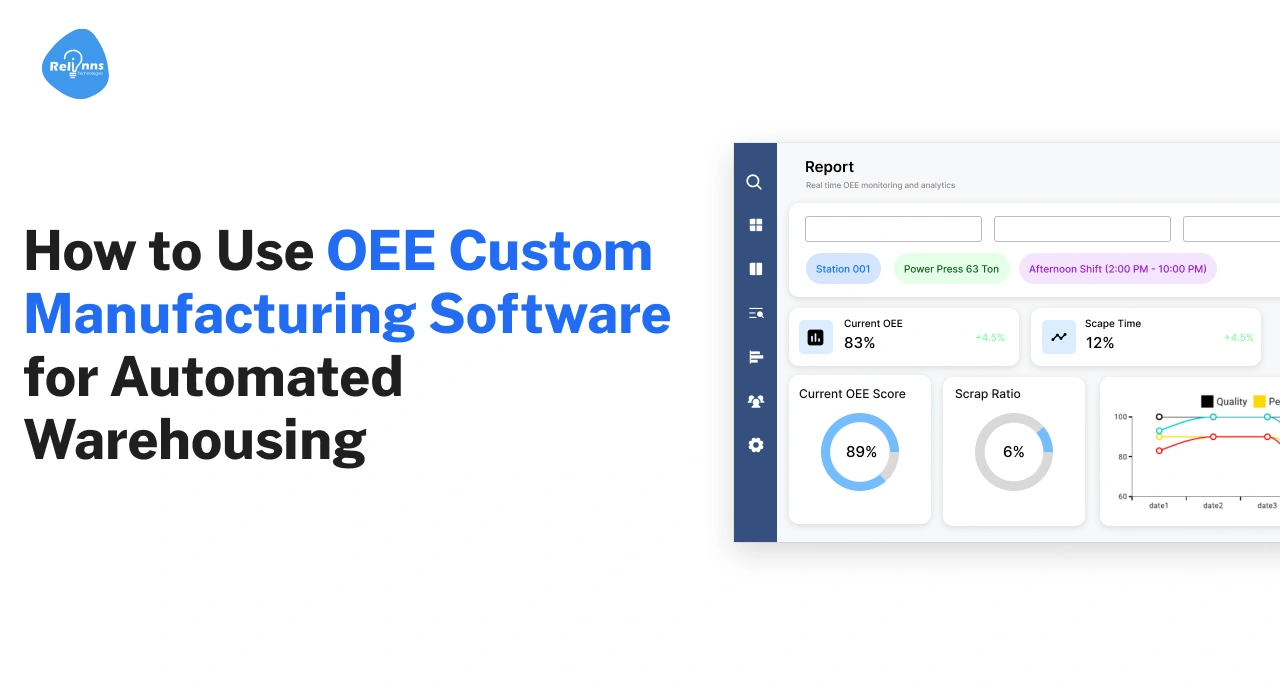
Monitoring warehouse availability, performance, and accuracy with OEE tracking software for manufacturing supports daily improvements and structured decision-making.
- Daily dashboards highlight hidden losses affecting material movement or slotting patterns.
- Continuous tracking shows improvement trends and validates results from workflow changes.
- Supervisors implement targeted training based on zone performance metrics.
- Teams react faster to emerging inefficiencies due to shared visibility across shifts.
- Long-term warehouse planning becomes easier with precise historical OEE performance data.
8. Automate Receiving and Putaway Using Advanced Scanning Technologies
A modern warehouse must capture item details quickly and accurately upon arrival.
Automated receiving systems use barcode scanners, RFID tags, or vision-based tools to instantly register incoming units.
When connected to WMS and OEE custom manufacturing software, these systems ensure every item is traced, validated, and routed to the correct location without manual delays.
- Automated scanning reduces inbound errors through instant data capture and verification.
- Putaway tasks accelerate when item details are automatically entered into systems.
- Inventory updates occur immediately, improving stock accuracy across all zones.
- Misplaced items decline as routing directs workers to correct storage locations.
- Receiving congestion is reduced through streamlined workflows that eliminate unnecessary steps.
9. Implement Workflow Orchestration to Coordinate Cross-Functional Tasks

Manual hand-offs, whether via radio, paper, or verbal cues, are the primary cause of warehouse friction. Workflow orchestration replaces these manual triggers with automated logic, ensuring that tasks move seamlessly between teams and systems without human intervention.
By integrating orchestration with OEE tracking software, you transform the warehouse from a reactive environment into a synchronized operation. This digital "conductor" ensures the right person is at the right location when a material need arises.
- Eliminate Idle Time: Automatically trigger material moves based on real-time machine consumption signals.
- Synchronized Readiness: Align maintenance schedules with warehouse lulls to maximize throughput without disrupting fulfillment.
- Proactive Exception Handling: Instantly reroute tasks when a bottleneck is detected, preventing small delays from becoming floor-wide stoppages.
- Data-Driven Accountability: Gain clear visibility into how long tasks actually take, allowing for precise labor planning and performance coaching.
Real-World Use Case in Automated Warehouse Management
Leading companies have successfully implemented warehouse automation in various ways, with notable case studies demonstrating the positive impact of integration.
Warehouse Automation enabled by Robotics, Data Analytics, and Integrated Workflow processes has many measurable benefits for Organizations in high-demand environments.
DHL Supply Chain: Robotics for High-Volume Fulfillment
Problem: DHL's Warehouse Picking Workflow was overwhelmed by Increased Volumes during the holiday season, resulting in slow batching, Longer Travel Distances, Inefficient Task Routing, and higher error rates, which increased the number of employees needed during peak holiday hours.
Solution: AMR Robots were introduced to perform repetitive item movement tasks across multiple Distribution Centers throughout the Region where DHL ships goods during the busiest seasons, such as Holidays.
AMR Robots move Items from where they are stored until they reach their Destination, and the Person using the Items will determine which Item to pick and where to put them after they have been picked.
The Workflow Orchestration System is Fully Integrated with Warehouse Execution Tools and & OEE (Overall Equipment Effectiveness) Manufacturing Software to help distribute Workloads effectively within each Distribution Center based on Customer Order Demand, Inventory Levels, and SKU Thermal Production Speed.
Results:
- Peak-season cycle time was reduced nearly 60% through continuous robotic transport and reduced travel.
- Picking accuracy increased to 99.7% as zone adherence improved and fatigue decreased significantly.
- Productivity rose 35% due to better task allocation and reduced worker movement distances.
- Worker injuries decreased as physically demanding transport tasks were automated.
Use Case Reference: See more here.
Operational Impact of Warehouse Automation: What Early Results Show
Automation delivers visible improvements early in deployment. These improvements often appear first in activities that rely heavily on manual verification, such as receiving, scanning, and routing.
Systems stabilize, errors decline, and confirmations become faster as warehouses begin using OEE custom manufacturing software to track flow in real time.
Other gains emerge gradually as teams adapt to automated processes. Replenishment accuracy improves.
Travel patterns become more predictable. Coordination between the warehouse, production, and maintenance teams strengthens. These outcomes build steadily and reflect how automation reshapes daily work rather than replacing it outright.
This section outlines the initial operational shifts most organizations encounter when automation is introduced. It also lays the foundation for the real-world case studies that follow by outlining the types of early improvements that drive measurable performance gains.
Conclusion: Improving Warehouse Operations With OEE Custom Manufacturing Software
Warehouse automation is most effective when supported by connected systems, synchronized workflows, and clear visibility across material movement.
Organizations that combine automation with OEE custom manufacturing software gain real-time operational insight, more consistent resource planning, and lower error rates.
Automated processes also help leadership identify patterns that manual tracking misses, creating a stronger foundation for scaling operations without increasing complexity.
As warehouses continue to manage rising order volumes and tighter delivery windows, solutions that integrate automation with dependable performance data will remain essential for long-term efficiency and resilience.
Why Choose Relinns for Warehouse Automation Solutions?
Relinns approaches warehouse automation as a system-level responsibility, not a tool deployment. Every solution is designed to fit existing production environments, operational constraints, and growth objectives.
- Proven expertise in complex warehouse automation systems
- OEE-aligned workflows built for manufacturing realities
- Seamless integration across warehouse and production platforms
- Scalable automation designed for long-term operations
- Enterprise-grade reliability with transparent operational governance
With deep experience across manufacturing and logistics environments, Relinns delivers solutions that are stable, adaptable, and built for real-world operational pressure. The emphasis remains on clarity, control, and long-term operational confidence.
Frequently Asked Questions (FAQ's)
What is warehouse automation, and how does it improve workflow performance?
Warehouse automation uses technologies that streamline material movement, scanning, and coordination. When connected to OEE custom manufacturing software, these systems improve accuracy, reduce process time, and help manage higher order volumes with fewer delays.
How does OEE custom manufacturing software support warehouse automation?
It provides real-time performance tracking that reveals bottlenecks and inefficiencies. These insights guide process adjustments, improve scheduling, and help automation tools operate with greater accuracy across receiving, picking, and replenishment activities.
Can warehouse automation integrate with existing systems such as WMS or ERP?
Yes. Most automation platforms integrate directly with WMS, ERP, and MES systems. This enables data from different environments to synchronize quickly, improving decision-making and reducing cross-team communication errors.
Does automation reduce the need for warehouse employees?
Automation reduces repetitive tasks but increases the need for skilled workers who manage exceptions, oversee system operations, and handle complex tasks. It improves productivity without eliminating the value of human expertise.
How soon can companies expect results from warehouse automation?
Early improvements appear within weeks in areas such as receiving, scanning, and routing. Deeper gains in replenishment, layout flow, and coordination develop gradually as automated processes stabilize and teams adapt to new workflows.
Is warehouse automation scalable for small and mid-sized operations?
Yes. Solutions connected to OEE tracking software for manufacturing scale easily as order volumes grow, allowing smaller warehouses to adopt automation gradually while maintaining performance consistency and budget control.