Logistics Management Systems Explained: Modules, Workflow, and Use Cases
Date
Dec 09, 25
Reading Time
12 Minutes
Category
Enterprise Solutions
Share


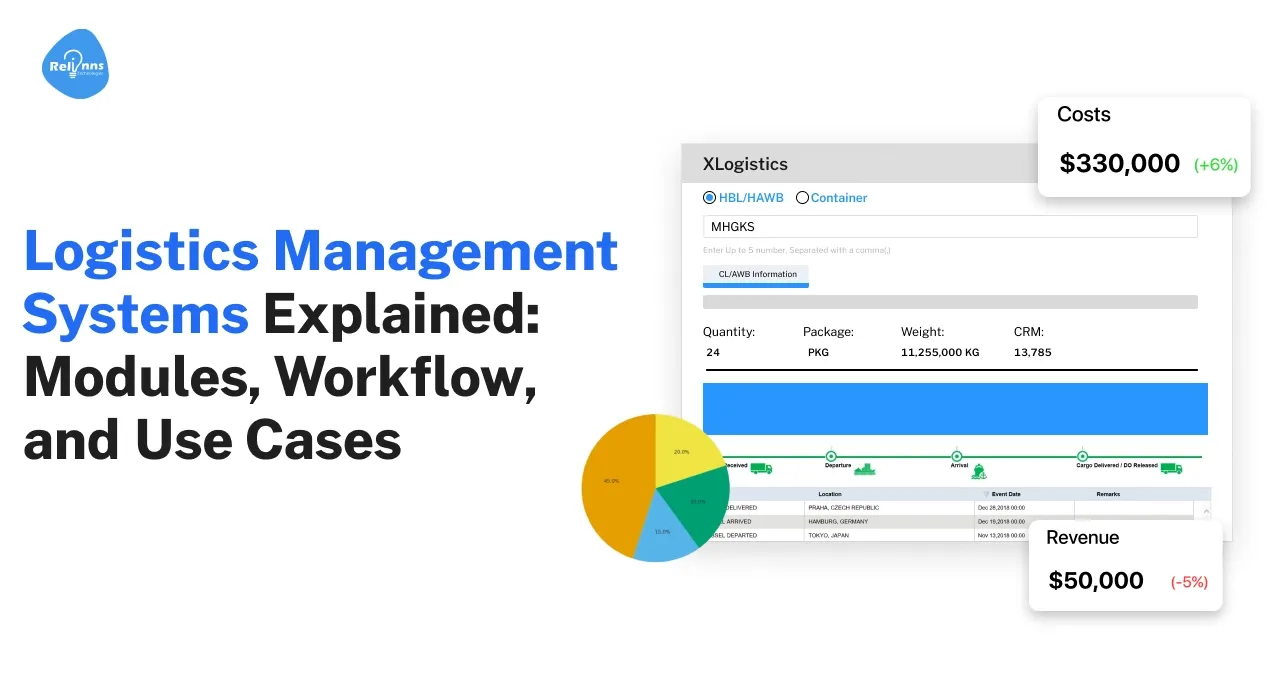
From sourcing the raw materials used to make products to getting them to their final destination, the entire process of transporting goods requires significant logistical planning and coordination.
That’s why logistics management systems (LMS) are so important – they have evolved from basic spreadsheets to advanced software that enables businesses to run their global supply chains more effectively.
In fact, businesses today are using Logistics Management Systems not only to track shipments and manage inventory, but also to develop smarter, data-driven strategies that enable them to deliver products at lower cost while increasing customer satisfaction.
By consolidating all their supply chain activities into a single digital dashboard, logistics managers now have access to real-time information across the entire supply chain.
As consumers demand greater accuracy, speed, and affordability, Logistics Management Systems will remain an integral component of any company seeking to stay competitive in today’s complex supply chain environment.
Understanding Logistics Management Systems
Logistics management systems unify ordering, inventory, and transportation.
They automate shipment tracking, warehousing, and delivery workflows to improve accuracy and reduce manual work.
By centralizing logistics data, Logistics Management Systems provide 24/7 visibility into every shipment and inventory level. A Logistics Management System helps prevent issues like empty return trips.
- Minimizes empty miles: Route planning ensures loads on return trips, addressing the ~50% of trucks that otherwise return empty.
- Centralized data hub: Connects orders, inventory, and carrier information in one platform, reducing manual errors and stockouts.
- Transportation optimization: Companies cut freight spend by ~11% on average with advanced TMS modules, boosting profit margins.
What are the core functions of a logistics management system?
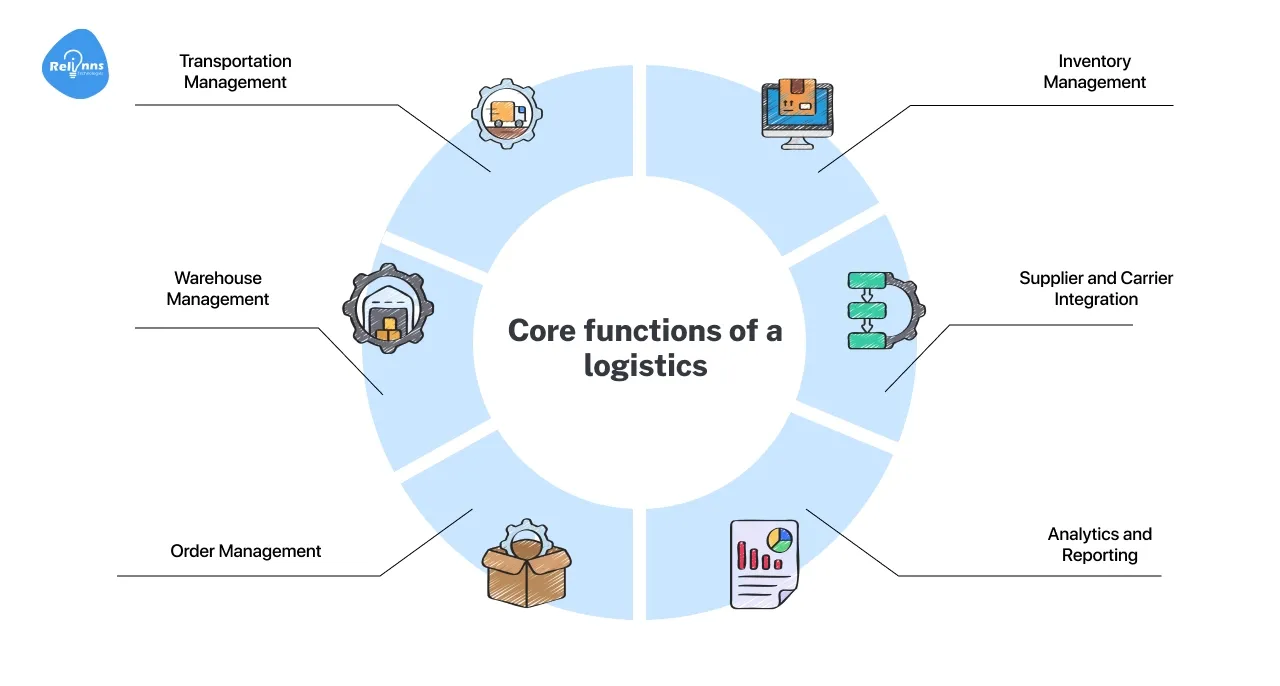
A Logistics Management System streamlines end-to-end logistics operations by integrating key components into a single platform. Below are the core functions and their subcomponents.
Transportation Management
- Helps plan and execute efficient freight movements across road, air, rail, or sea.
- Enables real-time tracking and monitoring of shipments for transparency and security.
- Supports freight rate comparison, contract management, and route optimization to reduce costs.
Warehouse Management
- Provides real-time visibility of inventory levels and stock movements.
- Automates picking, packing, and shipping processes to improve order accuracy.
- Utilizes technologies like RFID, barcode scanning, and IoT for better warehouse control.
Order Management
- Synchronizes order processing across multiple channels (retail, online, B2B).
- Offers real-time order status updates to customers and internal teams.
- Integrates with CRM and ERP systems to streamline sales, returns, and customer service.
Inventory Management
- Maintains optimal stock levels to avoid both overstocking and stockouts.
- Automates inventory replenishment based on demand forecasts and sales data.
- Links warehouse locations and distribution centers for unified inventory control.
Supplier and Carrier Integration
- Establishes digital connections with third-party logistics providers and carriers.
- Facilitates seamless data exchange on shipments, invoices, and compliance documents.
- Enhances communication for real-time problem resolution and scheduling adjustments.
Analytics and Reporting
- Delivers dashboards for KPIs such as delivery times, freight spend, and inventory turnover.
- Supports predictive analytics for demand forecasting and capacity planning.
- Enables data-driven decision-making to continuously refine logistics performance.
What are the key features to look for in a logistics management system? (LMS)
Choosing the right Logistics Management System means prioritizing features that keep shipments visible, teams aligned, and decisions fast at scale.
1. Real-Time Tracking & Visibility
The live unified view of all orders, Inventory Shipped, and Inventory in Transit for an Enterprise Logistics Management System can be achieved by combining GPS and IoT data to provide near-real-time location updates.
This Unified View allows teams to provide Accurate ETAs to Customers, Re-route Delayed Shipments, and be proactive in the face of any supply chain disruption.
With all operations teams knowing the location of goods being transported in the Supply Chain, they can stabilize inventory levels and help reduce customer service issues.
Suggested Reading: Real-Time Logistics Tracking Solutions: Transforming Delivery Visibility in 2026
2. Integration & Interoperability
A successful Logistics Management System will seamlessly interface with ERP systems, warehouse systems, transport systems, and carrier networks.
This will allow all data to flow automatically between systems, eliminating the need for manual entry.
For instance, a purchase order in an ERP can automatically trigger a shipment and create an invoice in a Logistics Management System. The integration of all systems provides a single source of truth and eliminates data silos, enabling faster, more accurate decision-making.
3. Automation & Custom Workflows
Configurable workflow automation is the most significant benefit for your Logistics Management System, as it lets you leverage your specific business processes.
For example, automatically calculating shipping costs per carrier based on distance and triggering the appropriate alert to the airline when they need to be resupplied reduces the repetitive manual processes required for this task, streamlining it and allowing employees to do other work of greater value.
4. Advanced Analytics & Reporting
Through built-in dashboards and up-to-date reporting, logistics data can be converted into actionable insights.
The ability to use these tools to identify inefficient delivery routes, under-performing carriers, and inventory blockages is highlighted in a Logistics Management System powered by visual analytics.
They enable logistics managers to create demand forecasts, evaluate future capacity, manage costs, and make decisions quickly and accurately using the information available to them.
5. User-Friendly Interface & Mobility
An easy-to-use user experience is critical to driver, logistics manager, and warehouse staff adoption.
A strong mobile experience in a Logistics Management System gives field teams a way to scan barcodes, check for updated delivery schedules, respond to alerts, and handle whatever else comes up while they're on the go.
This helps streamline communication, support a consistent system across all users, and reduce onboarding time for new users.
6. Scalability & Flexibility
Your Logistics Management System should grow alongside your company as you scale.
Cloud-based logistics platforms will allow you to grow shipment volumes, add new geographic locations, and grow into international markets without needing to redo your infrastructure.
Along with Growth & Flexibility, cloud-based logistics platforms support multimodal transit, are compatible with multiple currencies and languages, and can adapt to changing workflows to ensure your logistics management system remains effective as your operations evolve.
Each of these capabilities is critical for successful logistics operations in today’s dynamic environment.
Real-time tracking improves responsiveness, automation reduces costs, integration ensures accuracy, and analytics drive more innovative logistics strategies. Combined, they position your Logistics Management System as the digital control tower of your supply chain.
3 Types of Logistics Management Systems
The current state of logistics operations requires greater reliance on software solutions across the entire goods lifecycle, with tools focused on supporting specific functions or processes.
Businesses need to carefully select the right software platform to achieve maximum operational efficiency, increase customer satisfaction, and provide the tools to build their businesses and scale warehouse and transportation capabilities.
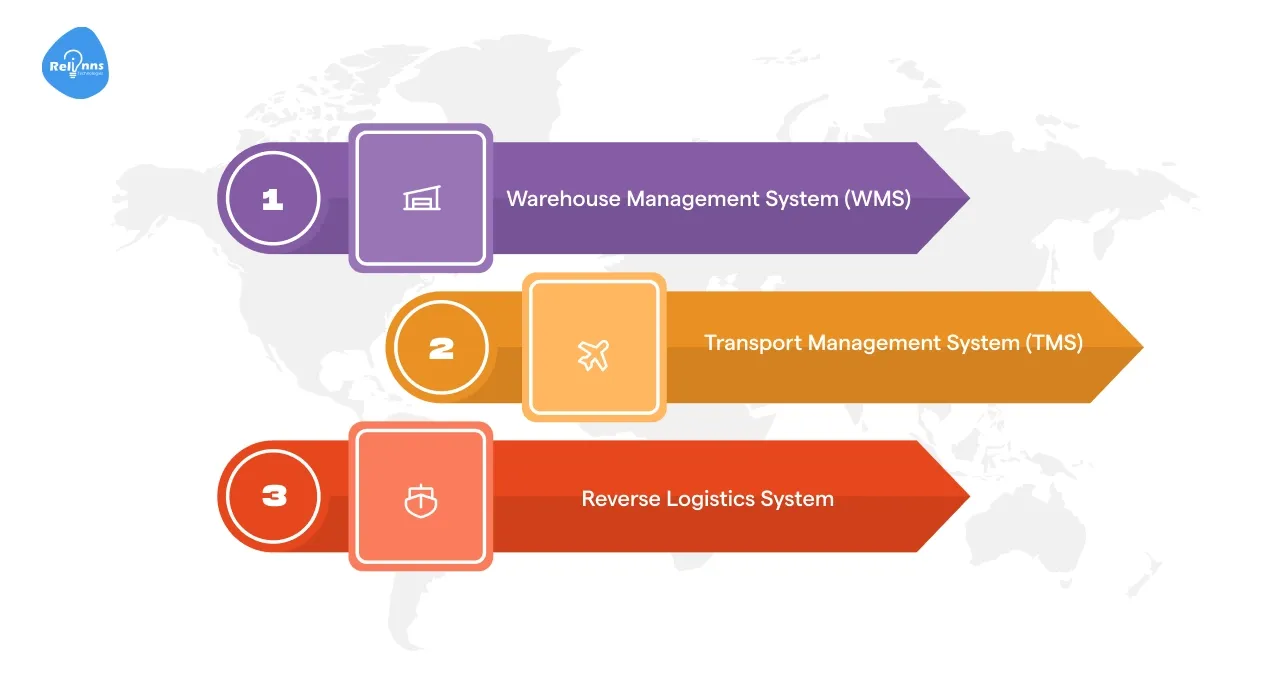
Outlined below are some of the most common logistics solutions that businesses utilise to operationalise their logistics processes and workflows, including: Warehouse Management Systems (WMS), Transport Management Systems (TMS), and Reverse Logistics Solutions.
1. Warehouse Management System (WMS)
The Warehouse Management System (WMS) provides a foundational solution for managing and improving warehouse operations.
If you're running an ecommerce or wholesale distribution centre, the WMS will also help you maintain accurate inventory records, fulfill orders efficiently, and provide real-time visibility into your warehouse.
Inventory Control and Real-Time Tracking
- Enables continuous monitoring of stock levels across multiple warehouse locations.
- Helps prevent overstocking and stockouts through automated threshold alerts.
- Improves demand forecasting accuracy using historical data and inventory movement trends.
Inbound Logistics and Putaway Optimization
- Guides warehouse staff with system-generated putaway instructions for optimal storage locations.
- Minimizes handling time by assigning the nearest available slots for received goods.
- Enhances receiving accuracy through barcode scanning and real-time verification.
Order Picking, Packing, and Labeling Efficiency
- Supports various picking strategies, including batch, wave, and zone picking.
- Reduces fulfillment errors through barcode- and RFID-enabled packing workflows.
- Automatically generates shipping labels, invoices, and packing slips for each order.
2. Transport Management System (TMS)
A Transport Management System is a critical component of modern Logistics Management Systems.
It streamlines transportation planning, execution, and monitoring, empowering logistics teams to optimize delivery performance, reduce shipping costs, and improve real-time visibility across the supply chain.
Route Planning and Delivery Optimization
- Plans cost-effective routes using traffic, weather, and delivery time constraints
- Reduces fuel consumption and transit times through AI-driven optimization
- Increases last-mile efficiency with real-time route updates and driver notifications
Carrier Management and Freight Booking
- Compares rates and service levels from multiple carriers in a single dashboard
- Automates carrier assignment based on rules like region, cost, or speed
- Tracks carrier performance with KPIs such as on-time rate, cost per mile, and delay reports
Freight Billing and Payment Automation
- Validates invoices against delivery data to detect billing discrepancies
- Generates digital freight bills and payment records for finance teams
- Integrates with ERP systems to sync logistics and accounting workflows
3. Reverse Logistics System
Reverse logistics software helps businesses manage returns, repairs, and the disposal of goods in a cost-effective, customer-friendly manner.
This system supports circular supply chains by optimizing value recovery and sustainability practices across the post-sale product lifecycle.
Returns Management and Product Flow Control
- Automates return authorization, inspection, and restocking across channels
- Tracks each returned item’s status and location with real-time visibility
- Reduces loss by routing eligible items for resale, recycling, or refurbishment
Repair, Refurbishment, and Warranty Tracking
- Coordinates product movement through repair centers and quality checks
- Maintains audit trails for warranty claims and service performance
- Enables resale of refurbished goods with accurate part and service logs
Disposal and Sustainability Compliance
- Ensures hazardous or expired goods are disposed of per compliance standards
- Logs disposal methods and documentation for sustainability audits
- Supports ESG goals with waste reporting and emissions data tracking
7 Modules of a Logistics Management System
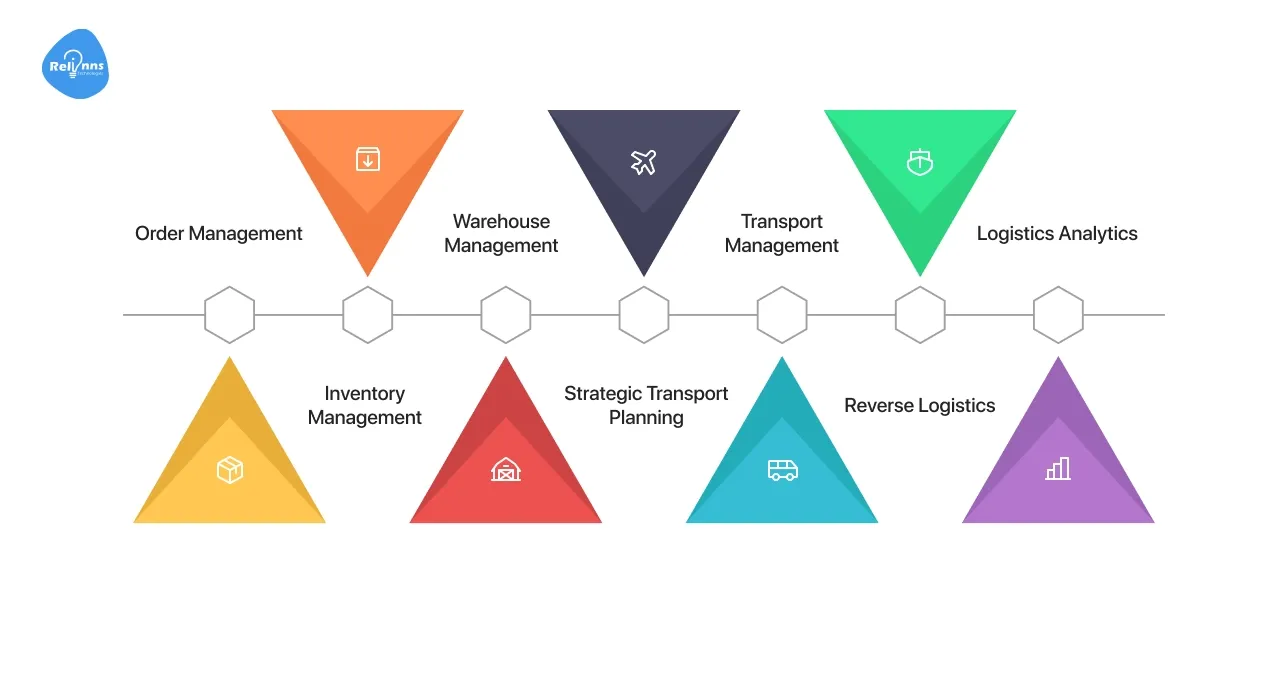
A Logistics Management System comprises seven core modules, each responsible for optimizing a critical part of the supply chain.
From order placement to delivery and returns, these modules work in sync to ensure efficiency, visibility, and adaptability.
1. Order Management
This module serves as the control center for processing orders across multiple sales channels.
It tracks orders in real time, coordinates inventory, and ensures seamless handoff to fulfillment and delivery systems.
Key features of Order Management
- Centralizes multichannel orders for real-time tracking
- Automates order verification, inventory check, and routing
- Manages cancellations, modifications, and partial shipments
- Integrates with CRM, accounting, and shipping APIs
Pros and Cons
Pros | Cons |
| Ensures fast, accurate order processing | May require complex rule configuration |
| Reduces order errors and overselling | Dependency on inventory accuracy for proper routing |
| Offers real-time customer notifications | High traffic volumes need a robust infrastructure |
| Boosts team productivity via automation | Limited, if not fully integrated with fulfillment tools |
2. Inventory Management
Inventory management maintains balanced stock levels across multiple nodes. It avoids excess holding costs and ensures product availability where and when it’s needed.
Key features of Inventory Management
- Tracks real-time inventory across warehouses and stores
- Automates replenishment based on set thresholds
- Supports batch tracking, serial numbers, and expiry dates
- Provides forecasting using sales velocity and seasonality
Pros and Cons
Pros | Cons |
| Reduces carrying costs with optimal stock levels | Errors can ripple across order and fulfillment systems |
| Improves stock turnover and planning | Inaccurate data sync causes over- or understocking |
| Enhances accuracy with barcode and RFID use | Advanced features may require staff training |
| Enables faster audits and compliance reporting | Integration with legacy tools can be complex |
3. Warehouse Management
A Warehouse Management System (WMS) is designed to organize the physical storage and flow of goods inside one or more facilities. It improves accuracy in picking, packing, and storage.
Key features of Warehouse Management
- Assigns dynamic storage zones for optimized space usage
- Streamlines picking and packing workflows using mobile tools
- Tracks goods with barcode, QR, or RFID systems
- Supports wave, zone, and batch picking strategies
Pros and Cons
Pros | Cons |
| Increases space utilization and storage efficiency | High upfront cost for implementation and setup |
| Cuts down fulfillment time with optimized workflows | Complex configurations may need customization |
| Enhances accuracy with guided pick-pack processes | Requires consistent employee training for best results |
| Reduces shrinkage through tighter stock controls | Mobile device dependency for real-time updates |
4. Strategic Transport Planning
This module focuses on forward-looking logistics strategy—optimizing routes, delivery networks, and transport models to improve cost and service-level performance.
Key features of Strategic Transport Planning
- Uses data to simulate and optimize future transport networks
- Models delivery costs vs. customer service trade-offs
- Identifies consolidation and load optimization opportunities
- Supports fleet investment, capacity forecasting, and lane analysis
Pros and Cons
Pros | Cons |
| Enables proactive route and cost optimization | Data-heavy and dependent on accurate forecasting inputs |
| Improves long-term transport efficiency | Not suited for daily execution tasks |
| Supports scenario planning and contingency mapping | Requires historical and predictive data integration |
| Aligns logistics with business growth strategy | High-end tools may be resource-intensive |
5. Transport Management
The Transport Management System (TMS) manages the execution side of delivery- selecting carriers, managing shipments, and ensuring freight compliance.
Key features of Transport Management
- Automates carrier selection based on rules and rates
- Tracks freight movement across all shipping modes
- Sends real-time delivery alerts and status updates
- Manages freight documents and proof of delivery
Pros and Cons
Pros | Cons |
| Enhances carrier performance visibility | Integration with external carrier systems can vary |
| Reduces shipping costs through rate optimization | May require manual overrides for exceptions |
| Enables on-time delivery through real-time tracking | Local carriers may lack full integration capabilities |
| Automates freight billing and compliance checks | System complexity increases with multiple transport modes |
6. Reverse Logistics
Reverse logistics handles the flow of products from customers back into the supply chain. It includes returns, repairs, recycling, and safe disposal.
Key features of Reverse Logistics
- Automates returns, inspections, and restocking paths
- Routes defective goods for repair or warranty processing
- Tracks each return item’s lifecycle and disposition
- Ensures disposal/recycling meets environmental compliance
Pros and Cons
Pros | Cons |
| Reduces waste and supports sustainability | Costly if returns aren’t optimized by location |
| Improves customer satisfaction with easy returns | Complex routing and inspection workflows |
| Allows value recovery via resale or refurbishment | Return fraud can inflate processing costs |
| Supports green compliance with full traceability | Disposal management adds documentation requirements |
7. Logistics Analytics
This module turns raw logistics data into actionable insights. It helps businesses identify inefficiencies, spot trends, and measure performance across supply chain KPIs.
Key features of Logistics Analytics
- Offers dashboards for delivery times, stock levels, and freight costs
- Visualizes trends in returns, delays, and carrier performance
- Supports cost benchmarking across routes, carriers, and regions
- Enables predictive analytics for demand and inventory planning
Pros and Cons
Pros | Cons |
| Empowers decision-making with data-backed insights | Dependent on the quality and consistency of input data |
| Identifies hidden costs and process bottlenecks | Visualization tools may require training or expertise |
| Helps optimize network design and warehouse loads | Real-time dashboards may lag without strong data sources |
| Supports ongoing performance improvement programs | Smaller companies may underuse advanced analytics tools |
How to Integrate Logistics Management Solutions
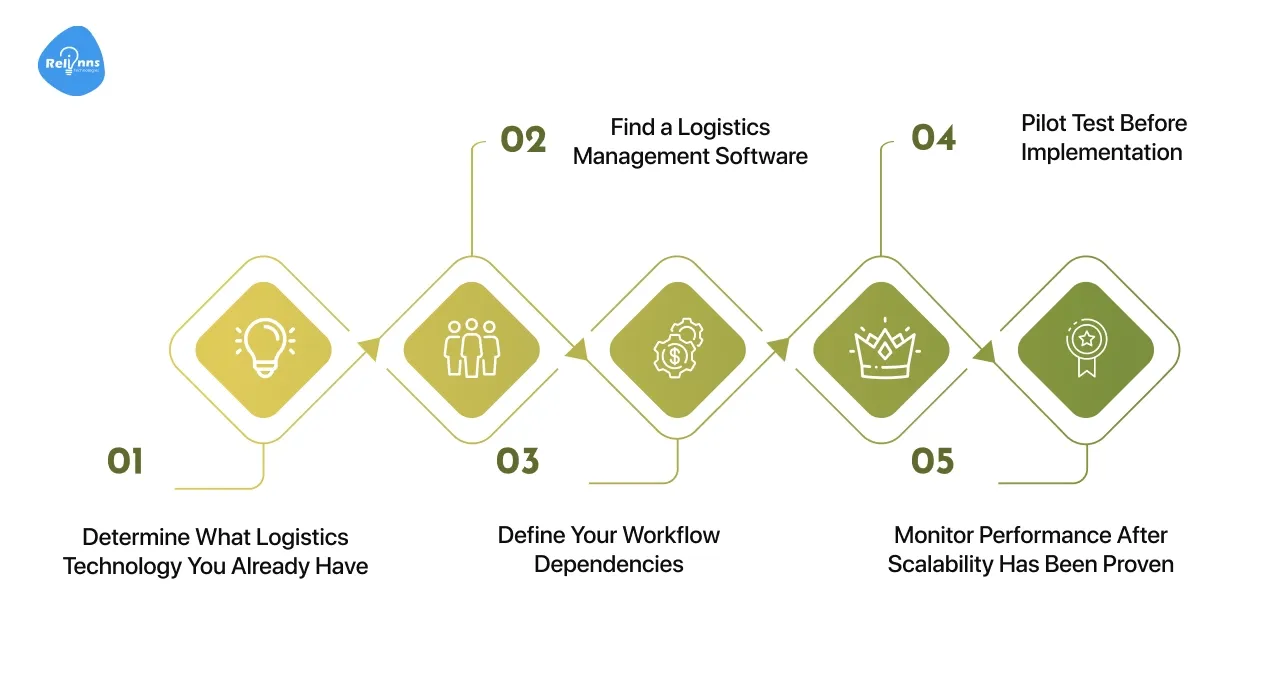
Integrating a Logistics Management System (LMS) into your existing infrastructure requires a strategic, phased approach.
It ensures all components- inventory, transportation, warehouse, and ERP systems- communicate effectively to optimize the supply chain.
Key integration tools and strategies
- Use API-based connections for flexible, scalable integrations
- Connect ERP, WMS, and CRM systems to centralize logistics data
- Enable mobile app access for on-ground tracking and updates
- Integrate with carrier systems for real-time shipping status
- Automate notifications, billing, and performance reports
1. Determine What Logistics Technology You Already Have
To get started on your journey toward digital transformation, look at all of the technologies being used by your logistics teams to manage inventory, order fulfillment, transport of goods, and report on performance metrics.
This will help you identify areas with data silos or manual workarounds.
2. Find a Logistics Management Software (LMS) That Integrates with Existing Systems
You should seek out a logistics management solution that includes API's, EDI support, and pre-built integrations with major ERP, WMS, and TMS systems.
This allows for a more streamlined approach, with little disruption and a quicker time to deploy new logistics management technology.
3. Define Your Workflow Dependencies and Data Flows
Once you have chosen a Logistics Management System that works with your existing systems, you will need to determine how each of them will work together to create an efficient supply chain.
Examples of workflow dependencies include an order to inventory, a shipment status to customer service, and a return to finance.
4. Pilot Test Before Implementation
The best way to validate your logistics management software is to pilot it at one warehouse, with one shipping partner, or one product category.
You should focus on resolving any bottlenecks that may arise, optimizing automated rules, and ensuring key members of your team know how to use the system.
5. Monitor Performance After Scalability Has Been Proven
Once you have verified that your Logistics Management System can successfully be deployed at an individual site.
Roll out your Logistics Management System across your entire logistics network and continuously monitor shipment visibility, carrier performance, and fulfillment speed using real-time dashboards.
What are the advantages of implementing a logistics management system?
The introduction of a Logistics Management System (LMS) enhances the efficiency of Supply Chain operations on multiple levels.
With the Logistics Management System, organizations will benefit from enhanced visibility and improved coordination of Logistics activities, as well as automated Logistics tasks (resulting in cost savings and service level enhancements).
Benefits at a glance
- 35–50% reduction in manual logistics tasks through automation
- Up to 30% improvement in on-time delivery rates
- 25% faster returns processing through reverse logistics optimization
- 40% better inventory accuracy with integrated stock tracking
- Up to 20% cost savings in freight billing and carrier management
1. Visibility Across the Supply Chain
Real-time tracking of inventory, shipment, and warehouse operations provides Logistics teams with the ability to oversee Logistics processes (activities) with no delays or guesswork.
2. Reduces Logistics Operating Costs
Automation reduces errors (manual) and eliminates additional administrative costs, in addition to optimizing route selection based on fuel consumption, freight costs, and labor costs.
3. Increased Speed & Accuracy of Order Fulfillment/ Delivery
Logistics Management System software enables faster order fulfillment and delivery through coordinated Picking, Packing, and Shipping modules, thereby allowing customers to receive orders accurately and on time.
4. Improvement of Customer Satisfaction
Proactive delivery notifications, seamless return processes, and accurate ETA notifications build customer trust and reduce support centre complaints.
5. Provision of Improved Data for Strategic Planning & Forecasting
Built-in Variables provide access to real-time Reports and Historical Data, enabling the Logistics Management System to provide businesses with the information they need to make Intelligent Procurement, Transportation Capacity, and Warehouse Expansion decisions.
6. Facilitates Business Growth
Logistics Management Systems are cloud-scalable, therefore they can accommodate increased shipment volumes and the addition of new warehouse locations without requiring extensive system upgrades.
7. Increased Compliance/Risk Control
Tracking Returns, recalls, or Regulated Materials on Logistics Management System Platforms enables Organizations to meet Compliance Requirements and reduce Liability Risk.
Conclusion: Choosing the Right LMS for Scalable Logistics
A Logistics Management System (LMS) is now a necessary component of a modern supply chain. A Logistics Management System provides structured, visible automation across all stages of the supply chain: from order placement, warehousing, and delivery to returns.
As businesses grow increasingly complex in their supply chain operations, Logistics Management Systems are no longer optional; companies should adopt a centralized Logistics Management System solution.
Not every Logistics Management System platform on the market will provide your company with what it needs; you want one with an adaptable architecture that integrates with other business systems to meet the unique needs of your evolving logistics operations.
That is where Relinns fits best. We do not sell rigid off-the-shelf LMS software. We build custom logistics and supply chain platforms that match how your operations actually run, then improve them with automation and real-time visibility.
Why Relinns for your LMS
- Custom-built workflows for dispatch, approvals, and exceptions
- Real-time dashboards for shipments, cargo status, and delays
- Smart approval automation with rule-based routing and escalations
- Accurate quantity and reconciliation logic to prevent over-dispatch
- Role-based portals for admins, operations, finance, and field teams
- Mobile-ready interfaces for on-ground updates and slip generation
- API first integrations with ERP, GPS, mapping, and tracking systems
- Cloud scalability proven in high-volume port operations
- Measured operational impact, like faster approvals and lower idle time
What you should look for in an LMS is simple. It must adapt to change, stay stable at scale, and deliver results you can measure. Relinns gives you that control with a system built around your logistics reality, not generic templates.
Frequently Asked Questions (FAQ's)
What are the four types of Warehouse Management Systems (WMS)?
The four types are standalone WMS, ERP-integrated WMS, cloud-based WMS, and on-premise WMS. Each offers different levels of control, scalability, and integration depending on the business's logistics needs and IT infrastructure.
What is an example of a logistics system?
A logistics system example is Amazon’s supply chain platform, which manages warehousing, transportation, and inventory using real-time data. It streamlines order fulfillment while providing delivery tracking, predictive analytics, and automation across global networks.
How can a Logistics Management System improve customer satisfaction?
A Logistics Management System improves customer satisfaction by offering faster deliveries, accurate order tracking, smoother returns, and proactive updates. These features reduce errors and delays, leading to better service and increased customer trust.