Improve Quality Control with AI: Apps, Use Cases, and Rollout Guide
Date
Nov 25, 25
Reading Time
9 Minutes
Category
Generative AI
Share


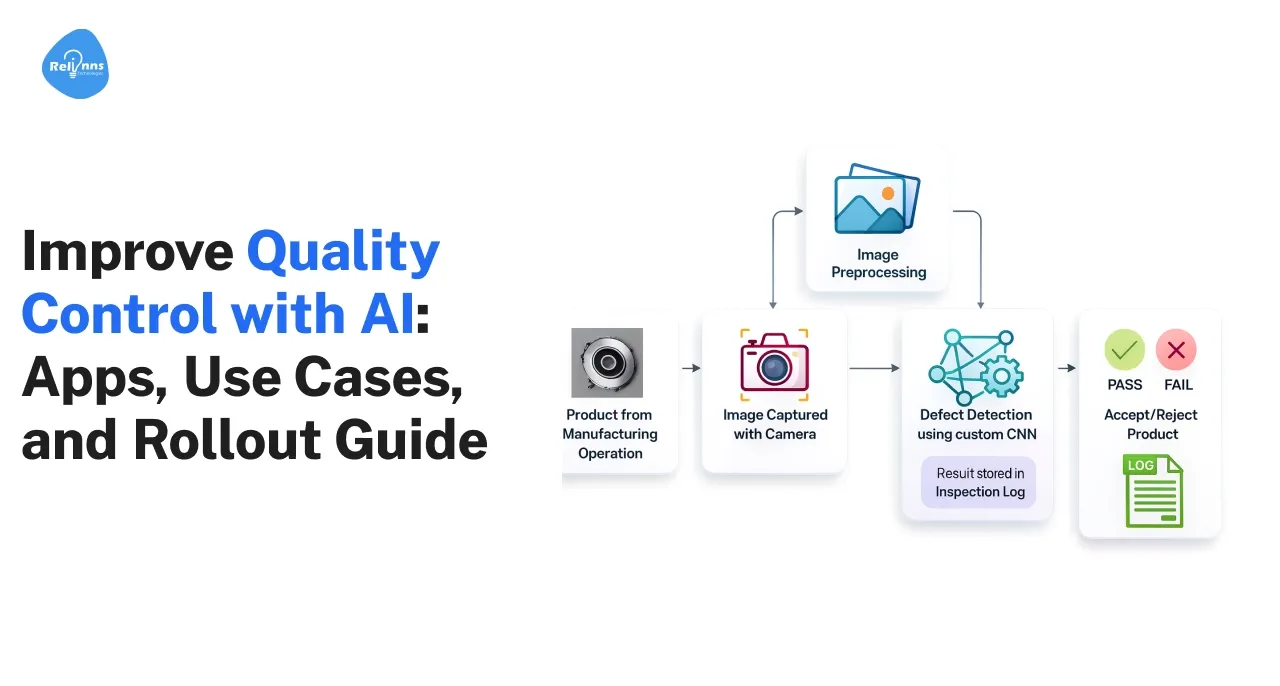
In modern manufacturing, companies face mounting pressure to raise standards, reduce defects, and respond quickly to market demands. Traditional inspection methods, manual checks, sampling, and visual review are reaching their limits.
With more complex products and faster throughput, many defects go undetected until it is too late.
That is why manufacturers are now seeking ways to improve quality control with AI. By deploying apps powered by computer vision, machine learning, and analytics, teams are transforming quality control from reactive fix to proactive excellence.
These tools deliver real-time insights, enforce consistency, and help maintain high product quality even at scale.
This article explores how manufacturing AI is driving this shift, the key capabilities of these apps, use cases across industries, and how to plan a successful rollout of a quality control solution that truly improves outcomes.
What Does “Improve Quality Control with AI” Mean?
When we talk about manufacturing AI for quality control, we refer to applications that go beyond human inspection and traditional statistical checks.
These systems incorporate sensors, machine vision, and data analytics to monitor production, detect irregularities, and predict defects before they reach the customer.
In essence, such apps automate aspects of quality control and integrate those capabilities into a job order or production-management system. They allow companies to inspect every unit rather than sampling, trace defects back to their root causes, and continuously refine inspection logic using real-world data.
Understanding this shift is essential: manufacturing AI is not replacing humans, but augmenting them. The focus is on accuracy, consistency, scalability, and using data to improve quality control processes over time.
Suggested Reading: SaaS for Manufacturing: Optimize Production with Cloud-Based Solutions
Key Features & Capabilities of Quality Control Apps
Below are the core domains where manufacturing AI apps deliver value by improving quality control.
1. AI-Driven Visual Inspection & Defect Detection
AI vision systems can spot surface defects, misalignment, missing components, burrs, discoloration, and more at speeds and with accuracy unmatched by human inspectors.
Sub-capabilities include
- Combined inspection of geometry, color, texture, and contamination in one pass.
- Adaptation to varying lighting, backgrounds, or part orientation.
- Heatmaps or segmentation that show precisely where the defect is located.
2. Real-Time Inline Quality Monitoring
These apps integrate directly with production lines, inspecting each item as it moves and sending alerts or automatically diverting defective units.
Sub-capabilities include
- Edge computing deployment so vision decisions happen locally with minimal latency.
- Tight integration to PLC, MES, or SCADA systems so the line can pause or adjust automatically when a problem occurs.
- Feedback loops where quality data drives immediate process adjustments.
3. Predictive Quality Analytics & Process Optimization
Beyond detecting defects, manufacturing AI uses sensor and process data to forecast conditions that lead to quality degradation.
Sub-capabilities include
- Machine learning models that correlate process parameters (temperature, pressure, speed) with defect likelihood.
- Unsupervised anomaly detection to flag unusual patterns when labelled data is scarce.
- Integration with SPC and other quality frameworks so insights drive recipe tuning and corrective action.
4. Root Cause Analysis & Traceability
Quality apps link inspection outcomes with production metadata to trace issues back to specific machines, operators, materials, or shifts.
Sub-capabilities include
- Genealogy mapping of each item’s production path, machine by machine.
- Automated CAPA workflows triggered by AI-detected patterns.
- Seamless integration with quality management systems so corrective actions are logged and tracked.
5. Continuous Learning, Data Pipeline & Model Management
For AI manufacturing to remain effective, the system must learn and adapt to changing products and processes.
Sub-capabilities include
- Retraining models as new defect types are found or new part variants are introduced.
- Active-learning loops where the system requests human verification for uncertain cases.
- Performance monitoring of models (precision, recall, latency) and version management across plants.
6. Multi-Modal Quality Analytics & SPC Integration
Quality control apps now combine vision data, sensor time series, MES events, and environmental variables into a unified analytics.
Sub-capabilities include
- Correlation of image defects and process signals to spot root causes invisible to rule-based approaches.
- Dashboards that show quality alongside throughput, uptime, and maintenance metrics.
- Digital twin or simulation support so teams can test changes virtually before applying them on the line.
7. Work-flows, UX & No-Code App Features
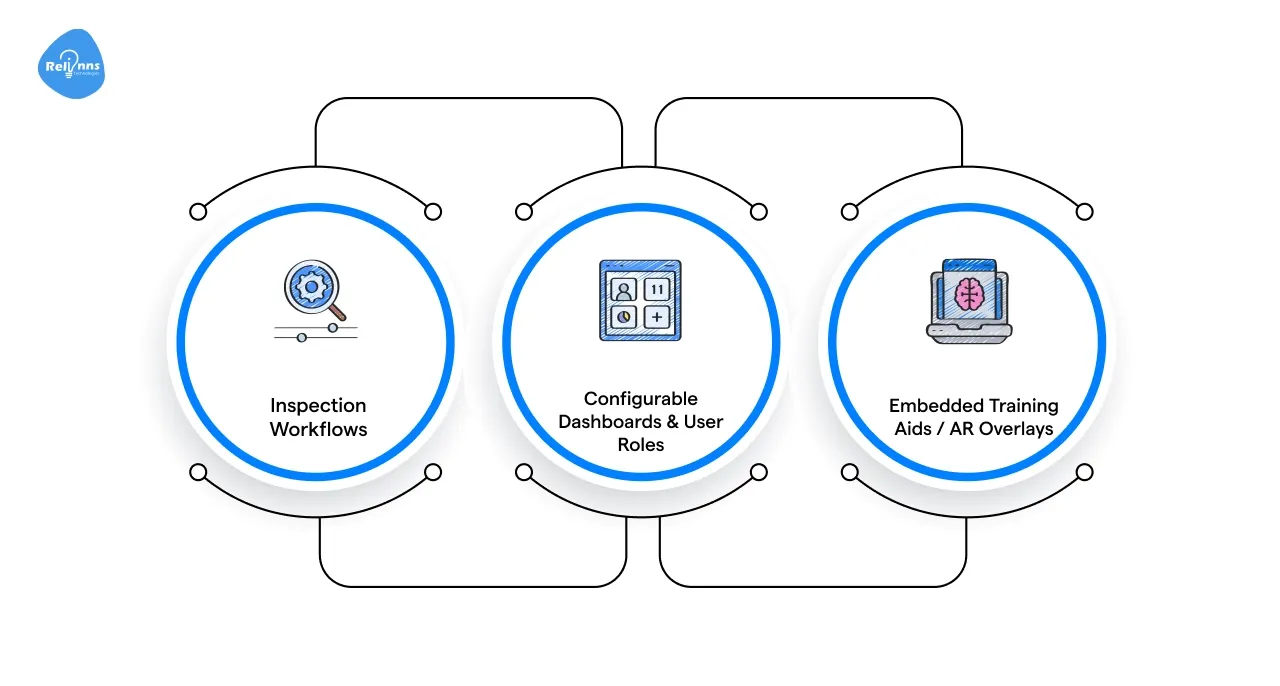
For broad adoption, these systems offer mobile and web apps for operators, supervisors, and quality engineers.
Sub-capabilities include
- Inspection workflows that guide technicians step by step and collect required data.
- Configurable dashboards and roles so each user sees only relevant information.
- Embedded training aids or AR-style overlays to help new users adopt the system quickly.
8. Deployment Architecture: Edge, Cloud & Hybrid
Manufacturing environments vary in connectivity and scale. Quality apps support different architectures accordingly.
Sub-capabilities include
- Edge vision and computing hardware onsite for high-speed inspections.
- Cloud back-end for analytics, model training, and fleet management.
- Hybrid setups where only metadata is sent to the cloud for data privacy or latency reasons.
9. Human-in-the-Loop, Change Management & Skills
Even the best manufacturing AI apps require trained teams and strong change management. Practitioners highlight culture as a bigger barrier than technology.
Sub-capabilities include
- Override interfaces where human supervisors validate or correct AI decisions.
- Training programs for quality engineers, data analysts, and frontline operators.
- Gradual rollout in assist mode, AI suggests, humans decide, before full automation.
10. Governance, Compliance & Security
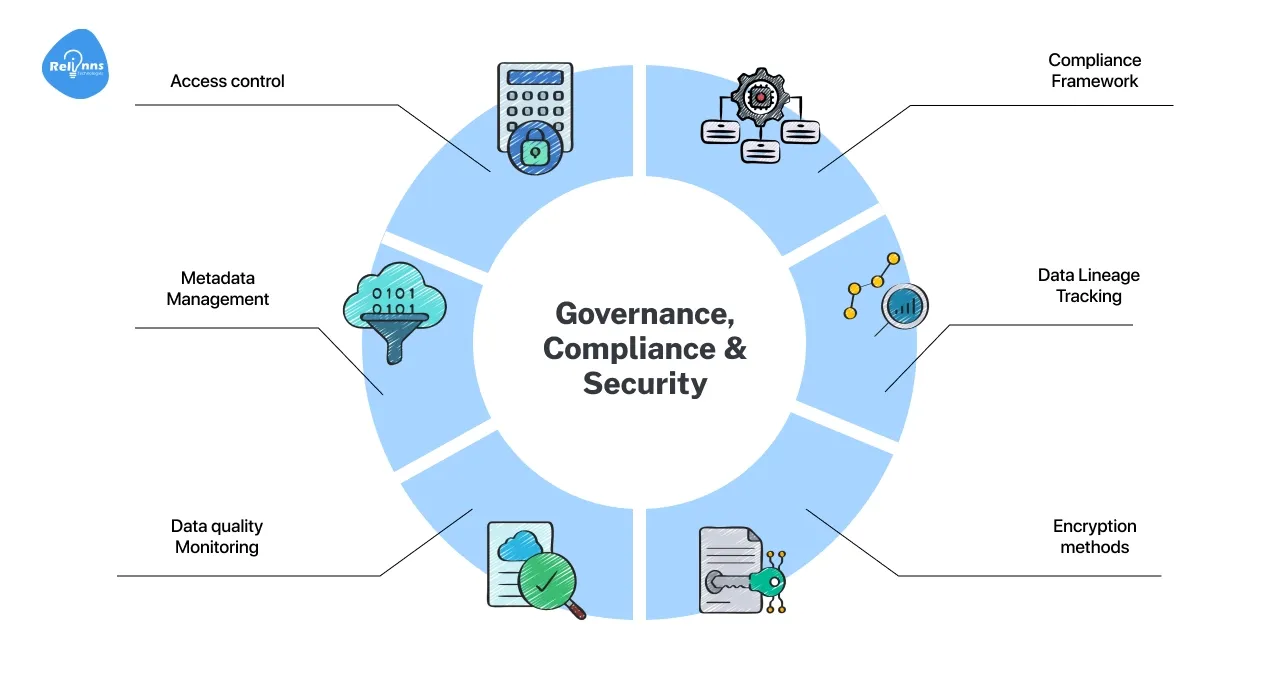
Quality systems must support traceability, audit logs, and regulatory standards, especially in sectors such as automotive, aerospace, and medical.
Sub-capabilities include
- Version control for AI models so each batch links to a known model version.
- Secure data storage and access controls for inspection images and metadata.
- Audit-ready logs that capture who approved what, when, and why.
How to Plan an AI-Powered Quality Control App Rollout
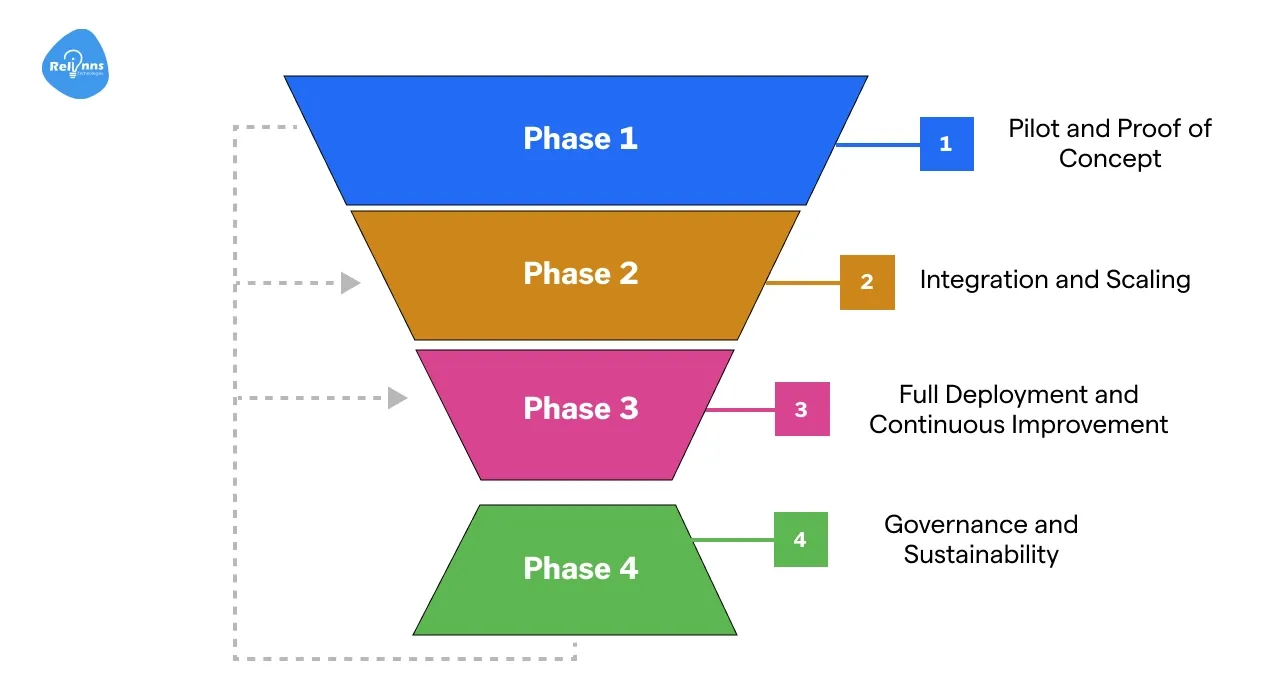
To truly improve quality control with AI, organizations must plan strategically. The following roadmap outlines key phases.
Phase 1: Pilot and Proof of Concept
AI-powered pilots help manufacturers improve quality control with AI by identifying high-impact defect areas and testing solutions on a controlled scale.
This phase confirms that the quality control app can deliver measurable gains before wider rollout.
- Select a high-value defect category that offers clear potential for quality improvement.
- Capture baseline data, including defect rates, cycle times, and scrap values for comparison.
- Deploy a focused vision or analytics module that targets the identified defect area.
- Validate that the manufacturing AI app reduces defects and integrates smoothly with existing systems.
Phase 2: Integration and Scaling
After the pilot proves successful, this phase focuses on integrating the solution into broader operations.
Manufacturing teams strengthen quality control by ensuring smooth data flow and scaling AI driven tools across multiple lines.
- Connect the quality control app to MES, ERP, and inventory systems to create a unified data source.
- Expand AI inspection and analytics to additional machines, stages, or complete production lines.
- Establish secure, reliable data pipelines that enable real-time insights across teams.
- Configure retraining workflows so the manufacturing AI system evolves with new conditions.
Phase 3: Full Deployment and Continuous Improvement
Once integration is stable, the AI solution is deployed across all relevant production areas.
This phase strengthens the quality control process by promoting consistent usage and creating a cycle of ongoing enhancement.
- Roll out the AI powered system across all target lines or plants with structured planning.
- Train operators and supervisors to follow standardized workflows supported by the app.
- Monitor performance trends such as defect rates and throughput to measure improvements.
- Refine quality rules and inspection logic through insights gathered from real-time analytics.
Phase 4: Governance and Sustainability
To sustain long-term success, manufacturers establish governance practices that protect accuracy, compliance, and reliability.
This ensures the AI system supports quality control even as production evolves.
- Define model management policies that oversee updates, retraining, and approval processes.
- Maintain audit trails, documentation, and data controls that meet regulatory requirements.
- Conduct periodic model evaluations to identify drift and ensure ongoing performance.
- Align system enhancements with operational changes to keep the manufacturing AI reliable.
Suggested Reading: Job Order Management: Tracking and Optimizing Operations with Custom
Quality Control with AI: Challenges and How to Overcome Them
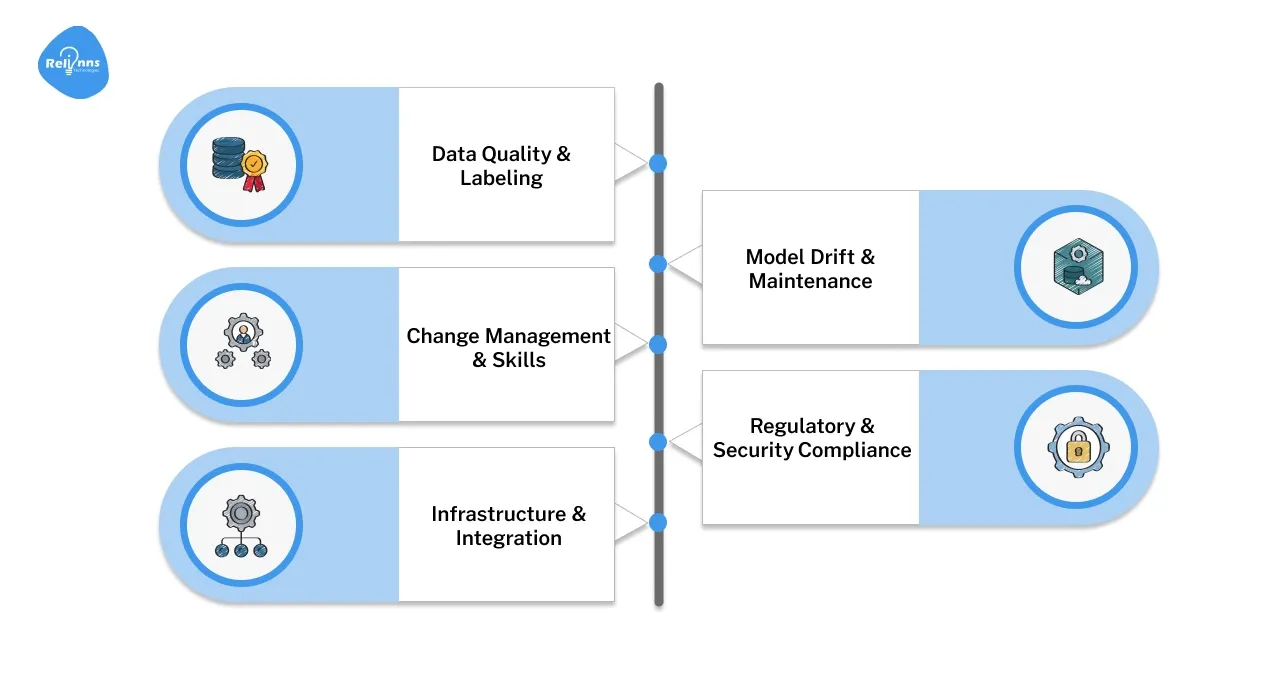
Deploying manufacturing AI to improve quality control with AI delivers significant value, but it also introduces practical challenges that organizations must address early.
These issues affect accuracy, adoption, and long-term reliability, making careful planning essential. By understanding these challenges in advance, manufacturers can build stronger quality control systems that scale successfully.
1. Data Quality & Labeling
AI models need high-quality datasets of part images, defect labels, and process parameters. Without this foundation, accuracy suffers. Mitigate this by capturing labelled data during the pilot, using active learning, and ensuring annotation standards.
2. Change Management & Skills
New tools change how people work. Operators may resist if they feel their roles are threatened. Engage teams early, position AI as assistance, not replacement, train technicians, and create human-in-the-loop workflows initially.
3. Infrastructure & Integration
High-speed inspection requires hardware, network bandwidth, and integration with MES or PLC systems. Choose a validated deployment architecture, start small, and scale gradually to ensure stability.
4. Model Drift & Maintenance
Manufacturing lines change, materials, machines, and products. AI models must adapt to avoid degradation. Set up retraining procedures, performance monitoring, version control, and continuous improvement workflows.
5. Regulatory & Security Compliance
Manufacturers in regulated sectors must meet audit, traceability, and data-protection standards. Ensure the quality control app supports version logs, secure storage, and full traceability of inspection decisions.
How to Choose the Right AI Quality Control App Partner
Selecting the right development partner is just as important as choosing the right technology. A strong partner ensures your manufacturing AI system improves quality control reliably, integrates smoothly, and scales across lines and plants. Here are the factors that matter most when evaluating an AI quality control app partner.
1. Proven Manufacturing AI Expertise
Choose a partner with experience in improving quality control with AI, including computer vision, predictive analytics, edge deployment, and model management. Review past projects in manufacturing and regulated industries.
2. Understanding of Production Environments
Your partner must understand MES, PLC, SCADA, traceability, defect taxonomies, cycle-time constraints, and online inspection challenges. This ensures the app is built for real factory conditions.
3. Ability to Build Custom Workflows & Integrations
Quality control needs differ by plant and product. Choose a team capable of integrating with MES, ERP, QMS, and sensor systems while building custom workflows that match your processes.
4. Strength in Data Engineering & Model Reliability
AI inspection requires structured data pipelines, annotation strategy, retraining workflows, and drift monitoring. Your partner should help you maintain model accuracy long term.
5. Scalability Across Lines, Plants & Operators
The ideal partner builds systems that scale across multiple machines, production lines, and global facilities while maintaining inspection consistency.
6. Compliance, Security & Governance Readiness
Ensure the partner supports audit logs, model versioning, data privacy, and regulatory requirements relevant to automotive, electronics, aerospace, medical, or FMCG sectors.
7. Strong Change Management & Operator Enablement
Your partner must provide training programs, onboarding workflows, role-based UX, and human-in-the-loop capabilities to support adoption across teams.
8. Transparent Execution, Timeline & Support
Manufacturing teams need predictable delivery, quick iterations, and responsive support. Prioritize partners offering clear timelines, sprint structures, and long-term maintenance.
Why Choose Relinns for Your Quality Control App
Choosing a partner who knows how to help you improve quality control with AI makes all the difference. Relinns brings deep expertise in manufacturing AI, quality control systems, vision analytics workflows, and full-stack deployment. Here’s how we align with your needs:
- Proven capability to improve quality control with AI through custom computer-vision and machine-learning solutions that detect defects, support inline monitoring, and traceability.
- Extensive experience integrating manufacturing systems (MES, PLC, SCADA, ERP) so your quality control workflows are seamlessly connected rather than siloed.
- Strong focus on operationalising AI: model management, continuous learning, drift detection, data-pipeline engineering, version control, and audit-ready governance.
- Architecture expertise covering edge, cloud, and hybrid deployments, so your quality app can inspect in real time at the line, aggregate analytics in the cloud, and scale across plants.
- Deep domain knowledge in manufacturing quality: Root-cause analysis, defect taxonomy, SPC frameworks, digital-twin simulation, and real-time feedback loops.
- UX and workflow design for operators, supervisors, and quality engineers: intuitive apps, role-based dashboards, mobile and web interfaces tailored for the shop-floor context.
- Change-management support and human-in-the-loop strategies for adoption: Training, operator enablement, staged rollout, clear workflow,s and collaboration between human and AI.
- Rigorous compliance, security, and traceability: Audit logs, inspection-image storage, version tagging, traceability from batch to inspection outcome; all aligned with regulated industries including automotive, aerospace, medical, and electronics.
- Scalable and sustainable implementation: Not just a pilot but a partner who can roll out across lines, sites and geographies while maintaining high-performance quality control with AI.
By choosing Relinns, manufacturing companies gain a partner that understands both the technical and operational sides of quality control. The result is a system that not only improves quality control with AI but also supports long-term manufacturing excellence.
Conclusion: Improve Quality Control with AI for Stronger Manufacturing Performance
Improving quality control with AI is no longer a futuristic option. It is a practical and powerful way for manufacturers to raise standards, reduce defects, and stay competitive.
The capabilities of manufacturing AI, from vision-driven inspection and predictive analytics to traceability, no-code workflows, and edge or cloud architecture, represent a step change in how quality is managed.
Organizations that adopt these tools will create resilient, data-driven operations where each defect can be detected early, each process can be tuned, and quality becomes a differentiator.
By following a structured rollout, investing in change management and integration, and partnering with the right system-builder, manufacturers can turn the promise of quality control into a reality that delivers both performance and margin benefits.
Frequently Asked Questions (FAQ's)
How does vision-based manufacturing AI improve defect detection?
Vision-based AI analyzes images at high speed and high accuracy to spot defects like missing components, misalignment, or surface flaws that humans often miss, boosting inspection consistency and coverage.
Can AI quality tools in manufacturing predict defects before they occur?
Yes. By analyzing sensor data, process logs, and past quality outcomes, AI models forecast conditions likely to cause defects, enabling preventive actions rather than reactive fixes.
Are these quality control apps suitable for smaller factories?
Absolutely. Cloud-based manufacturing AI solutions scale down for smaller operations. They require less hardware investment and can be deployed line by line, delivering quality gains without heavy capital.
What role do operators play when using quality control AI?
Operators remain essential. Manufacturing AI excels at detection and analytics, but humans interpret uncertainty, validate edge cases, and provide feedback that refines the model over time.
How should I measure ROI when deploying AI for quality control?
Track metrics such as defect rate, scrap cost, inspection throughput, rework rate, and customer returns. Improvements in these areas directly reflect the impact of quality control with AI.
How do manufacturing AI apps integrate with existing systems, such as MES or ERP?
Effective apps include APIs and edge or cloud architecture that connect vision, sensor, and quality data with MES or ERP systems, enabling real-time alerts, traceability, and unified operations.