Fleet Management Software Integrations Guide for Modern Logistics
Date
Jan 12, 26
Reading Time
7 Minutes
Category
Enterprise Solutions
Share


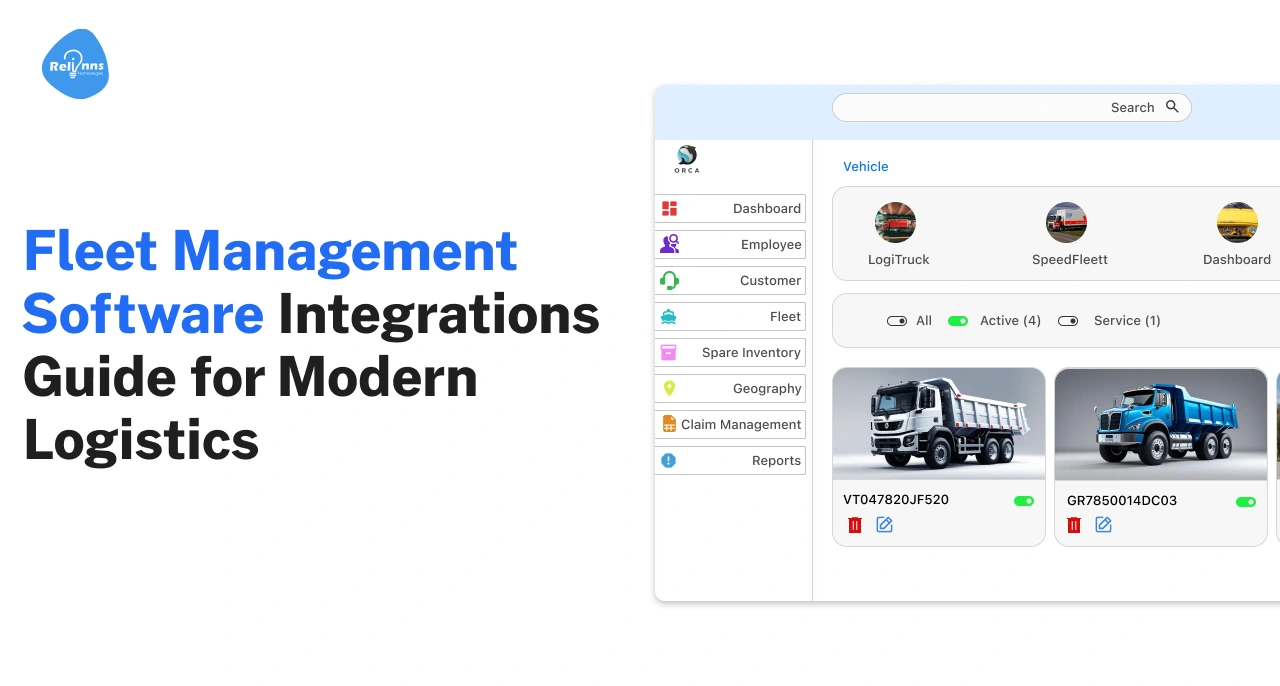
Companies managing large vehicle fleets face a complex challenge: real-time tracking, data silos, and disconnected workflows slow decision-making and inflate costs.
Modern operations need fleet software integrations that break down data barriers and unify systems.
By integrating fleet tracking GPS, ERP, telematics, maintenance, and other fleet monitoring systems into a single ecosystem, organizations gain real-time visibility, automated workflows, and reliable reporting across the entire fleet lifecycle.
This guide explains how fleet management integrations work, how to implement them step by step, and how they deliver measurable business outcomes through smarter maintenance, compliance automation, and operational efficiency.
Why Fleet Software Integrations Matter for Modern Fleet Operations

Fleet operations generate massive volumes of data every day, from vehicle location and engine diagnostics to fuel usage and maintenance records. When this information is scattered across disconnected systems, decision-making slows, and operational costs rise.
Fleet software integrations solve this problem by connecting telematics, maintenance, dispatch, and business platforms into a unified operational view. Instead of reacting to issues after they occur, fleet teams can monitor performance, automate workflows, and act in real time.
Business Impact Summary
For fleet managers, this means fewer breakdowns, faster responses to exceptions, improved compliance reporting, and clearer visibility into cost drivers across the fleet.
Key Operational Pressure Points Without Integration
- Limited visibility into route efficiency and vehicle health
- Maintenance delays caused by missing or delayed telemetry
- Manual data reconciliation between tracking, maintenance, and finance tools
- Inability to scale alerts and exception handling in real time
By removing data silos, fleet management integrations enable smarter planning, proactive maintenance, and consistent performance across growing fleets.
What Is an Integrated Fleet Management System?
An integrated fleet management system brings together all critical fleet technologies into a single, connected operational environment. Instead of managing vehicle tracking, maintenance, compliance, and finance through separate tools, fleets operate from a unified system where data flows automatically between platforms.
At its core, this approach connects fleet tracking, telematics, maintenance systems, and enterprise software so every team works with the same real-time information.
Dispatchers see live vehicle status, maintenance teams receive automated service triggers, and leadership gains accurate performance and cost insights without manual reporting.
Core Systems Commonly Integrated
- Vehicle tracking and telematics platforms
- Maintenance and service management systems
- Dispatch and transportation management tools
- ERP, finance, and reporting systems
Uncommon Integrations and Operational Edge Cases
- Fuel card and toll management systems for automated cost reconciliation
- Insurance and claims platforms for incident and accident workflows
- Warehouse and yard management systems for dock and asset coordination
- Driver identity, HR, and payroll systems for shift and compliance alignment
- IoT sensors for cold-chain monitoring, tire pressure, or load condition tracking
By aligning both standard and edge-case systems, fleet software integrations support complex operational models and enable fleets to adapt to specialized regulatory, geographic, and industry-specific requirements.
How to Integrate Fleet Management Software Step by Step

Integrating multiple systems across a modern fleet operation is a technical endeavor that requires a well-defined architecture, reliable data flows, and robust tooling.
To implement fleet software integrations that deliver real-time visibility and automation, fleet engineers and integration architects must follow a structured process to ensure operational reliability, scalability, and performance.
Step 1: Establish Integration Requirements and Scope
Begin by defining the functional and non-functional requirements of your integration project:
- Data Domains: Identify telemetry signals (GPS location, engine status, fuel level, DTC codes) and business records (work orders, dispatch events, invoices) that must flow between systems.
- Latency Requirements: Classify data by criticality — real-time (sub-second to minute updates), near-real-time, or batch (hourly/daily).
- Security & Compliance: Determine access control, encryption, and audit requirements early to support operational and regulatory needs.
Documenting these ensures that the technical team and business stakeholders share a clear integration scope.
Step 2: Design the Integration Architecture
Choose an architecture pattern appropriate for your scale and requirements:
- API-First Architecture: APIs are the backbone of modern integrations, enabling real-time two-way communication between disparate systems such as TMS, CMMS, ERP, and telematics cores.
- Middleware / ESB (Enterprise Service Bus): Acts as a centralized broker handling protocol translation, routing, and transformation for systems that don’t natively support modern APIs.
- Event Streaming: Use platforms like Kafka or MQTT to process live telemetry events and deliver updates with deterministic latency, critical for real-time dashboards and alerting.
This phase also defines how fleet telematics software maintenance tracking integration fits within the broader ecosystem architecture — ensuring that telemetry feeds are routed to maintenance workflows without manual intervention.
Step 3: Prepare Data Models and Canonical Schemas
Standardize and normalize data across systems to avoid mismatches:
- Define canonical models for vehicles, drivers, events, and telematics signals.
- Align identifiers (e.g., VIN, asset IDs) across systems to prevent duplication.
- Create unified payload definitions for events such as fault codes, fuel transactions, and maintenance records.
Standardizing data early is essential for building an integrated fleet management system that scales reliably.
Step 4: Implement Authentication & API Security
Security remains a priority at the integration layer:
- Use OAuth 2.0 or mutual TLS for service-to-service API authentication.
- Apply RBAC (Role-Based Access Control) to control access to sensitive data.
- Enforce encryption in transit (TLS 1.2+) and at rest for all integration components.
Secure APIs ensure that telemetry sources, dispatch systems, and ERP/CMMS platforms exchange data safely without creating new attack surfaces.
Step 5: Build the Integration Connectors
Technical teams must write or configure the actual integration components:
- REST API Connectors: Request/response logic for maintenance, work orders, billing updates, and dispatch events.
- Event/Webhook Handlers: Subscribe to telematics events (location changes, engine faults) and push them into downstream services.
- Batch Sync Jobs: Set up ETL/ELT processes to run periodically to reconcile finance systems with compliance and reporting modules.
- Field Device Interfaces: Integrate directly with telematics APIs or SDKs to collect and forward sensor data for analytics and to trigger work orders.
This phase also involves handling protocol translation (e.g., legacy systems that only speak XML vs. modern JSON APIs).
Step 6: Validate and Test Integration Workflows
Rigorous testing is critical before production deployment:
- Unit and Integration Tests: Verify data formatting, endpoint reliability, error handling, and throttling limits.
- End-to-End Scenarios: Simulate telemetry streams, maintenance triggers, and order status updates across all connected modules.
- Exception Handling: Build workflows to manage missing data, unexpected downtime, or rate limiting from third-party APIs.
Testing ensures that how fleet tracking systems integrate with other software USA workflows, especially those tied to compliance, function predictably under load.
Step 7: Deployment, Monitoring, and Optimization
After validation:
- Roll out your integrations in a staged or blue/green deployment model.
- Implement observability dashboards for data latency, API performance, and ETL throughput.
- Feed operational metrics back into your SLA monitoring to reduce downtime and improve reliability over time.
Continuous monitoring enables iterative improvement and responsiveness to operational changes.
Core Integration Patterns for an Integrated Fleet Management System

When planning robust fleet management integrations, three patterns serve as foundational architecture pillars.
These patterns help build an agile setup that supports current needs and future scale.
1. Event Streaming for Real-Time Visibility
Real-time visibility requires live event feeds that update location, sensor status, and driver behavior. Tools like MQTT and Kafka deliver low-latency performance.
- Stream vehicle telemetry into dispatch dashboards with <30 second delay.
- Trigger alerts for idle time or deviation and link to maintenance workflows.
- Use geofence events and route milestone timestamps to compare plan versus actual.
2. REST and Webhook Workflows for Actions
Beyond visibility, fleets need systems that act automatically.
REST APIs and webhooks enable workflows like triggering work orders and updating job status in connected systems.
- When engine fault codes appear, automatically create a maintenance task.
- When a delivery is completed, update ERP stock levels and trigger billing.
- Use webhooks to notify external partners of milestone events or exceptions.
3. Batch Sync for Finance and Compliance
Not all data demands real-time updates. Some systems operate on daily or hourly batches, such as billing, payroll, or fuel reconciliation.
These are essential to how fleet tracking systems integrate with other software in the USA context.
- Import fuel card transactions nightly and map them to vehicles and drivers.
- Sync inspection and DVIR data for compliance reporting.
- Aggregate cost data in the ERP for cost-per-mile dashboards.
Maintenance Tracking Integration that Actually Works
Strong fleet software integrations turn vehicle telematics data into maintenance actions and cost savings.
Bringing diagnostics, odometer readings, fuel levels, and work orders into a unified workflow gives your fleet a proactive edge rather than a reactive one.
1. Mapping Telematics to Preventive Maintenance
- Automatically feed odometer, engine hours, and fault codes into work-order triggers inside a fleet telematics software maintenance tracking integration setup.
- Link vehicle sensor data streams to parts inventory and scheduling systems to avoid delayed repairs.
- Use built-in analytics to prioritize assets for service based on usage, cost, and remaining life.
2. Fault-Code to Work-Order Automation
- When a diagnostic trouble code (DTC) appears, push it via API or webhook into a mechanic’s mobile workflow.
- Create a work order, assign parts and labor, and schedule the job all from one integrated interface.
- Capture repair history so dashboards can show root cause and trending failure modes.
3. Close-the-Loop Analytics for Continuous Improvement
- After service completion, update the analytics module with downtime, repair cost, and root-cause details.
- Feed this data back into your integrated fleet management system to fine-tune maintenance schedules and alert thresholds.
- Monitor key metrics such as mean time between failures, cost per mile, and downtime per vehicle to justify the integration investment.
Data Model and Governance for Reliable Decisions
In logistics, you cannot trust data that is late, isolated, or inconsistent.
A robust fleet management integration strategy requires a clear data foundation, canonical IDs, consistent timestamps, and complete lineage so that every decision is traceable.
1. Building the Shared Asset Identity
- Assign unique Asset, Driver, and Sensor IDs to ensure cross-system alignment among TMS, CMMS, and telematics systems.
- Standardize the time base, whether vehicle GPS time or depot local time, so metrics are comparable.
- Maintain a data dictionary listing each KPI’s definition, data source, and owner.
2. Enforcing Role-Based Access and Security
- Use role-based access control (RBAC) to govern who can view or edit dashboards, like how fleet tracking systems integrate with other software USA modules.
- Mask or encrypt sensitive attributes, such as driver ID, fuel consumption, or geo-fenced addresses.
- Keep audit logs of formula changes, user access, and data refresh failures.
3. Monitoring Data Freshness and Quality
- Set SLAs for data ingestion, ETL latency, and dashboard refreshes to avoid stale information.
- Build exception alerts when ingestion halts, feed volumes drop, or data mismatches exceed thresholds.
- Run regular reconciliations to unify metrics across transport, maintenance, and finance modules.
Security and Privacy Essentials for Fleet Management Integrations
Security is the backbone of every modern fleet software integration.
Given that fleets handle sensitive GPS coordinates, driver IDs, and maintenance records, robust privacy and compliance protocols are not optional. A single breach can compromise trust and expose operations to legal risk.
A well-structured integrated fleet management system must therefore combine protection, compliance, and accountability.
A. Establishing Access Control and Identity Management
A secure integration starts with defining who can access what. Transparent identity governance prevents unauthorized use of APIs and dashboards.
- Apply role-based access control (RBAC) across all applications and databases.
- Integrate with enterprise single sign-on (SSO) for user authentication and easier off-boarding.
- Use token-based API authentication (OAuth 2.0) with time-bound refresh tokens.
B. Securing Data at Rest and in Transit
Data privacy should extend beyond encryption checkboxes. Logistics networks rely on multi-system communication that demands encryption consistency.
- Encrypt all stored files and backups using AES-256 or equivalent standards.
- Use TLS 1.2+ for all data transmissions between telematics units and servers.
- Regularly rotate encryption keys and monitor for expired certificates.
C. Ensuring Compliance and Auditability
Operating a connected fleet across the USA involves regulatory scrutiny and contractual obligations. Maintaining compliance protects both business reputation and operational continuity.
- Adhere to SOC 2, ISO 27001, and GDPR requirements for data processing.
- Keep immutable audit logs for every API call, dashboard edit, or user access.
- Conduct quarterly penetration testing and vulnerability scans to ensure ongoing security readiness.
Strong governance and consistent auditing transform security from a legal checkbox into a competitive advantage for logistics companies using fleet management integrations.
US Compliance Integrations for Fleet Operations
Compliance in the United States is an operational necessity for fleets that juggle driver hours, inspections, fuel tax reporting, and safety audits.
When building fleet software integrations, integrating compliance workflows into your core systems eliminates manual tasks and ensures real-time compliance with federal and state mandates.
DOT and ELD Data Integration
At the heart of US compliance is the Department of Transportation (DOT) mandate for Electronic Logging Devices (ELDs) and Hours of Service (HOS) tracking.
ELDs capture driver duty status, vehicle motion, and hours driven, then feed that data into backend systems for audit, alerting, and analysis. A tightly integrated ELD implementation:
- Automatically captures hours of service and logs based on vehicle motion and duty status changes.
- Feeds driver status and duty logs into compliance modules and fleet dashboards without manual uploads.
- Triggers alerts or maintenance checks when HOS violations or threshold breaches occur.
These integrations enable fleet tracking systems to integrate with other software and USA workflows by feeding compliance data into dispatch planning, driver payroll, and safety analysis in a unified way.
DVIR and Maintenance System Sync
Driver Vehicle Inspection Reports (DVIRs) are another cornerstone of federal compliance and fleet safety. Integrating DVIR workflows with maintenance systems ensures that inspection results automatically spawn service tasks:
- Drivers complete pre-trip and post-trip inspections on mobile devices, with immediate syncing to central systems.
- Inspection defects and faults are automatically linked to maintenance work orders or telematics fault codes.
- Closed-loop inspection and repair records update both compliance logs and vehicle health databases.
Because DVIRs encompass both compliance reporting and operational health, these integrations bridge fleet telematics software maintenance tracking integration with safety workflows, improving repair turnaround, reducing downtime, and keeping inspection history traceable and audit-ready.
IFTA Fuel and Mileage Reporting Integration
The International Fuel Tax Agreement (IFTA) governs how fleets allocate fuel tax liability across US states based on mileage and fuel consumption. Automated integrations relieve fleets from tedious manual reporting:
- Mileage and fuel usage captured via telematics are mapped to state jurisdictions.
- Quarterly IFTA reports are generated automatically based on standardized odometer and tax rules.
- Fuel purchase data and mileage records flow into compliance reporting and financial systems for reconciliation.
This linkage minimizes errors, reduces administrative burden, and helps fleets maintain accurate audit trails that feed into both tax compliance and broader integrated fleet management system analytics.
The Future of Connected Fleets and IoT Expansion

Fleet operations are moving toward more intelligent, more autonomous, and eco-conscious systems. The next generation of fleet software integrations will combine IoT, AI, and automation to create fleets that think, learn, and adapt in real time.
1. IoT-Enabled Vehicles
- Sensors continuously track vehicle health, route data, and driver behavior.
- Real-time telemetry connects assets to a unified, integrated fleet management system.
- Visibility improves utilization, compliance, and fleet safety.
2. Edge and 5G Intelligence
- Edge processors analyze events locally for instant decision-making.
- 5G networks deliver ultra-low latency data exchange across fleets.
- Reduced lag ensures precise routing and timely corrective actions.
3. Predictive Maintenance and Self-Healing Systems
- AI detects potential issues before they impact performance or safety.
- Automated triggers feed into connected fleet management integrations.
- Maintenance schedules evolve dynamically based on vehicle condition data.
4. Sustainable Fleet Operations
- Fleet telematics software maintenance, tracking, and integrations monitor emissions and energy efficiency.
- Intelligent routing reduces fuel waste and supports hybrid and EV fleets.
- Data dashboards display sustainability metrics in real time.
5. Autonomous and Connected Coordination
- Vehicles communicate directly with logistics, warehouse, and dispatch systems.
- Algorithms manage lane use, delivery priorities, and load balancing.
- Fully connected ecosystems minimize idle time and boost delivery accuracy.
Conclusion: Driving the Future of Fleet Software Integrations with Relinns
The evolution of fleet operations depends on how effectively data and technology converge. Through seamless fleet software integrations, logistics teams gain the clarity, speed, and intelligence to manage operations proactively rather than reactively.
Connected systems, predictive analytics, and sustainable design now define the difference between industry leaders and laggards.
That’s where Relinns Technologies plays a transformative role. With proven expertise in integrated fleet management systems, Relinns delivers end-to-end SaaS platforms that unify data, enhance decision-making, and secure long-term ROI for logistics enterprises worldwide.
Why Choose Relinns?
Relinns combines low-code flexibility with deep analytics and cloud-native architecture to empower connected fleet ecosystems.
- 46% faster deployment of fleet and logistics integrations.
- 33% lower maintenance and integration costs per asset.
- 38% improvement in fleet uptime through predictive diagnostics.
- 40% higher user adoption rate due to intuitive dashboards.
Relinns transforms isolated operations into connected ecosystems, enabling organizations to build the smart fleets of tomorrow.
Frequently Asked Questions (FAQ's)
How do fleet software integrations improve daily operations?
Fleet software integrations unify telematics, maintenance, and tracking systems into one intelligent ecosystem. This connectivity enables managers to monitor vehicle health, routes, and driver performance in real time, reducing manual reporting while improving decision accuracy, compliance, and overall operational efficiency across the logistics chain.
What is an integrated fleet management system?
An integrated fleet management system serves as a centralized hub connecting GPS tracking, maintenance scheduling, driver performance, and analytics dashboards. By seamlessly linking data sources, it provides unified visibility and simplifies reporting, route optimization, and maintenance planning across diverse vehicle types and logistics networks.
How do fleet management integrations help reduce costs?
Fleet management integrations automate data exchange between systems like ERP and telematics, eliminating redundant manual work. They lower fuel consumption, reduce downtime, and extend asset life by proactively identifying inefficiencies, allowing organizations to achieve significant cost savings and improved return on investment in logistics operations.
What role does AI play in modern fleet telematics software maintenance and tracking integration?
AI-powered fleet telematics software maintenance tracking integration improves performance through predictive maintenance and dynamic route optimization. Machine learning models identify fault patterns before breakdowns occur, automate work orders, and optimize fleet utilization—creating faster, safer, and more cost-efficient logistics operations at scale.
How can fleet tracking systems integrate with other software in the USA?
Modern fleet tracking systems integrate easily with ERP, TMS, and maintenance tools via REST APIs, IoT connectors, and webhooks. These integrations enhance data flow while maintaining compliance with DOT, ELD, and regional telematics standards for transparent, real-time fleet management across the United States.