The Role of AI in Ship Management: Future Trends
Date
Aug 24, 26
Reading Time
9 Minutes
Category
Custom development
Share


AI in ship management is transforming how fleets are operated and maintained. These solutions, spanning from analytics to autonomous navigation, are enabling more intelligent decision-making across the maritime domain.
AI in shipping encompasses route optimization, safety, and environmental compliance, boosting efficiency and reliability.
Leading AI-powered ship management companies are integrating Shipping AI for real-time monitoring, while AI for shipping supply chains ensures end-to-end visibility.
The industry is rapidly evolving, with data-driven workflows as operators leverage AI to cut costs and emissions. This article explores the future of ship management powered by AI, with practical use cases and complex data.
What Is AI in Ship Management and Why Is It Transforming Maritime Operations?
AI in ship management is reshaping how global fleets operate. AI in ship management allows vessels to make smarter, faster, and safer decisions using real-time data.
AI in shipping enables predictive intelligence across maintenance, routing, fuel planning, and environmental compliance.
As AI for shipping grows, Shipping AI technologies create more resilient, efficient operations for AI-powered ship management companies.
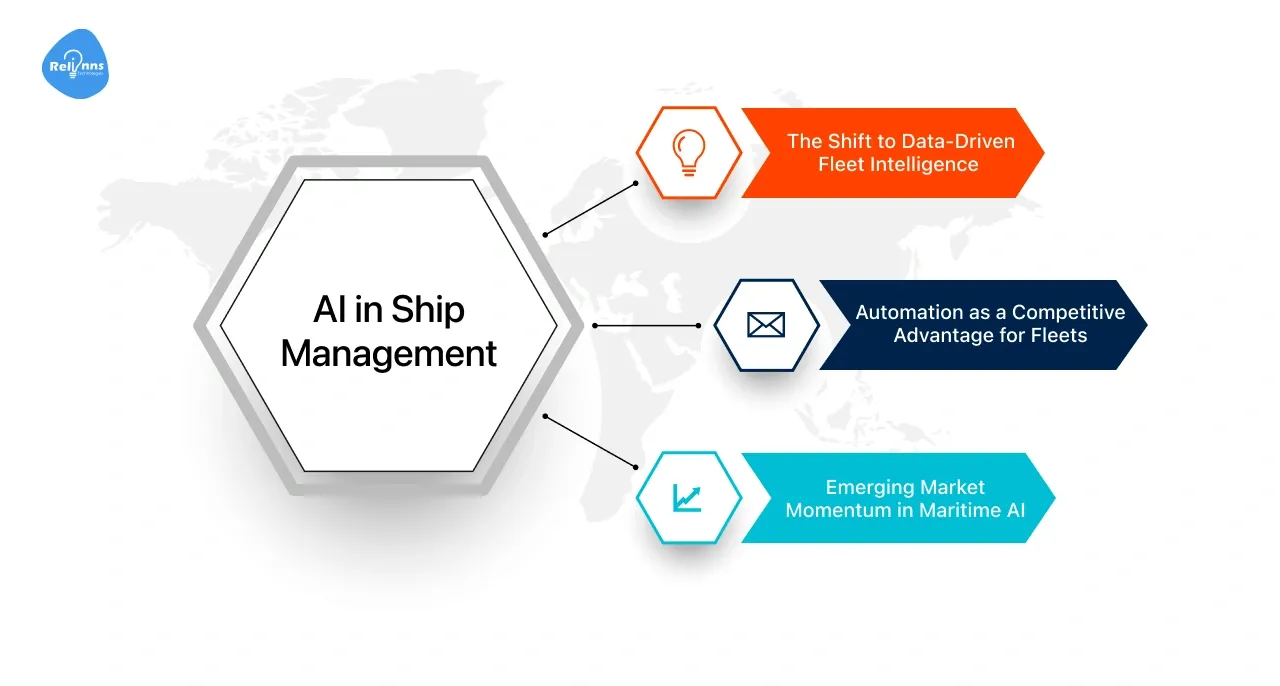
1. The Shift to Data-Driven Fleet Intelligence
AI transforms traditional operations into data-driven workflows. This shift enables faster responses, better predictions, and steady operational gains.
Maritime companies now rely on insights generated from engines, sensors, cargo, and environmental data.
- Data insights support accurate decisions in real operational time
- AI models forecast failures, congestion, or delays before impact
- Predictive workflows streamline everyday fleet operational planning
2. Automation as a Competitive Advantage for Fleets
Automation improves consistency, stability, and productivity. AI in shipping reduces human workload while elevating decision quality.
Operators get clearer visibility of vessel health and voyage conditions with less manual intervention.
- Automation reduces routine workload for maritime operational teams
- Predictive tools improve resource use across entire global fleets
- Route-planning systems optimize voyages in complex ocean conditions
3. Emerging Market Momentum in Maritime AI
Demand for AI in global shipping continues to rise. Carriers seek lower costs, cleaner operations, and stronger compliance.
AI-powered ship management companies are scaling solutions across fleets of all sizes.
- Market value grows steadily across core maritime industry segments
- Digital adoption increases as ships integrate real-time monitoring
- AI tools expand rapidly across voyage, fuel, and maintenance workflows
Which Core Ship Management Functions Can AI Optimize (Maintenance, Routing, Fuel, and Crew)?
AI improves essential ship management functions by automating analysis and predicting outcomes.
Operators use AI for shipping to reduce delays, fuel costs, and component wear.
AI in ship management enables better maintenance scheduling, crew planning, and voyage performance. Shipping AI brings measurable improvements in safety, reliability, and fleet availability.
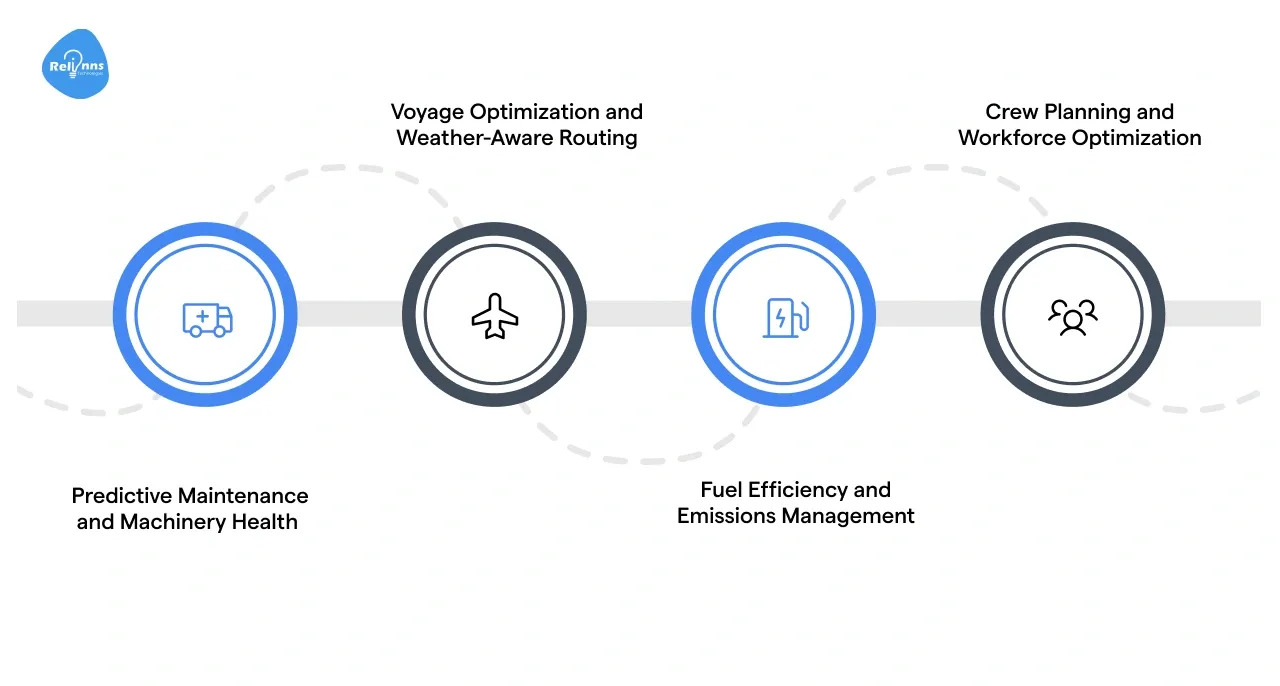
1. Predictive Maintenance and Machinery Health
Predictive systems use sensor data to forecast failures. This prevents costly breakdowns and unplanned downtime.
AI-powered ship management companies rely on real-time diagnostics to extend equipment lifespan.
- Predictive alerts prevent sudden machinery failures at sea
- Engine analytics optimize component use across long voyages
- Maintenance timing improves through real-time mechanical insights
2. Voyage Optimization and Weather-Aware Routing
AI adjusts routes using weather patterns, currents, and port congestion. This minimizes fuel consumption and delays.
AI in shipping improves voyage time, safety, and predictability for global carriers.
- Routing models reduce delays in volatile marine conditions
- Weather-aware planning lowers risk during severe sea events
- Predictive mapping improves arrival accuracy at global ports
Suggested Reading: https://relinns.com/blogs/port-management-software
3. Fuel Efficiency and Emissions Management
AI for shipping reduces fuel burn by enhancing speed, trim, and engine load. This lowers operating expenses and boosts environmental compliance.
Shipping AI platforms help fleets meet emissions regulations.
- AI-based trim control improves vessel fuel performance daily
- Speed planning reduces excess burn in high-resistance waters
- Emissions tracking ensures alignment with regulatory targets
4. Crew Planning and Workforce Optimization
Crew scheduling improves when supported by AI. The system balances qualifications, rest hours, and safety standards.
AI in ship management helps companies allocate workforce efficiently.
- Crew rotation aligns with fatigue-risk management standards
- Role-matching improves shipboard operational task readiness
- AI schedules enhance crew time use across vessel categories
How Does AI Improve Safety, Compliance, and Environmental Performance at Sea?
AI strengthens maritime safety through early detection and automated monitoring. AI in shipping enhances compliance readiness, onboard decision-making, and incident prevention.
AI for shipping elevates environmental tracking, while AI-powered ship management companies integrate advanced warning systems across global fleets.
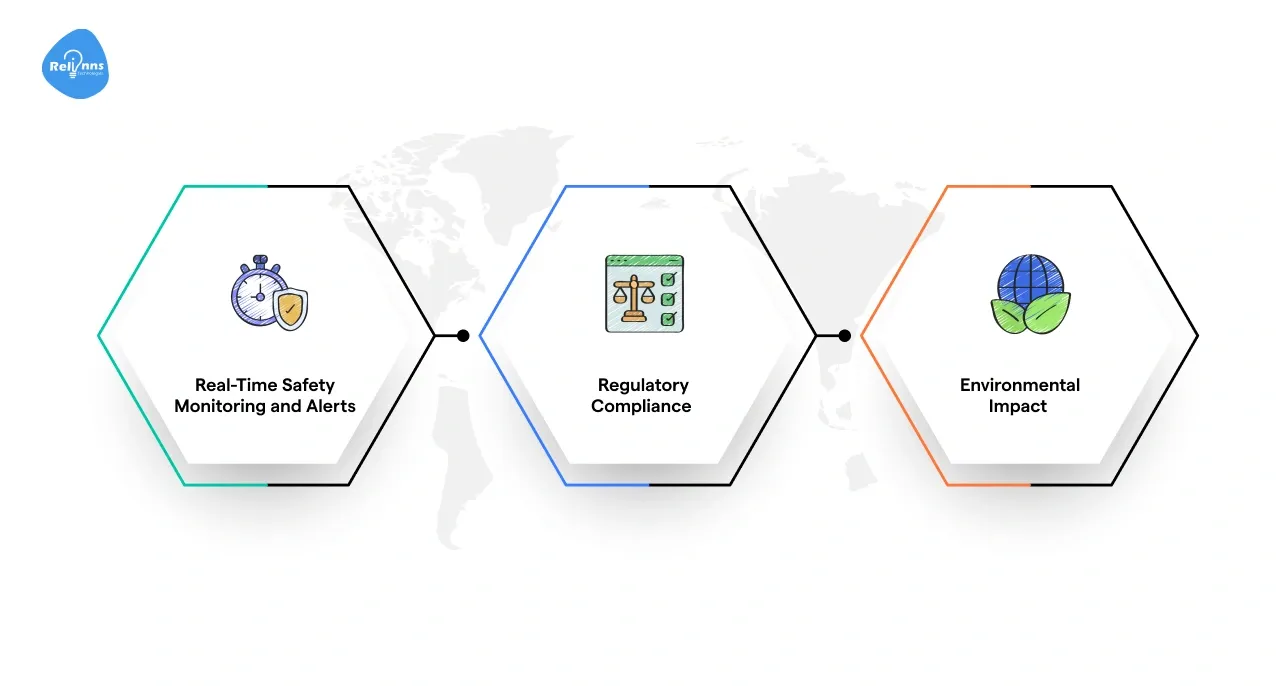
1. Real-Time Safety Monitoring and Alerts
Advanced sensors track vessel movement, machinery status, and environmental conditions. AI identifies anomalies faster than manual systems.
This reduces collisions, onboard hazards, and mechanical failures at sea.
- Alerts identify high-risk mechanical or navigational conditions
- Predictive detection limits hazards on high-traffic sea routes
- AI monitoring improves onboard safety performance globally
2. Regulatory Compliance and Automated Documentation
Compliance improves with automated reporting, emissions tracking, and certification updates. Shipping AI reduces administrative load while raising accuracy.
Documentation is generated in minutes instead of hours.
- Emissions data is logged accurately for inspection readiness
- Automated reporting reduces errors in safety documentation
- AI workflows simplify compliance across global maritime zones
3. Environmental Impact and Sustainability Monitoring
AI for shipping reduces emissions and fuel waste. Environmental sensors feed real-time data to predictive systems.
Fleets gain actionable sustainability insights without increasing workload.
- CO₂ and NOₓ emissions reduced through optimized voyage plans
- Fuel models support greener operations and regulatory alignment
- AI sustainability insights improve carbon-efficiency baselines
What are the main challenges and risks of implementing AI in ship management?
AI adoption brings financial, operational, and regulatory challenges. Shipping AI requires consistent data quality and robust digital infrastructure.
AI in ship management succeeds when fleets address technical, cultural, and security risks during rollout.
1. Data Quality, Integration, and Infrastructure Gaps
Reliable AI operations need clean, structured data. Older vessels lack unified systems or sensor networks. This reduces prediction accuracy and complicates integration.
- Legacy equipment limits accurate AI system prediction ranges
- Disconnected systems reduce data consistency across ship fleets
- Missing sensors lower the insight quality in mechanical analysis
2. Cybersecurity, Privacy, and System Vulnerabilities
AI for shipping increases reliance on digital networks. Stronger cybersecurity becomes essential. Vulnerabilities can disrupt operations or expose sensitive fleet data.
- Cyber threats impact navigation, routing, and fuel systems
- Data breaches affect operational and regulatory obligations
- AI networks require a secure architecture across vessel systems
3. Skills, Training, and Workforce Adoption Barriers
Adoption succeeds when crews understand AI workflows. Skill gaps reduce system accuracy and value. Ship operators require continual training to manage AI-enabled systems.
- Limited AI literacy delays fleet adoption timelines globally
- Crew reluctance impacts operational transformation success
- Training needs increase with new maritime AI technologies
How can shipping companies successfully adopt AI-powered ship management solutions?
Successful integration requires a phased strategy. AI in shipping must align with fleet size, vessel type, and operational goals.
Maritime leaders use scalable frameworks to deploy AI across predictive, navigational, and compliance workflows in shipping.
1. Start with High-Impact Use Cases and Clear ROI Goals
Companies begin with functions that deliver immediate improvement. Early wins build momentum for broader adoption.
AI-powered ship management companies target maintenance, fuel, or routing first.
- Prioritized functions maximize immediate operational value gains
- Smaller pilots have a lower risk during fleet transformation stages
- Measured KPIs establish clear performance improvement trends
2. Integrate Sensors, Digital Twins, and Scalable Platforms
Strong infrastructure accelerates AI success. Sensors, IoT networks, and digital twins support accurate predictions.
Systems must scale across a range of vessel types.
- Sensors create baseline visibility for core critical machinery
- Digital twins improve simulation accuracy for voyage planning
- Scalable platforms support entire multi-vessel fleet operations
3. Build Cross-Team Collaboration and Skills Readiness
Technical and operational teams must collaborate. AI in ship management thrives when workflows align.
Training ensures fleets capture maximum system value.
- Shared ownership improves AI adoption across departments
- Upskilling boosts system usage across maritime operations
- Change management supports consistent digital transformation
What does the future of AI-driven ship management look like for the global maritime industry?
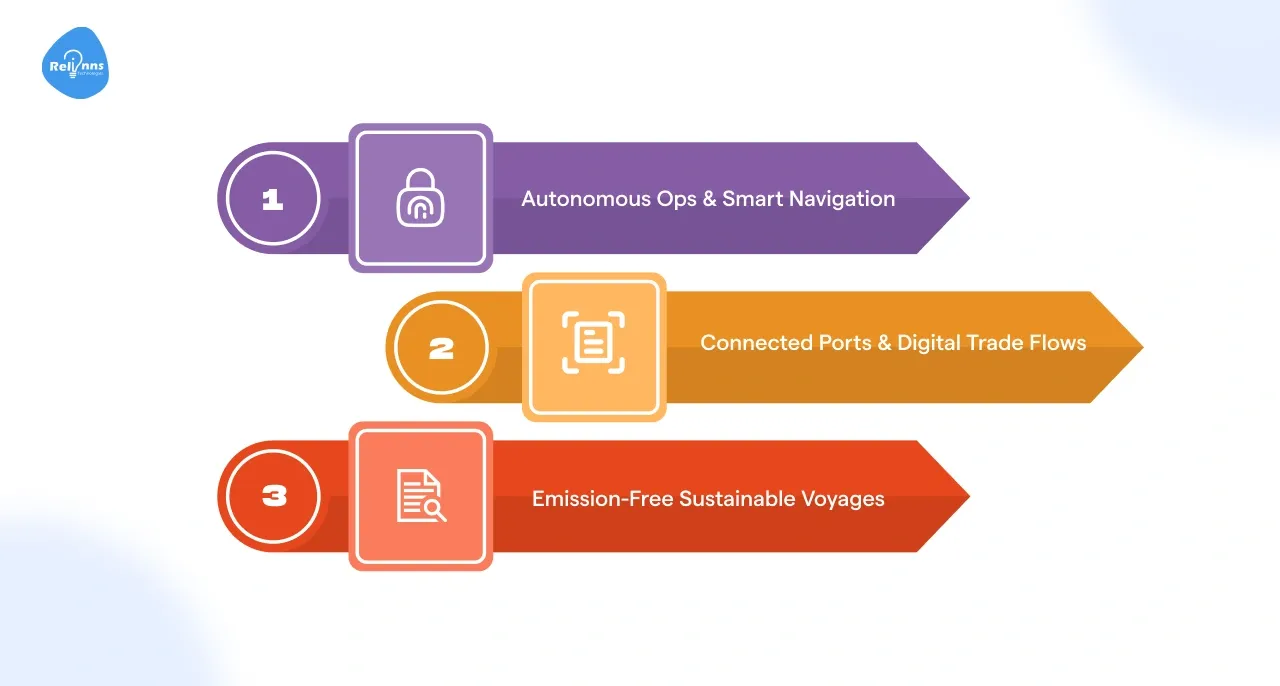
AI will define future maritime operations. Autonomous ships, smart ports, and real-time analytics will reshape global trade.
AI in ship management will bring deeper automation, cleaner voyages, and predictive intelligence across all vessel classes.
1. Autonomous Operations and Smart Navigation Systems
Autonomy will grow as vessels rely on AI for routing, collision avoidance, and port entry. Human oversight will remain essential, but AI will manage most routine decisions.
Pilot deployments already show strong reliability.
- Automated navigation improves accuracy in complex sea lanes
- Intelligent routing reduces congestion and travel time significantly
- Hybrid autonomy decreases human fatigue and cognitive load
2. Connected Ports and End-to-End Digital Trade Flows
Ports will integrate AI into berthing, cargo sequencing, and documentation. Shipping AI ecosystems will unify vessel and port data.
This creates a frictionless global trade movement.
- AI ports reduce turnaround time across major shipping hubs
- Cargo-flow prediction increases operational efficiency globally
- Unified systems improve scheduling accuracy and fleet readiness
3. Large-Scale Sustainability and Emission-Free Voyages
Green shipping will accelerate. AI for shipping enables low-carbon navigation and fuel optimization.
Fleets will use predictive sustainability models for full-voyage visibility.
- Sustainable routing improves low-carbon voyage performance
- Prediction models reduce overall fleet environmental footprints
- Emission-free voyages become standard for short-sea routes
Real-world AI in ship management & maritime operations
AI adoption across the maritime sector is accelerating as ports, shipping lines, and logistics companies seek stronger predictability, sustainability, and operational resilience.
These cases illustrate how AI in ship management, AI in shipping, and AI for shipping deliver measurable results across routing, autonomy, and logistics execution.
Each showcases proven outcomes backed by real organizations.
A. SCM System – Logistics & Dispatch Optimization
Problem: A Sweden-based global logistics provider struggled with fragmented tracking, manual dispatching, and unpredictable shipment visibility across land, sea, and air routes. Inefficient workflows slowed deliveries, increased SLA breaches, and reduced customer confidence. The company needed real-time intelligence, automation, and AI-enabled tracking to stabilize end-to-end logistics operations and scale reliably.
Solution: Relinns built a Joget-based logistics automation platform tailored for multimodal freight operations, providing real-time tracking and unified air, land, and sea shipment visibility. Automated workflows replaced manual planning and dispatch tasks. Predictive alerts flagged potential SLA breaches early. Dashboards enabled data-driven decisions across distributed logistics teams.
Results
- Shipment processing accelerated 54%, sharply reducing planning delays across all operational segments.
- On-time delivery performance rose to 95%, significantly enhancing customer satisfaction and reliability.
- Manual coordination delays decreased by 48%, improving throughput and operational efficiency across networks.
- Cross-team collaboration increased by more than 50%, boosting performance across regional and international logistics workflows.
See more here: Relinns SCM System Logistics Case Study
C. Yara Birkeland – Autonomous Electric Container Ship
Problem: Yara International sought to reduce thousands of diesel truck trips that transported fertilizer to a port nearby. Transport by road causes a negative impact due to high emissions, traffic congestion, and unsafe conditions. Yara needed an alternative mode of transport that's safe, sustainable, fully automated, and capable of operating regularly over short distances with no fossil-fuel consumption, due to stricter environmental protection regulations.
Solution: Consequently, Yara created the Yara Birkeland, the world's first fully electric, autonomous shipping container vessel. Navigation of the ship is accomplished through artificial intelligence systems that include obstacle detection and collision avoidance. Additionally, computer vision is used for automated cargo docking and movement. There is no use of fossil fuels, as battery electric drives the propulsion system entirely; thus, there is no need to produce or use them. The machine learning model continuously monitors the vessel's operating characteristics after each voyage.
Results
- Eliminated around 40,000 diesel truck trips yearly, significantly reducing emissions across the corridor.
- Completed 175 autonomous voyages carrying 21,826 containers, proving real-world autonomous viability.
- Achieved zero local CO₂ and NOₓ emissions on its operational route entirely.
- Reduced ground-transport safety risks by automating hazardous manual logistics movements.
See more here: Yara International – Yara Birkeland Autonomous Vessel Program
Conclusion: AI in Ship Management for the Next Era
The role of AI in marine shipping is becoming vital to the way modern Shipping operates, as AI is no longer an experimental technology in shipping but has matured into a proven method of increasing reliability, Decreasing Fuel waste, and enhancing safety on the water.
The integration of AI into the maritime commerce industry enables vessels to operate with real-time situational awareness, enhanced predictive capabilities, and smoother decision-making, and equips the ports they serve.
Shipping companies that began using AI to manage their operations in the early will benefit from measurable improvements across Fleet Performance, Environmental Compliance, and Operational Efficiency.
Predictive Maintenance, Intelligent Route Planning, Automated Document Management, and Autonomous Navigation make up the foundation of an ecosystem in which vessels will operate much more stably, while operating at significantly Reduced Costs.
AI-powered ship management companies are setting the standard for how maritime logistics will operate in the next decade.
The future belongs to fleets that adopt digital tools, embrace automation, and invest in scalable AI systems. Operators who take these steps now will lead the next generation of global trade with safer voyages, greener operations, and stronger competitive resilience.
Why Choose Relinns for AI-Based Ship Management Solutions?
Relinns specializes in creating effective solutions based on Artificial Intelligence (AI) for Logistics, Fleet Operations, and Maritime Analyzing Workflows.
Relinns provides scalable systems that automate all processes related to ships, from equipment monitoring to documentation creation and shipping routes, with the accuracy needed to avoid shipping delays.
Relinns’ Joget-based architecture also empowers enterprises to create their own customized AI solutions without the burden of complex engineering and development.
Relinns’ deep knowledge of workflow automation and its ability to deliver fast, reliable results have made it a trusted partner for Global Supply Chain (LSPs and 3PLs) Customers around the world. Additionally, Relinns’ AI Drives help monitor in real time any deviation from operational conditions, anticipate and prevent operational risks, and improve communication and collaboration between teams both on land and at sea.
As a result, Relinns has become an industry leader, especially as Digital Transformation is taking place across so many areas of shipping.
- 50% faster digital workflow adoption across fleet and logistics environments
- 95% delivery accuracy supported by AI-enabled tracking and predictive scheduling
- 54% speedier shipment processing through unified maritime logistics automation
- 40% reduction in manual coordination delays across complex operational networks
- 90% of workflows are automated without requiring internal developer intervention
Relinns ensures maritime organizations get the flexibility of low-code development with the intelligence of modern AI systems.
This combination allows fleets to launch new capabilities faster while improving safety, uptime, and regulatory compliance.
Frequently Asked Questions (FAQ's)
What is the use of AI on ships?
AI on ships improves navigation, routing, maintenance, and safety by analyzing real-time data from sensors and voyage systems. AI in ship management helps vessels operate more efficiently, reduce fuel use, predict failures, and support safer maritime operations.
Can AI replace seafarers?
AI in shipping cannot fully replace seafarers because ships still need human judgment, emergency handling, and operational oversight. However, Shipping AI supports crew by automating repetitive tasks, improving safety, and reducing workload through predictive and autonomous decision-support systems.
What is maritime AI?
Maritime AI refers to AI for shipping operations, including routing, port coordination, maintenance forecasting, compliance automation, and cargo management. It uses machine learning and real-time analytics to optimize ship performance and enhance reliability across the global maritime ecosystem.
What is the first AI ship in the world?
The first widely recognized AI-enabled autonomous ship is the Yara Birkeland. It uses Shipping AI for navigation, obstacle detection, and remote monitoring, demonstrating how AI for shipping can support zero-emission and fully automated short-sea maritime operations.