How AI is Transforming Logistics: Visibility, Automation, and Faster Delivery
Date
Nov 27, 25
Reading Time
7 Minutes
Category
Generative AI
Share


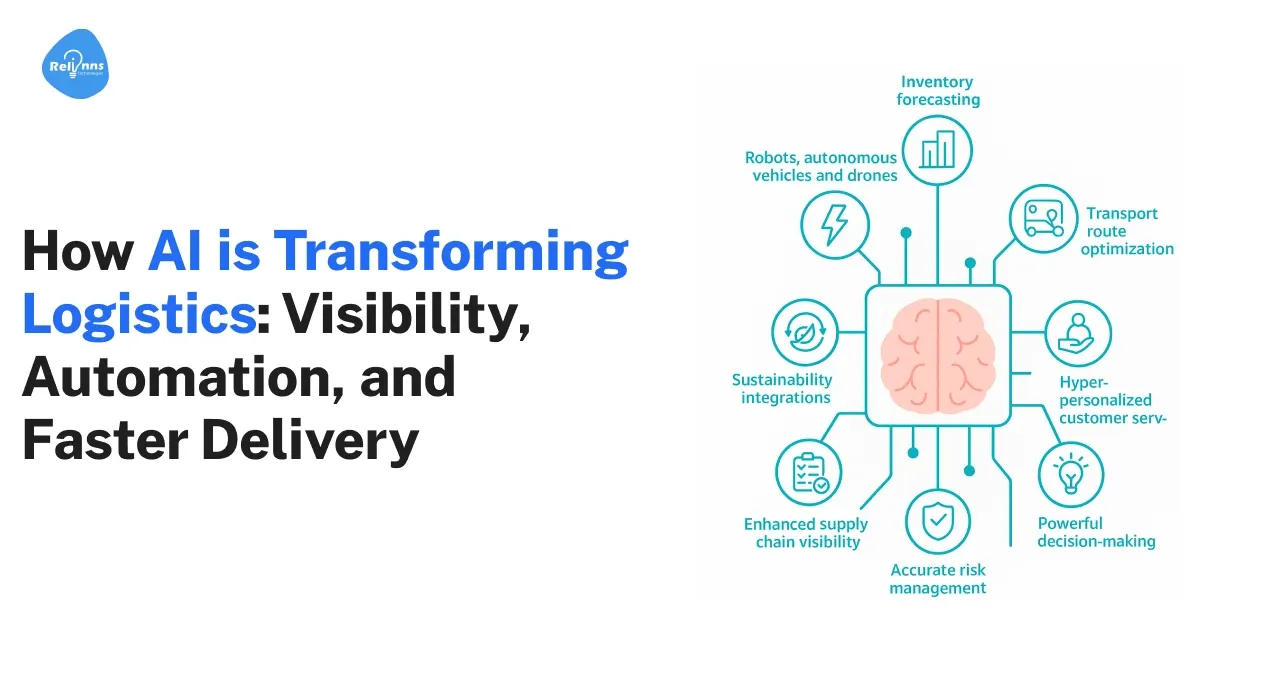
Global logistics networks are becoming larger, faster, and more unpredictable. Markets shift quickly, customers expect real-time tracking, and supply chains face frequent disruptions that demand constant visibility.
AI in logistics now serves as the engine that keeps these systems synchronized. It analyzes massive data streams, predicts delays, optimizes routes, and automates warehouse tasks that previously consumed hours of manual effort.
The momentum behind AI adoption is accelerating.
Together, they enhance transparency across ports, warehouses, carriers, and delivery networks while reducing inefficiencies hidden within daily operations.
In this guide, you will explore the benefits of AI in logistics, real-world examples of AI in logistics, automation strategies, and the expanding future of AI in logistics.
Each section is designed to help leaders understand what AI truly delivers and how modern logistics organizations are using it to move faster, operate smarter, and compete globally.
What Is AI in Logistics?
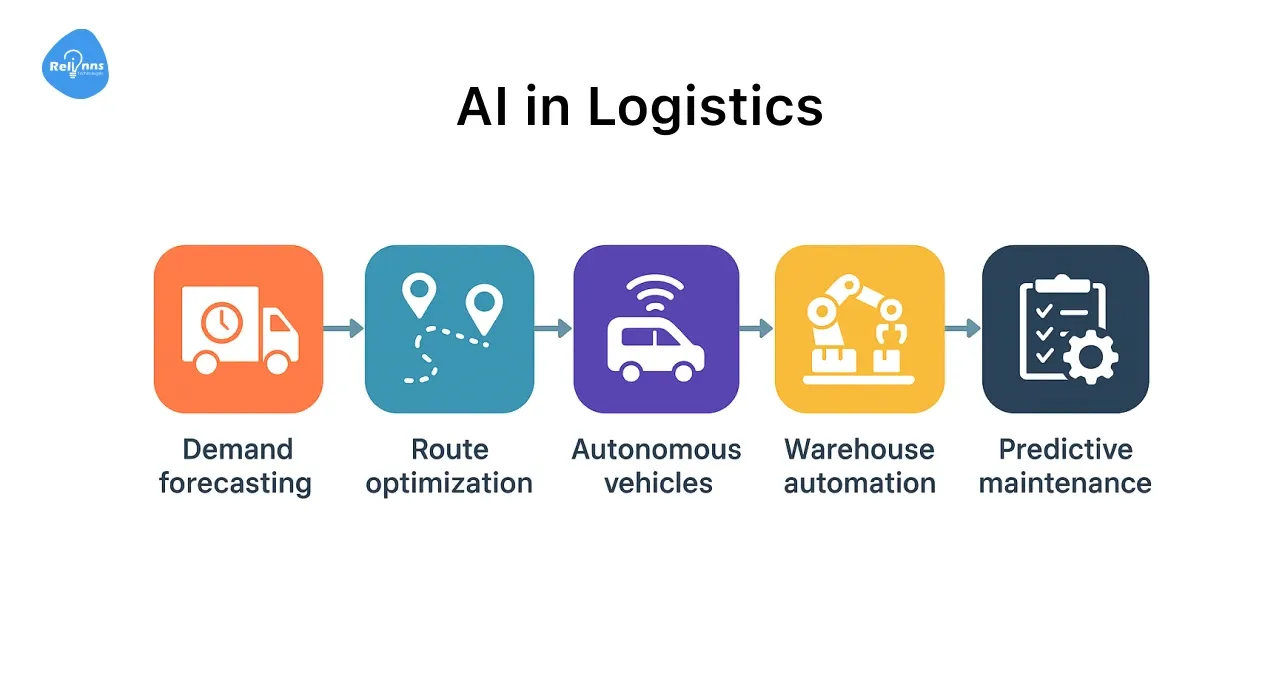
Artificial Intelligence in logistics refers to the use of machine learning, predictive analytics, AI agents, computer vision, and automation systems to improve the movement, management, and visibility of goods.
It enables logistics networks to analyze data, make decisions, and adjust operations without waiting for human intervention. This shift allows supply chains to react instantly to delays, disruptions, and unexpected peaks.
AI transforms logistics by creating end-to-end transparency.
It merges data from transportation, warehouses, carriers, customer orders, inventory systems, and external signals like traffic and weather. With this unified layer, logistics organizations can avoid bottlenecks, forecast demand more accurately, and manage exceptions before they escalate.
The core promise is simple: logistics operations become faster, more accurate, and far more predictable.
This foundation powers every section of this guide, from the benefits of AI in logistics to advanced AI in logistics examples used globally.
What are the benefits of AI in logistics?
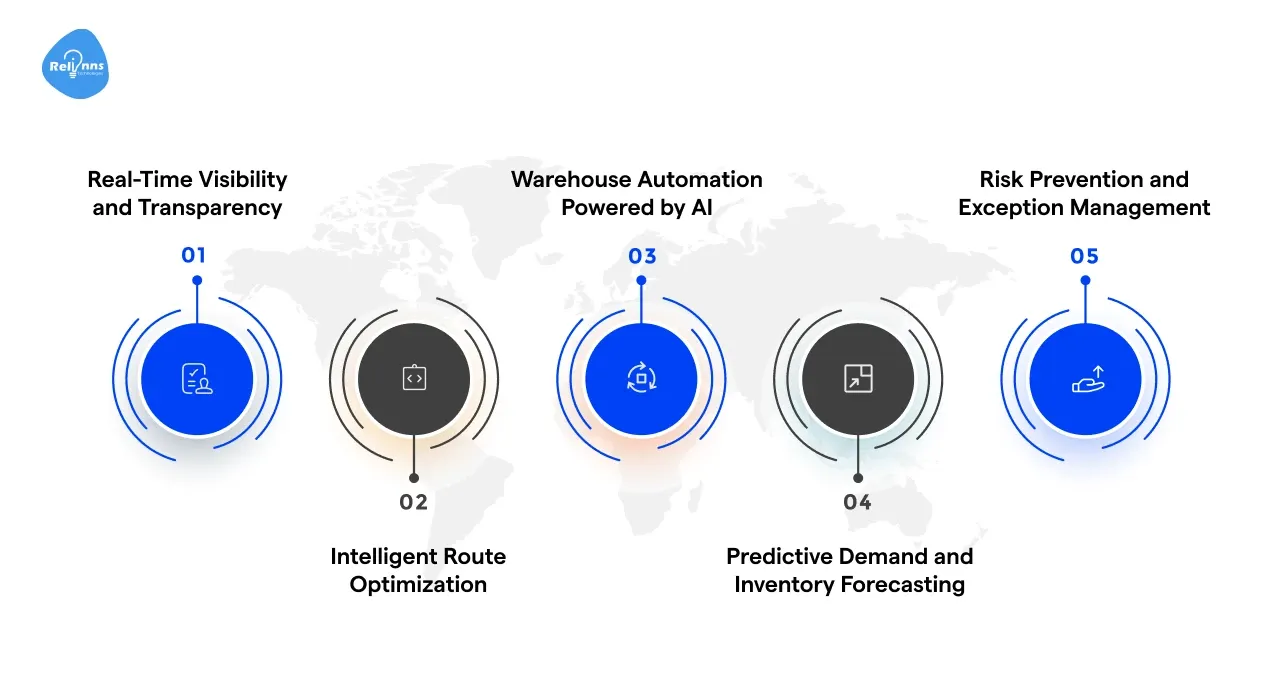
AI delivers measurable improvements in speed, clarity, and decision-making across logistics networks.
1. Real-Time Visibility and Transparency
AI enables complete visibility across inventory, transport, docks, and last-mile delivery. Data that was once siloed in WMS, TMS, and ERP systems is unified and analyzed in real time.
This visibility helps teams respond before delays occur and strengthens collaboration across departments.
- AI ensures accurate shipment updates across every transport stage.
- Predictive models flag potential delays hours before they happen.
- Centralized visibility helps teams proactively manage exceptions.
2. Intelligent Route Optimization
Route optimization is one of the most essential benefits of AI in logistics.
Traditional routing reacts to problems; AI anticipates them. Machine learning models analyze traffic, weather, distance, carrier capacity, and cost to automatically select the most efficient route.
- AI reduces fuel consumption by optimizing routing decisions.
- Delays decrease as models evaluate real-time traffic conditions.
- Capacity is used more efficiently across multiple carrier networks.
3. Warehouse Automation Powered by AI
AI manages warehouse workflows with precision. Computer vision tracks inventory movement, AI agents schedule tasks, and robotics increases picking speed.
Warehouses operate with fewer errors, faster cycle times, and reduced labor strain.
- Picking accuracy reaches 99 percent with AI-supported systems.
- Robotics significantly reduces travel time and manual touchpoints.
- Operation speed increases as AI automates repetitive warehouse tasks.
4. Predictive Demand and Inventory Forecasting
AI improves forecasting accuracy by examining sales trends, seasonality, supplier performance, and real-time demand patterns.
Companies reduce stockouts, avoid excess inventory, and maintain tighter control over working capital.
- Forecasting errors drop by as much as 20 to 50 percent.
- Stockouts decline as AI anticipates demand surges earlier.
- Inventory costs fall due to optimized safety stock levels.
5. Risk Prevention and Exception Management
Exceptions account for more than half of logistics disruptions.
AI agents identify root causes, recommend resolutions, and in many cases resolve low-value exceptions autonomously.
- AI reduces avoidable exceptions through real-time monitoring.
- Teams receive early warnings about port congestion or supplier risks.
- Time spent managing exceptions falls dramatically.
AI in Logistics Examples: Real-World Use Cases
AI adoption in logistics is no longer experimental. It is becoming the core operating system for global supply chains that move millions of shipments every week.
The companies leading this transformation are not tweaking old processes; they are rebuilding logistics execution with intelligent automation.
The following real-world cases show how AI reshapes warehouse speed, transport reliability, and inventory flow at a scale traditional systems cannot match.
1. DHL and Locus Robotics: Scaling Warehouse Productivity
Problem: DHL faced rising e-commerce volumes that strained picking teams and slowed fulfillment speed. Existing manual travel paths increased worker fatigue and reduced accuracy during peak seasons. Warehouses struggled to maintain consistency as demand fluctuated sharply across global markets. DHL needed a solution that improved speed without sacrificing workforce safety or accuracy.
Solution: DHL deployed Locus Robotics AMRs into high-volume fulfillment centers. Robots handled repetitive travel tasks while guiding workers through optimized pick paths. AI analyzed pick history to train robots on high-demand SKUs. The system significantly reduced the distance walked manually. Supervisors monitored workflows through AI dashboards.
Results
- Productivity increased by 200-300% across multiple DHL fulfillment locations worldwide.
- Worker travel distance reduced by nearly 50 percent during high-volume operational windows.
- Order accuracy improved to more than 99 percent across automated warehouses worldwide.
- Fulfillment cycle times reduced by 30 percent due to AI-directed sequencing.
Suggested Reading: Modular Logistics Dashboards: Types, KPIs, Architecture, and Power BI Guide
2. Walmart: Forecasting and Warehouse Efficiency with AI
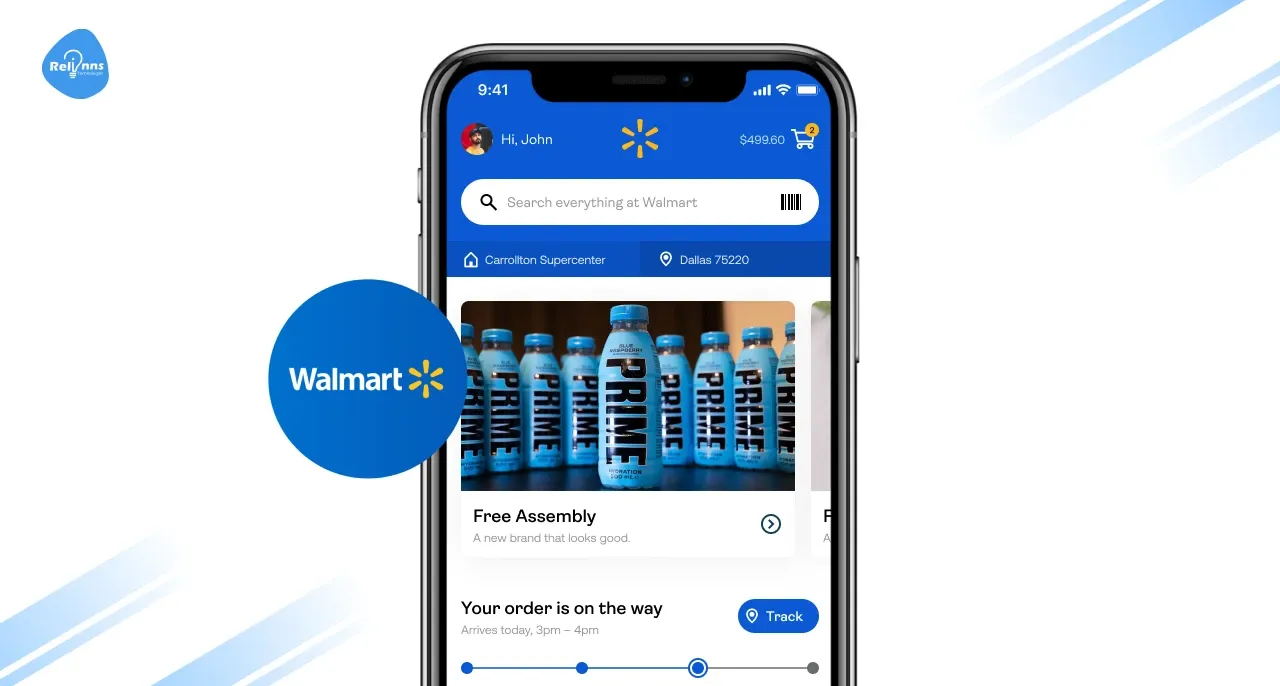
Problem: Walmart faced fluctuating store demand across thousands of global locations. Traditional forecasting systems struggled to accurately anticipate seasonal spikes or regional differences. Warehouses experienced stockouts and surpluses simultaneously. Walmart needed a scalable AI system that could analyze millions of daily data points and improve inventory distribution.
Solution: AI analyzed historical sales data to identify demand patterns. Models detected seasonal behavior changes. Warehouse allocation was dynamically updated. Retail stores received more intelligent replenishment recommendations. Warehouse robotics accelerated order preparation.
Results:
- Out-of-stock events reduced by nearly 30 percent across major Walmart retail markets.
- Demand forecasting improved significantly through machine-learning inventory models.
- Warehouse throughput increased due to AI-driven automation workflows.
- Inventory waste declined as replenishment accuracy improved across stores.
How to Implement AI in Logistics?
The impact of AI in logistics examples comes from strong execution. Companies that deploy AI successfully follow structured steps that align technology with operational needs.
The goal is not to add tools but to redesign logistics workflows around intelligent automation.
1. Assess Data Landscape and Identify High Impact Use Cases
Start by reviewing existing systems and understanding where the most significant gaps. Many organizations discover that data is scattered across WMS, TMS, ERP, and manual logs.
AI systems need unified data to produce meaningful predictions.
The most substantial benefits of AI in logistics emerge when teams begin with a clear, well-defined problem such as route delays, warehouse congestion, or frequent exceptions.
2. Select Tools That Match Operational Requirements
Choosing the right AI solutions depends on your scale and workflow needs. Some companies adopt cloud-based AI routing engines.
Others use warehouse robotics and computer vision.
More advanced logistics teams incorporate multi-agent systems for planning. What matters is selecting tools that integrate with existing infrastructure and can continuously process logistics data.
3. Pilot with a Controlled Scope
A focused pilot validates feasibility without disrupting the network—companies commonly test AI for demand forecasting, container loading, yard scheduling, or inventory movement.
These limited deployments show how quickly AI can improve daily operations.
Leaders evaluate speed, accuracy, and stability before expanding to more complex workflows.
4. Scale Across the Supply Chain with Governance
After successful pilots, organizations gradually scale AI across transportation, warehousing, and the last-mile segments.
Governance ensures models remain accurate as data and demand evolve.
This stage requires cross-functional alignment among logistics, IT, analytics, and planning. Scaling AI in logistics ultimately creates a unified system where decisions flow smoothly across the entire network.
Suggested Reading: Real Time Logistics Tracking Solutions: Transforming Delivery Visibility in 2026
What is the future of AI in logistics?
AI in logistics is moving toward a phase in which reasoning systems, predictive engines, and autonomous decision cycles work together across the entire supply chain. The next decade will see a shift from basic automation to intelligent orchestration, where systems evaluate disruptions, allocate resources, and adjust routing without human intervention.
This trend builds on the growing demand for transparency, shorter delivery cycles, and stable operational flow.
One major trend shaping the future of AI in logistics is the rise of multi-agent systems. These systems collaborate across planning, routing, warehousing, and exception handling to maintain flow with minimal delays.
They interpret context and choose the best action based on real-time goals. As these agents mature, they will handle tasks that previously required continuous human supervision.
Digital twins will also shape the future of AI in logistics. These virtual models simulate entire networks, allowing companies to test scenarios before deploying solutions.
Planners can identify bottlenecks, measure risk, and evaluate route changes instantly. This level of predictive simulation helps organizations prevent outages before they spread across the supply chain.
Conclusion: AI in Logistics for a Smarter, Faster Supply Chain
AI in logistics has shifted from a competitive advantage to a critical requirement for modern supply chains. Companies that embrace AI gain a clearer view of their operations, faster response times, and more efficient resource use.
Intelligent systems help predict risk, automate planning, and maintain flow even during disruptions.
As the future of AI in logistics continues to expand, organizations that adopt AI now will position themselves for sustainable growth and long-term resilience.
Why Choose Relinns for Logistics Automation?
Relinns delivers tailored AI and workflow automation solutions designed to improve the speed, accuracy, and reliability of logistics networks.
Their platforms help organizations redesign operations with intelligent processes that scale easily.
- Relinns clients report 48% fewer manual workflow delays.
- Operational visibility increases by almost 55% across logistics teams.
- Automation reduces repetitive tasks and improves accuracy by more than 40%.
- Predictive workflows shorten decision cycles and improve reliability by 38%.
- Cross-functional coordination improves by nearly 50% after system integration.
Frequently Asked Questions (FAQ's)
What are the main benefits of using AI in logistics?
AI improves visibility, strengthens decision-making, and reduces operational delays. It helps teams forecast demand accurately, optimize routing, prevent errors, and reduce costs. These improvements represent the core benefits of AI in logistics.
Which companies are using AI in logistics today?
Leading brands such as UPS, Maersk, FedEx, and Amazon have deployed AI at scale. These AI examples in logistics show how intelligent automation increases speed and accuracy across global supply chains.
How does AI improve warehouse productivity?
AI helps warehouses reduce travel time, improve picking accuracy, and enhance inventory movement. Automated processes reduce errors and maintain steady throughput. These improvements reflect the benefits of AI in logistics.
Is AI difficult to implement in traditional logistics operations?
Implementation depends on data quality and system integration. Starting with small pilots and expanding gradually helps teams adopt AI smoothly. Most providers offer support that simplifies complex adoption stages.
What is the future of AI in logistics?
The future of AI in logistics includes multi-agent systems, digital twins, and predictive automation. These technologies will enhance transparency and efficiency across global supply chains.